
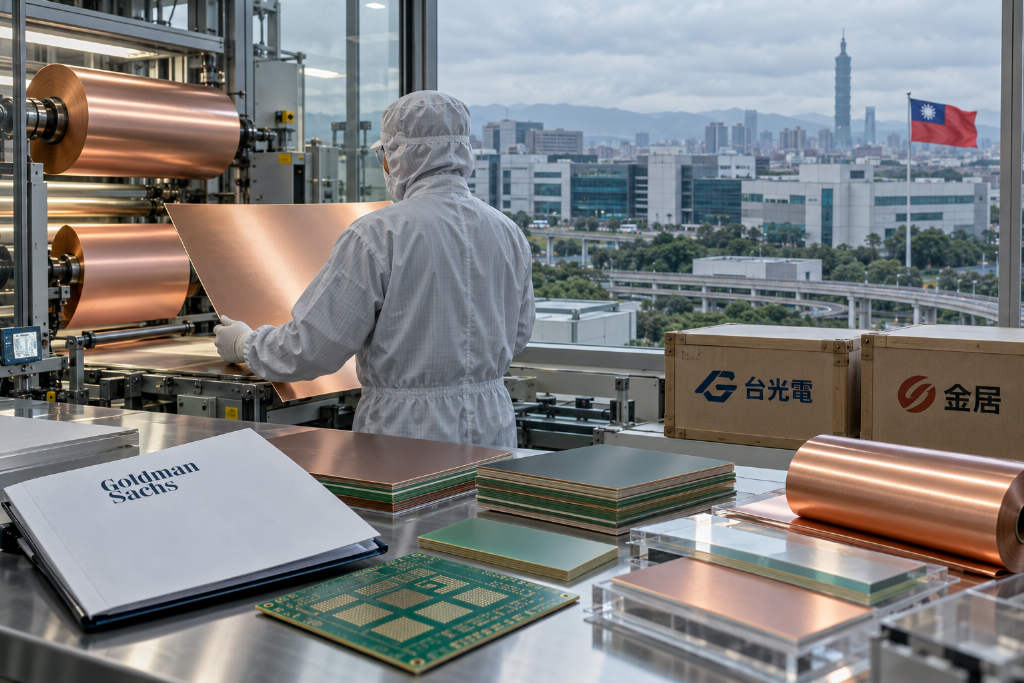
Goldman Sachs said in its latest checks on Taiwan’s PCB and copper clad laminate, or CCL, industry that Japanese suppliers of substrate materials have been expanding capacity at a slow pace even as demand for ABF substrate materials keeps rising. The bank said that dynamic has pushed end customers to speed up qualification of Taiwanese and Chinese suppliers from the first half of 2026, opening a path for Taiwanese CCL makers to enter the higher-priced, higher-margin ABF substrate supply chain.
Japanese suppliers still dominate key ABF materials
According to Goldman Sachs, key ABF substrate materials including ABF CCL, T-glass and ultra-thin copper foil have been controlled by Japanese suppliers for more than a decade, with market share above 95%. The issue, the bank said, is that capital spending by those suppliers remains relatively conservative, leaving capacity growth behind demand.
Goldman Sachs tied the demand increase to substrate specification upgrades. It said material usage for ABF substrates doubles every one to two years as substrate sizes increase, layer counts rise and lower production yields raise the amount of material needed for each unit of output. Slow supply growth and a sharp increase in material consumption have created gaps in what had been a highly concentrated supply chain.
Qualification of Taiwanese and Chinese suppliers has picked up since 1H26
To address supply constraints, end customers have clearly accelerated qualification of ABF substrate supply chain vendors in Taiwan and mainland China since the first half of 2026, Goldman Sachs said. The bank added that this points to a long-term market share increase for new material suppliers from Taiwan and China, and named EMC and Co-Tech as likely beneficiaries.
EMC could start gaining ABF substrate CCL share in 2H26
Goldman Sachs expects EMC to begin taking ABF substrate CCL market share from the second half of 2026. It estimated the total addressable market for ABF substrate CCL at $800 million to $1.2 billion in 2026, rising to $2.0 billion to $2.5 billion in 2027 and then to $4.0 billion to $4.5 billion in 2028.
The bank said this business could account for about 15%, 19% and 22% of EMC’s revenue in 2026, 2027 and 2028, respectively.
Pricing is a key part of the thesis. Goldman Sachs estimated ABF substrate CCL average selling price at about $1,500 per sheet, compared with about $130 for M7 grade and $180 for M8 grade, indicating room for EMC’s blended ASP to move higher.
On profitability, Goldman Sachs said ABF substrate CCL gross margin is already above 50% and, based on its industry checks, could move closer over time to an industry average of above 70%. For comparison, the bank forecast EMC’s overall gross margin at 35.2% in 2026, 40.7% in 2027 and 43.4% in 2028.
Co-Tech’s new ultra-thin copper foil business may not contribute until 2H28
In ultra-thin copper foil, the market is also currently led by Japanese suppliers. Goldman Sachs said new suppliers may begin to appear from late 2027 to early 2028.
Co-Tech said it is preparing research and development resources and has started designing a new production line for this new substrate-grade product. Goldman Sachs expects the business to begin contributing to the company’s revenue no earlier than the second half of 2028.
Faster qualification does not guarantee immediate volume
The report said Taiwanese CCL and copper foil makers now have a chance to enter an ABF substrate materials market that has long been difficult to penetrate, as Japanese suppliers expand slowly, material demand doubles over time and end customers bring in new suppliers more quickly.
Still, Goldman Sachs noted that faster qualification is not the same as volume ramp. Actual shipments and revenue contribution will depend on each company’s qualification progress and the timing of capacity coming online.



