The Commodity Futures Trading Commission is moving ahead with its own crypto rulebook, sending a pair of digital-asset rulemaking items to the White House for review just days after the Clarity Act stalled in the Senate.
A filing posted this week shows the CFTC submitted a prerule titled “Regulation Crypto Asset Transactions and Regulation Crypto Asset Markets” to the Office of Information and Regulatory Affairs, the White House office that reviews federal rules before agencies release them.
The filing is still at an early stage. As a prerule, it does not represent a finished regulation, and OIRA review is a procedural step that comes before public release. The agency has not published the text, leaving the actual provisions unclear for now.
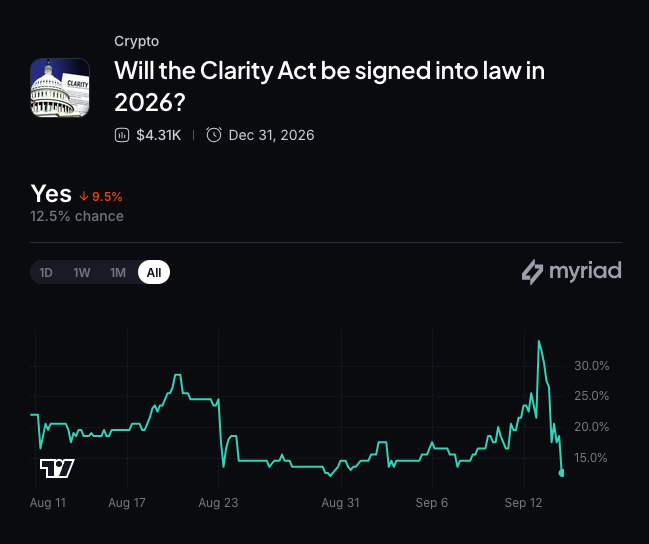
The move points to a CFTC effort to build a framework for crypto derivatives under its own authority instead of waiting for Congress. The push comes right after Tuesday’s failed cloture vote on the Clarity Act, a market-structure bill that would have created federal rules for digital assets and split oversight between the CFTC and the Securities and Exchange Commission.
The bill did not reach the 60 votes required to move forward. Lead negotiator Senator Cynthia Lummis said its chances this year were nearly gone, although others have since said they still plan to push ahead despite a shortened legislative calendar as midterm elections approach.
At the same time, both the CFTC and SEC have indicated they are not standing still.
Following the bill’s failure, regulators have stepped up crypto-related initiatives. The SEC this week introduced an “innovation exemption” that allows qualifying venues to trade tokenized U.S. stocks directly on blockchain networks without registering as national exchanges.
The CFTC has also been active elsewhere. The agency recently issued no-action relief that lets certain software providers, including crypto wallet apps, give users access to regulated derivatives without registering as introducing brokers.
Regulators have framed the current rulemaking push as a bridge to eventual legislation. Treasury Secretary Scott Bessent previously said agency rulemaking could serve as the fallback if the Clarity Act stalled. For now, that leaves agency action as the closest thing U.S. crypto markets have to a regulatory timeline.