CFTC
Nov 7, 2026

CFTC Gives Kalshi and Other Contract Markets 30 Days to Restore Nationwide Access

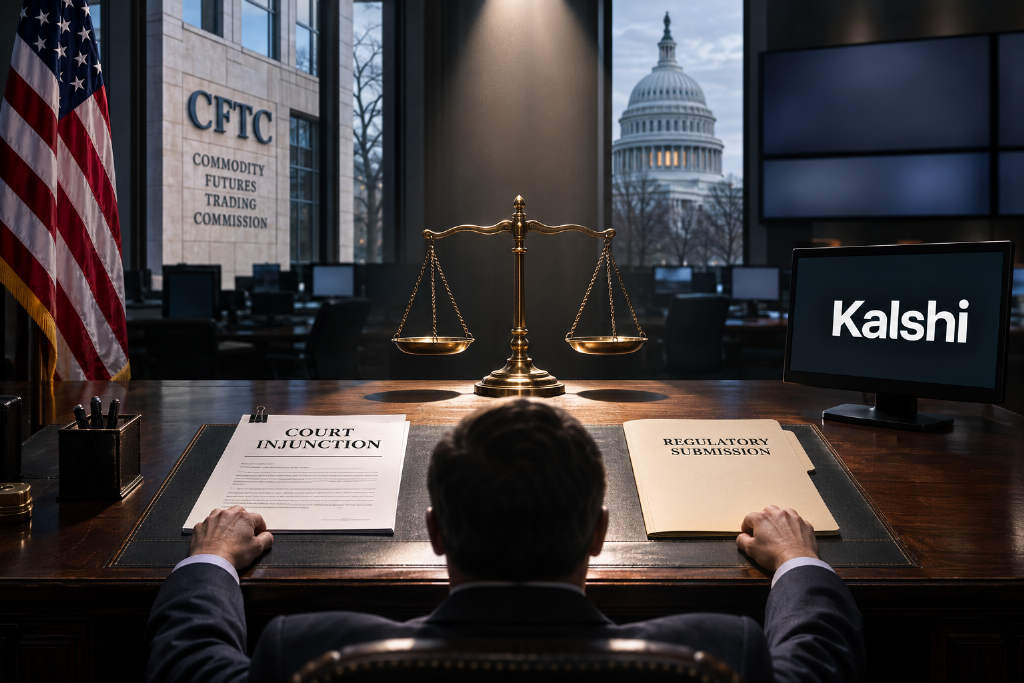
The U.S. Commodity Futures Trading Commission has issued an interpretation of its fair-access requirement that bars registered designated contract markets from restricting trading based on a customer’s state. The markets have 30 days to restore nationwide service or submit a written explanation to the CFTC’s Division of Market Oversight stating why compliance is not feasible. The directive applies to all DCMs, including event-contract platforms such as Kalshi and Polymarket. It also requires exchanges to ensure that intermediaries directing customers to their markets do not block access. The move puts the federal regulator on a collision course with several federal courts that have recently ordered Kalshi to restrict service in specific states and tribal jurisdictions. Kalshi has faced access restrictions in Nevada, Washington and Michigan, while Utah has pursued civil litigation and 14 criminal charges against the company and two co-founders. The dispute has also drawn criticism from Better Markets and Sen. Adam Schiff. CFTC Chairman Mike Selig says geographic restrictions undermine nationwide derivatives-market standards, liquidity and access to local information. The interpretation could face further legal challenges as the December deadline approaches.

480
CFTC Gives Kalshi and Other Contract Markets 30 Days to Restore Nationwide Access
US equities
Nov 5, 2026

CFTC Clears Single-Stock Perpetual Futures, Bringing a Crypto-Born Trading Model Into Regulated U.S. Markets

A major shift in U.S. market structure is taking shape after Commodity Futures Trading Commission Chairman Mike Selig said on Nov. 3 that single-stock perpetual futures can begin trading on regulated U.S. exchanges under a joint CFTC-SEC framework. The move brings a product long associated with crypto venues into the American regulatory perimeter and extends a trend that has been building across both digital-asset platforms and traditional finance. Perpetual futures removed the expiry date from conventional futures contracts and became one of crypto’s defining market innovations. According to figures cited in the source article, they accounted for about 75% of centralized crypto exchange volume in 2025, with nearly $49 trillion in annual trading, while TokenInsight said derivatives made up 83% of major exchange volume in Q3 2026. Over the past year, platforms including Binance, Coinbase, Kraken, Bitget, MSX and Ondo Finance have expanded stock-linked perpetual products, while ICE announced plans with Trade[XYZ] to bring a Hyperliquid-based perpetual market into the U.S. The article also traces how weekend price discovery is emerging around stock perpetuals. Even when Nasdaq and the NYSE are closed, traders can still price Nvidia, Apple and Tesla exposure through crypto-native venues using internal indexes, tokenized stock quotes, funding rates and cross-platform arbitrage. In that sense, stock perpetuals are no longer just a speculative side market. They are becoming an alternative channel for continuous price discovery outside traditional exchange hours.

1660
CFTC Clears Single-Stock Perpetual Futures, Bringing a Crypto-Born Trading Model Into Regulated U.S. Markets
Policy Regulation
Nov 5, 2026

CFTC Clears U.S. Equity Perpetual Futures, Then Faces Same-Day Court Challenge From Wall Street-Backed Group

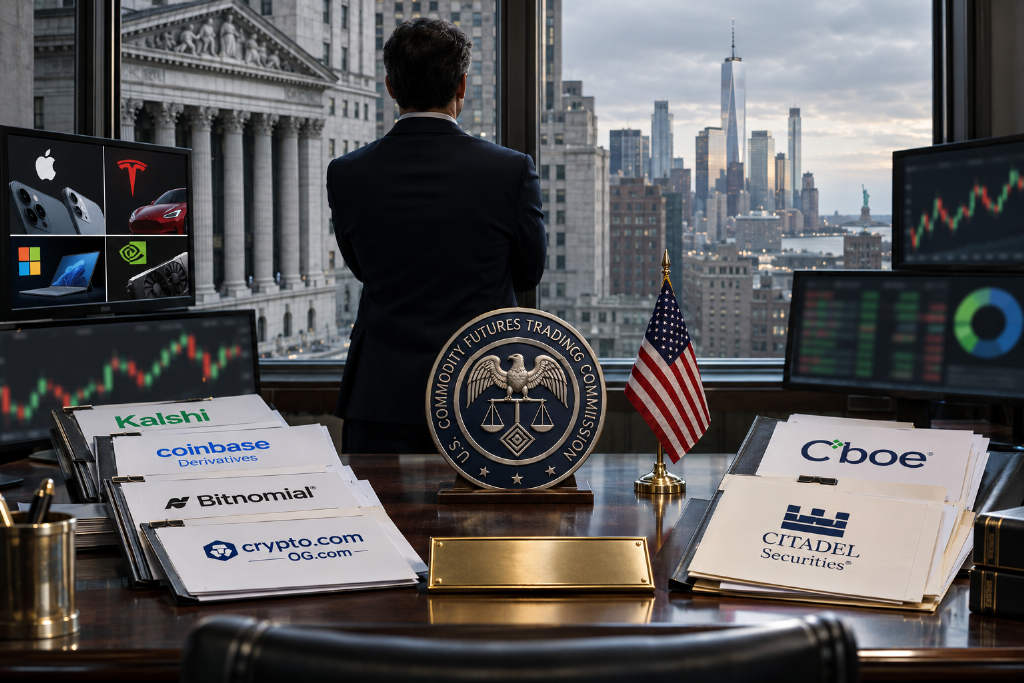
The U.S. Commodity Futures Trading Commission cleared equity perpetual futures for the regulated U.S. market on Nov. 3, opening the door for a product structure long associated with crypto trading to move into stock-linked derivatives. Hours later, Capital Markets Alliance, backed by traditional market players including Cboe and Citadel Securities, sued in federal court in the Southern District of New York to overturn the approval. Four crypto-linked venues — Kalshi, Coinbase Derivatives, Bitnomial and OG.com, a Crypto.com affiliate — have been advancing equity perpetual products tied largely to heavily traded names such as Nvidia, Apple, Tesla and Microsoft, along with ETFs including SPY and QQQ. The contracts are designed to trade from Sunday evening to Friday evening, extending access beyond regular U.S. stock market hours, though not on a full 24/7 basis. The legal dispute centers on classification. The CFTC treated the products as security futures, which fall under a shared CFTC-SEC framework. The plaintiffs argue they more closely resemble security-based swaps because they have no fixed maturity and rely on recurring funding payments to keep prices aligned. That distinction matters because security-based swaps face tighter restrictions, especially for retail distribution. The case also reflects a broader fight over market structure, compliance costs and whether crypto-native exchanges are being allowed into a business long dominated by traditional options and market-making firms.

890
CFTC Clears U.S. Equity Perpetual Futures, Then Faces Same-Day Court Challenge From Wall Street-Backed Group
US Congress
Nov 4, 2026

House Democrats weigh a crypto market structure bill that would give the SEC a larger role

House Democrats are discussing a plan to build their own crypto market structure bill in the next Congress after the party’s sweep of Congress, according to a Wednesday report from Eleanor Terrett cited by Bitcoin Magazine. The proposal would reportedly use Rep. Maxine Waters’ Crypto Investor and Consumer Bill of Rights as a foundation, while also incorporating Democratic provisions that were left out of the House version of the Clarity Act and provisions Senate Democrats had agreed on with Republicans before the failed Sept. 15 cloture vote. The talks point to a different regulatory design from the Republican-backed Clarity Act. Rather than placing most digital commodity oversight with the Commodity Futures Trading Commission, the Democratic approach under discussion would move more authority back toward the Securities and Exchange Commission. The proposal is also expected to include tougher ethics restrictions on President Donald Trump and other federal officials involved in crypto activity. No bill text has been released, and the details currently in circulation come from industry sources who spoke with Democratic staffers, not from lawmakers directly. Republicans have dismissed the effort as a “messaging bill,” but Democrats now hold more leverage over the future of crypto market structure legislation.

440
House Democrats weigh a crypto market structure bill that would give the SEC a larger role
Greeks.live
Nov 5, 2026

Greeks.live says U.S. midterm elections add uncertainty to Hyperliquid’s federal compliance path

Greeks.live researcher Adam said in a post on X that the U.S. midterm elections have increased uncertainty around crypto policy, including the proposed Clarity Act. He said the election outcome could shape both the legislative outlook for Hyperliquid and the pace at which its compliance efforts move forward in the United States. Adam also pointed to earlier support from Donald Trump, who had publicly backed Hyperliquid and instructed the Commodity Futures Trading Commission, or CFTC, to study a federal compliance path for the platform. In Adam’s view, that path now faces more variables as the political outlook shifts. He added that the crypto market could see more capital inflows if derivatives gain broader adoption in the U.S. and if the AI investment bubble fades. The comments were cited by Odaily.

640
Greeks.live says U.S. midterm elections add uncertainty to Hyperliquid’s federal compliance path
US Congress
Nov 5, 2026

House Democrats Said to Be Weighing Broader Crypto Market Structure Bill for Next Congress

U.S. House Democrats are discussing a broader crypto market structure bill for the next Congress, according to crypto reporter Eleanor Terrett, who cited sources familiar with the matter. The proposal under discussion would expand Rep. Maxine Waters’ 2025 amendment to the CLARITY Act, titled the Crypto Investor and Consumer Rights Act, into a wider legislative package. The bill is expected to incorporate provisions from Democrats’ version of the CLARITY Act, along with terms that Senate Democrats had agreed on with Republicans before a cloture vote in September. The discussions point to a framework that would give the Securities and Exchange Commission, or SEC, a larger role in overseeing crypto markets while narrowing the role of the Commodity Futures Trading Commission, or CFTC. People familiar with the talks also said the measure could include ethics provisions aimed at restricting President Donald Trump and other federal officials from participating in crypto-related activities. The discussions remain ongoing.

430
House Democrats Said to Be Weighing Broader Crypto Market Structure Bill for Next Congress
Policy Regulation
Nov 4, 2026

New York court denies CMA bid to halt single-stock perpetual contracts

A federal judge in the Southern District of New York denied a request for a temporary restraining order filed by industry group Capital Markets Alliance, or CMA, over single-stock perpetual contracts. Judge Valerie Caproni said the plaintiffs had not shown that their members faced imminent, irreparable harm, which undercut the case for emergency relief at this stage. At the same time, the court said CMA’s argument that the U.S. Commodity Futures Trading Commission, or CFTC, exceeded its authority could ultimately prevail. The judge also wrote that the contracts at issue do not appear to fit the definition of "security futures" and instead look closer to swaps, a category regulated by the U.S. Securities and Exchange Commission, or SEC, according to the filing summary cited by Odaily. The ruling leaves the request for immediate restraint denied while signaling that part of CMA’s broader jurisdictional challenge may have legal traction.

440
New York court denies CMA bid to halt single-stock perpetual contracts
Policy Regulation
Nov 4, 2026

U.S. court declines to halt single-stock perpetual futures trading

A federal court in the Southern District of New York has denied an emergency request to pause single-stock perpetual futures trading in the United States, according to Techub News, citing Crypto.news. At the same time, the court said the challengers are likely to succeed on their claim that the U.S. Commodity Futures Trading Commission, or CFTC, exceeded its statutory authority. The ruling leaves the trading in place for now, while also casting doubt on the legal footing behind the regulator’s position. No additional details on the parties involved or the timetable for the broader case were disclosed in the source material.

450
U.S. court declines to halt single-stock perpetual futures trading
Total 1276 items
Go topage