
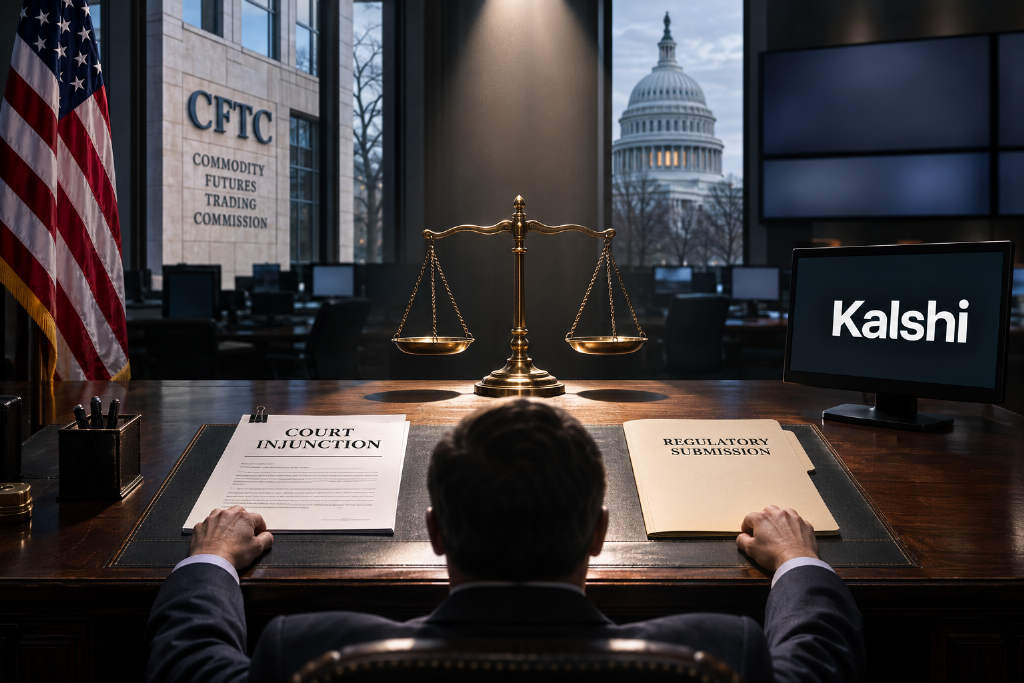
The U.S. Commodity Futures Trading Commission has ordered registered designated contract markets to stop restricting trading based on a customer’s state, giving the exchanges 30 days to restore nationwide access or explain in writing why they cannot do so.
The CFTC issued the interpretation on Thursday under the fair-access provision in Commission Regulation 38.151(b). It applies to every designated contract market, rather than a single company, and covers event-contract platforms such as Kalshi and Polymarket.
Two obligations within 30 days
The interpretation sets out two duties for DCMs. First, they must end domestic geographic restrictions that violate the fair-access requirement within 30 days. If an exchange believes removing the restrictions is not feasible, it must submit a written explanation to the CFTC’s Division of Market Oversight and state why compliance cannot be achieved.
Second, the exchanges must make sure that intermediaries directing customers to their markets are not blocking access and are following the same fair-access standard. If that condition cannot be met, the DCM must also provide a written explanation within the 30-day period. The CFTC said any later regulatory action would be assessed according to the facts and circumstances of each case.
That creates a direct conflict for platforms facing court-ordered restrictions. Restoring service in states where access has been blocked could put a platform at odds with a federal court order. Keeping the restrictions in place would require the platform to justify its position to the federal regulator.
Kalshi’s state-level restrictions
Kalshi has placed geographic restrictions on customers in Nevada, Washington and Michigan, citing unresolved legal disputes with those states. Utah has taken the most aggressive position. Its constitution broadly prohibits gambling, and the state has pursued civil litigation against Kalshi while also bringing criminal charges.
Recent appellate decisions have added pressure. The Second Circuit’s rulings involving Kalshi and Coinbase could allow Connecticut and New York to resume enforcement actions. The Ninth Circuit found that Kalshi’s argument that its contracts do not violate tribal gambling law was likely unsustainable, sending the case back to a federal judge in California. That judge later ordered the platform to restrict access to prediction markets in parts of tribal jurisdictions.
Kalshi is now facing pressure from both a federal regulator and federal courts at the same time.
A commission led by one member
The CFTC is legally supposed to be led by five bipartisan commissioners. Only one Republican commissioner, Chairman Mike Selig, is currently serving, leaving the commission’s action effectively dependent on a single member.
Selig made prediction markets a central policy priority after taking office and has repeatedly fought state governments that claim authority over the sector. In July 2026, the CFTC told Kalshi not to comply with a Michigan order seeking to end its local trading. The reasoning used at that time was largely the same as the position set out in this week’s full interpretation.
When the interpretation was released, Selig said derivatives markets must operate under a consistent national standard to meet the objectives of the Commodity Exchange Act. In his view, geographic access restrictions are incompatible with those objectives and with the law’s fair-access requirement.
Critics accuse the CFTC of encouraging gambling
Consumer advocacy group Better Markets described the latest action as the newest in “a series of clear and forceful rulings.” In a statement, the group said the law is clear and that the CFTC’s position in favor of unrestricted prediction markets cannot stand. It called for an end to what it described as illegal gambling and for those responsible to face enforcement.
Political pressure has also come from the Senate. Sen. Adam Schiff, a California Democrat who oversees the CFTC through the Senate Agriculture Committee, criticized the agency in a Friday post on X. Schiff said the CFTC and its “out-of-control chairman” appeared to be encouraging platforms to keep offering gambling products and openly defy court orders. He called the move the agency’s “worst attempt yet,” arguing that it first weakened state law, then tribal authority, and was now targeting the courts.
The CFTC’s case for liquidity and local information
The CFTC framed its position around market structure rather than state authority. The agency said excluding an entire state could make a market more dependent on a smaller group of participants, especially when the excluded jurisdiction accounts for a meaningful share of trading volume.
The interpretation uses sports contracts as an example. Interest in contracts concerning whether a home team will reach the playoffs is often concentrated in the relevant region. Removing that region from the market can reduce overall liquidity.
Election markets are presented as a more sensitive case. Trading volume and local information for state and municipal elections often come from residents who live in the area and vote there.
A Kalshi spokesperson had not responded to media questions about the company’s compliance plan by the reporting deadline.
Interpretation versus court orders
The central legal dispute is a direct clash between the CFTC’s interpretation and existing court orders. An interpretive document does not have to go through formal rulemaking, which makes it faster and more flexible. It may also be more vulnerable to being overturned in later litigation. Court orders have direct effect and can be enforced.
The most practical response for a platform may be to address both sides at once: submit an explanation to the CFTC saying that nationwide restoration is not feasible while asking a federal court to pause the geographic restrictions. The key test will come in early December, when the 30-day period expires. If a platform is found to have violated both sets of requirements, the priority between regulatory and judicial enforcement will become an immediate issue.
The dispute has escalated in stages. In late August, the Ninth Circuit ruled against the CFTC in the Nevada case. In late September, appellate courts in Ohio and Tennessee again ruled against Kalshi and found that event contracts did not qualify as futures exchanges. In late October, Utah brought 14 criminal charges against Kalshi and its two co-founders. This week, the CFTC responded with an interpretation aimed at imposing a nationwide access standard.
The circuit courts are now divided. Such conflicts are often left for the Supreme Court to resolve, meaning that the compliance boundaries for prediction markets may continue to be set through case-by-case rulings in different courts before 2027.
Access restrictions and platform liquidity
The dispute also affects the industry’s growth model. Prediction markets have been among the fastest-growing businesses for trading platforms over the past year. Kalshi’s valuation rose from $22 billion to $40 billion this year, with contracts tied to sports, politics and weather supporting the business.
If geographic restrictions become a permanent feature, the growth case will have to be reassessed. Each state ban removes part of the available liquidity, which is central to the prediction-market business.



