
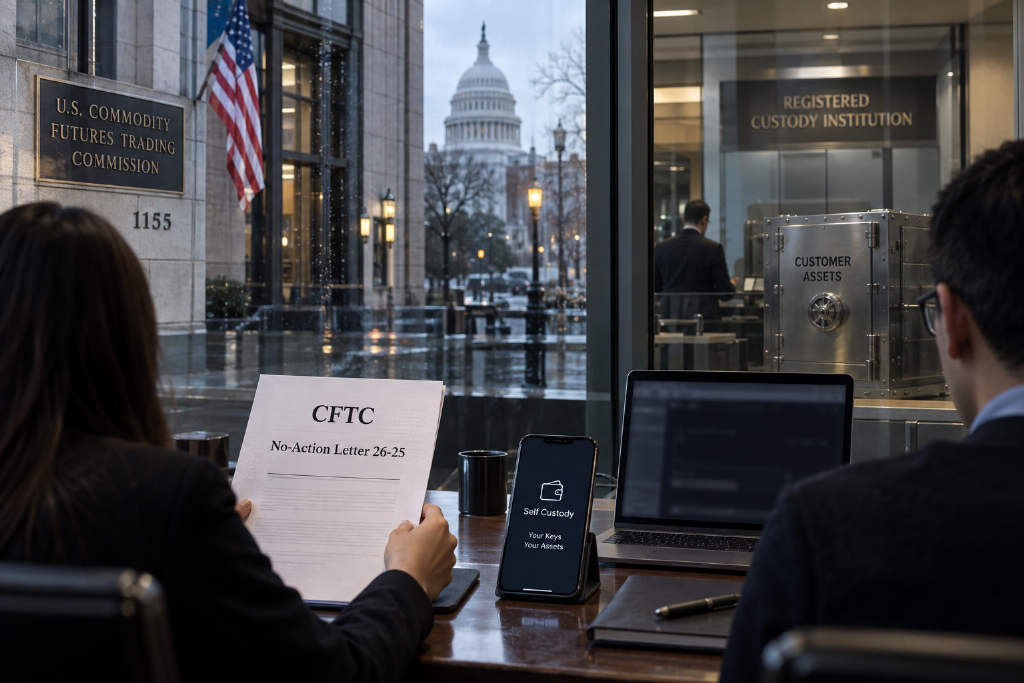
A no-action letter issued by the U.S. Commodity Futures Trading Commission on Sept. 17 has been described in some reports as an opening for the crypto industry. A close reading of Letter 26-25 points in the other direction. The document requires eligible firms to use a custody structure aligned with the current exchange-traded derivatives market, bars them from handling customer assets, and says orders must go directly to registered entities.
The letter says it is not limited to crypto
The connection to crypto comes from an earlier staff response. On March 17 this year, the Market Participants Division issued Letter 26-09 to Phantom Technologies in response to a developer of software that "passively enables users to trade regulated derivatives, including through self-custodial crypto wallet software."
Under Rule 140.99(a)(2), however, a no-action letter may be relied on only by its recipient. Other companies cannot cite it as their own protection. Letter 26-25 says the division later "received inquiries from other similarly situated passive software providers and their counsel," which led staff to generalize the same position.
Footnote 14 makes the scope explicit: "For the avoidance of doubt, passive software providers are not limited to providers of software related to crypto assets." In other words, the letter is not a crypto-specific exemption.
Covered activity stays inside the regulated derivatives structure
The key part of Letter 26-25 is its definition of "Covered Activity." It applies only when a user trades on a designated contract market, either as a member of that market or as a customer of a futures commission merchant or introducing broker that is a member of that market.
Funds and property used to margin positions must be held at the market’s clearing organization or at a member futures commission merchant. The letter sums this up as a custody model "consistent with the existing exchange-traded derivatives market structure."
Three clear limits on software providers
The document sets out three direct prohibitions. A passive software provider may not, at any time, hold, control, or custody user assets. It may not generate explicit buy or sell signals. It also may not exercise discretion over the routing or execution of user orders.
Its role in order entry is narrowed as well. The software may only provide functionality running on the user’s device that allows the user to transmit orders directly to a registered entity, and it must not take any active role in any specific order.
Users must also be able to access those registered entities without going through the software, with no contractual or operational restriction. If the interface is embedded in an existing wallet application, the software must "clearly and prominently distinguish" when a user is engaging in regulated activity and when the user is not.
One of the 10 conditions imposes joint and several liability
The no-action position is conditioned relief, not a blanket carveout. Among the 10 conditions attached to the letter, the seventh stands out most. It requires the passive software provider and the registered entity it works with to sign a written undertaking accepting joint and several liability for violations of law by the provider or its personnel in connection with covered activity. Both sides must also agree to CFTC jurisdiction for investigation and enforcement.
The other conditions cover statutory disqualification, disclosure of relationships and conflicts of interest with the registered entity including fees, delivery of a risk disclosure statement, marketing compliance policies modeled on those used by registered introducing brokers, a ban on advertising that requires prior approval from the National Futures Association, recordkeeping, notice to the division in the event of bankruptcy, and filing with the division to confirm agreement to those terms.
This is a staff view and does not bind the Commission
The letter also draws a sharp line around its legal effect. It says the document and the position it states "represent only the views of the Division, and do not necessarily represent the positions or views of the Commission or any other office or division of the Commission," and that it "does not bind the Commission."
A footnote cites Rule 140.99(a)(2) and says a no-action letter binds only the issuing division, not the Commission or other Commission staff. The division also keeps discretion to add conditions, modify the position, suspend it, or terminate it.
The position is based on the facts presented by the applicant. If those facts change, or if material facts were omitted, the relief may no longer apply.
The position expires when new rulemaking or guidance takes effect
Letter 26-25 is not open-ended. It remains effective only until "the effective date of any Commission rulemaking or guidance regarding the application of introducing broker registration requirements to software developers."
What the letter actually fixes
The issue it addresses is a mismatch between older staff conditions and newer app-based onboarding models. By statute, introducing brokers must register, and a 1983 Commission interpretation read "solicitation and acceptance" of orders broadly, not just in the literal sense of solicitation.
Between 2006 and 2008, staff issued several letters to technology service providers saying they were not introducing brokers, but those letters came with six conditions. One required users to have a pre-existing relationship with a futures commission merchant or introducing broker, and that relationship had to be independent of the technology provider.
Direct in-app registration does not satisfy that condition, so those older letters could not be used. Letter 26-25 addresses that gap. It allows front-end software to connect users to the existing regulated system without registering as an introducing broker, but only if the software does not handle assets or orders itself and shares liability with the registered entity.
