
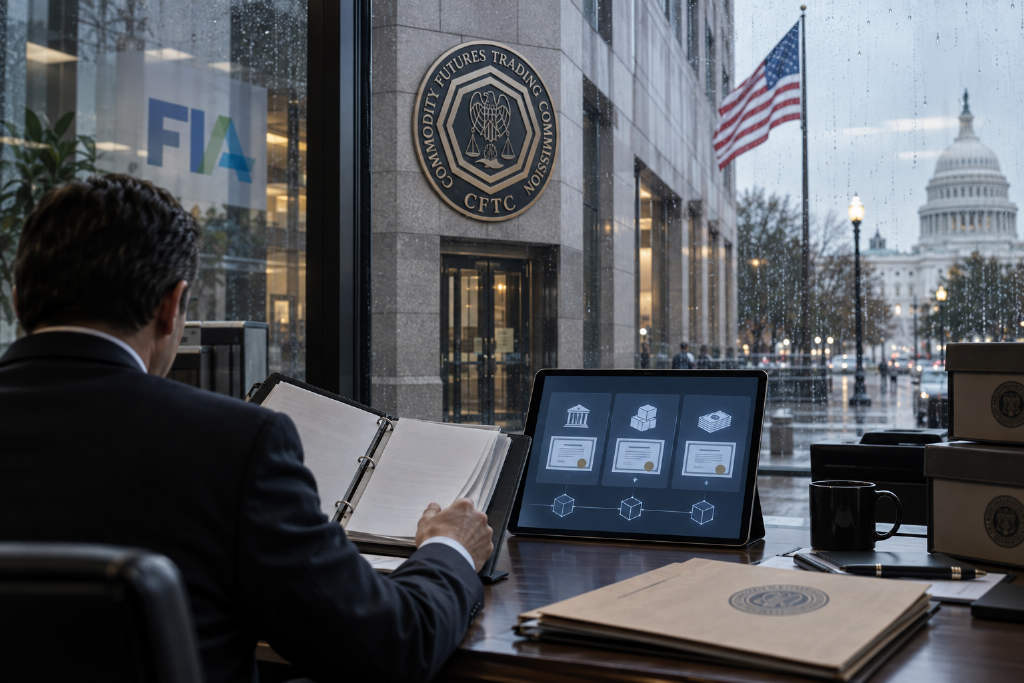
The U.S. Commodity Futures Trading Commission, or CFTC, this week issued an updated FAQ and a No Action Letter saying regulated commodity trading advisors can use tokenized asset portfolios to manage client funds and may treat blockchain ledgers as official records, without keeping a separate off-chain bookkeeping system.
The agency described the guidance in an official announcement. The document was signed by CFTC Chair Rostin Behnam and answers a petition submitted by the Futures Industry Association, or FIA. At the center of the request was whether the recordkeeping and books-and-records requirements under the Commodity Exchange Act are compatible with the on-chain nature of tokenized assets.
What the No Action Letter says
A No Action Letter is an informal form of guidance commonly used by U.S. regulators. It is not a rule and not a formal adjudication, but in practice it signals that the regulator will not bring an enforcement action if the recipient operates within the conditions laid out in the letter. For market participants, that often functions as a form of safe harbor.
The CFTC set three conditions for tokenized asset portfolios managed by commodity firms:
- the portfolio may invest only in asset types that commodity firms are allowed to hold under U.S. federal or state law;
- investment decisions must remain under the control of a regulated RIA;
- on-chain records must be verifiable, tamper-resistant, and fully accessible to the CFTC when needed for enforcement.
Blockchain records can satisfy books-and-records rules
Under the Commodity Exchange Act, RIAs must keep complete trade records, client account details, and information on the movement of funds, and those records must be available immediately during examinations. That requirement has long been seen as one of the main compliance hurdles for tokenized investing: if both the asset and the ledger live on-chain, firms still needed clarity on how traditional audit processes would work.
The CFTC’s answer is direct. If the blockchain meets standards for verification, immutability, and access, then the on-chain ledger can itself satisfy the books-and-records obligations under the Commodity Exchange Act. That removes the need to maintain two parallel record systems and lowers compliance costs tied to tokenized assets.
What assets are covered
The guidance is not limited to one narrow asset class. As long as the underlying asset type is one that a commodity firm may legally invest in, it can be included in a tokenized portfolio. In practical terms, the source report says that could include tokenized Treasuries, commercial paper, structured products, and even equities.
The report also says the move complements an SEC exemption issued last week for on-chain U.S. stock trading. In that framing, the SEC opened the market side, while the CFTC has now provided compliance footing for the management side.
The CFTC, however, avoided addressing the compliance status of cryptocurrencies themselves. The guidance assumes tokenized traditional assets such as tokenized Treasuries and tokenized stocks, rather than direct holdings of BTC, ETH, or other crypto assets. Firms looking to manage crypto-native products still need to work within the CFTC’s existing crypto asset framework.
FIA’s role in the request
The petition came from FIA, which the report describes as the world’s largest futures industry organization. Its members include CME Group, ICE, Nasdaq, major banks, and clearing houses.
FIA President and CEO Tim Skern said the guidance removes the final obstacle to tokenization in the futures industry: 「We can finally turn on-chain settlement from a concept into reality.」
The report argues that FIA’s involvement carries symbolic weight because it shows senior leaders in traditional futures markets now view tokenization as a path the industry will need to take, rather than a fringe experiment from the crypto sector. It adds that when institutions such as CME and ICE begin pushing for compliant frameworks, the scale-up of RWA may move faster than many had expected.
Scope and what comes next
The No Action Letter applies only to commodity trading advisors under the CFTC’s jurisdiction. It does not extend to investment advisers overseen by the SEC or to banks. The report adds that the SEC and the Federal Reserve are still working through stablecoin and tokenized-asset oversight, and that other regulators may look to the CFTC’s approach after this guidance.