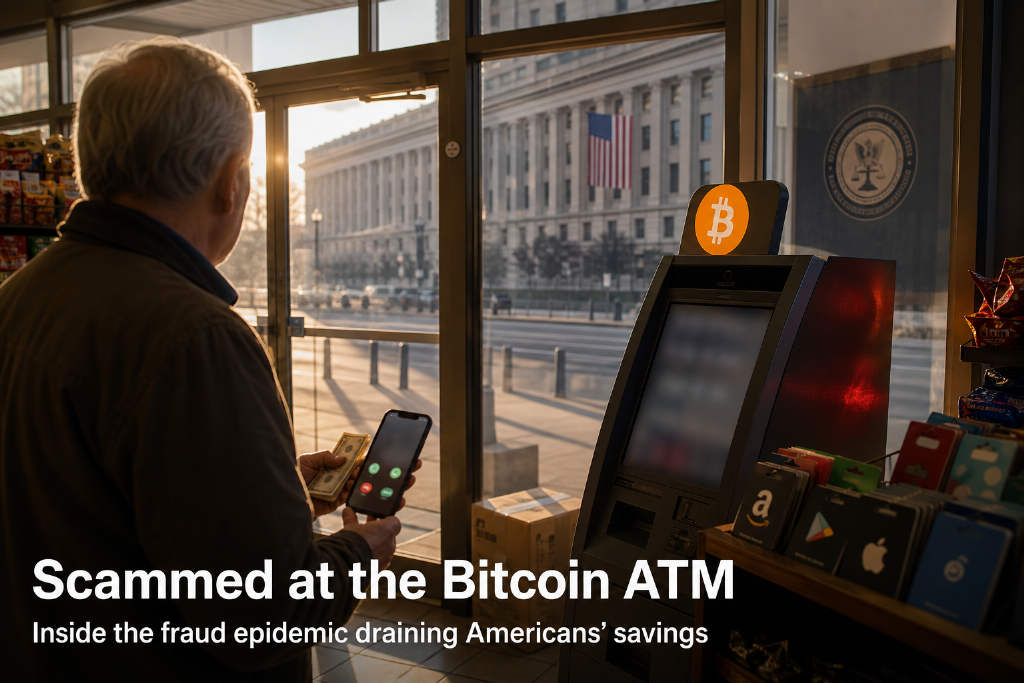
The U.S. Commodity Futures Trading Commission said scammers are increasingly posing as government agencies, banks, investment firms, utility companies, or tech support staff to trick victims into moving money through crypto ATMs, gift cards, unfamiliar apps, or parcel delivery. The agency said these schemes exploit the irreversible nature of crypto transfers and the difficulty of tracing wallet ownership. Data from the FBI’s Internet Crime Complaint Center, or IC3, showed reported losses tied to crypto ATM scams exceeded $388 million in 2025, up 58% from a year earlier, with actual losses potentially higher because not all cases are reported. The CFTC said legitimate government offices, financial institutions, and companies will not ask users to transfer assets through crypto ATMs, gift cards, or package delivery. It advised people to treat urgent claims about account or identity risks, secrecy requests, remote device access demands, and instructions to send funds to a specified wallet address or QR code as major warning signs. The regulator urged users to stop any transaction, verify information independently through official channels, and report suspected fraud to the CFTC or the FBI’s IC3.
The U.S. Commodity Futures Trading Commission, or CFTC, has warned that scammers are increasingly impersonating government agencies, banks, investment firms, utility companies, and tech support personnel to persuade victims to move funds through crypto ATMs, gift cards, unfamiliar applications, or parcel delivery services.
According to the agency, these fraud schemes take advantage of two common features of crypto transactions: transfers are generally irreversible, and wallet ownership can be difficult to trace. Data from the FBI’s Internet Crime Complaint Center (IC3) showed that reported losses from crypto ATM-related scams exceeded $388 million in 2025, a 58% increase from the previous year. The CFTC added that actual losses may be higher because many incidents go unreported.
Regulator outlines common warning signs
The CFTC said legitimate government departments, financial institutions, and companies do not ask users to move assets through crypto ATMs, gift cards, or package delivery. It also said people should treat several situations as high-risk signals: being told that an account or identity faces an urgent threat, being pressured to act quickly, being asked to keep the matter secret, being asked to allow remote control of a device, or being instructed to send funds to a designated wallet address or QR code.
CFTC urges independent verification and reporting
The regulator advised users to stop the transaction if they encounter suspicious activity, verify the information independently through official channels, and report suspected scams to the CFTC or the FBI’s IC3.
This article was originally published by Bit.Fan. For more cryptocurrency news and market insights, visit www.bit.fan. Disclaimer:
The market information, project data, and third-party content displayed on this platform are for industry information sharing only and do not constitute any form of investment advice or return commitment.
Cryptocurrency trading carries high risks. Users should fully assess their risk tolerance and make independent decisions. All profits, losses, and legal responsibilities are borne by the users themselves.