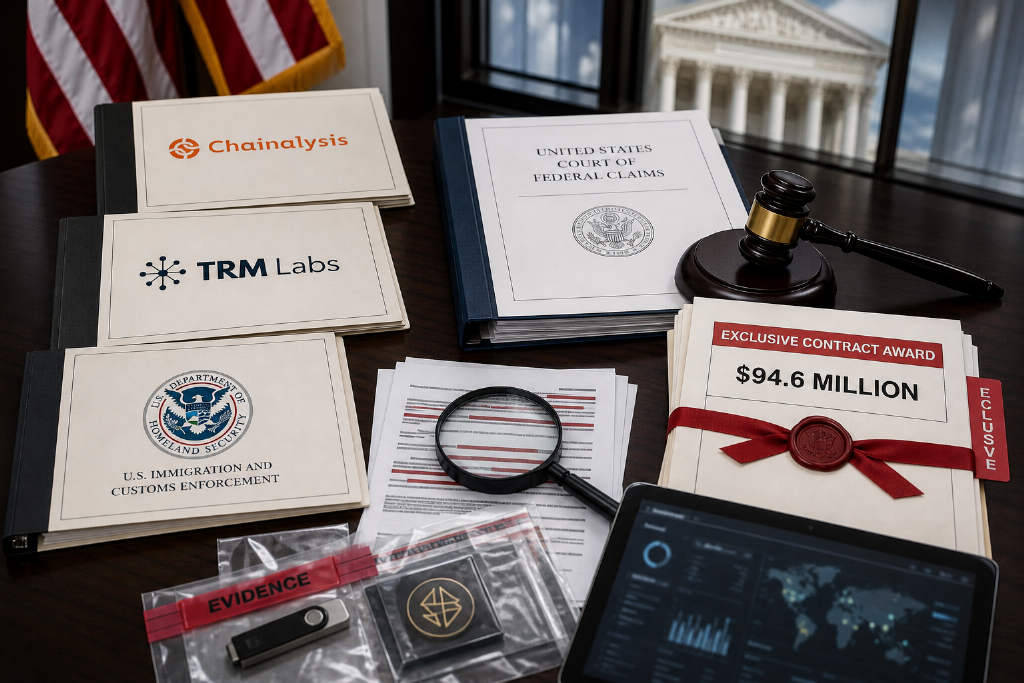
Blockchain analytics company Chainalysis has sued ICE before the U.S. Court of Federal Claims, alleging that the agency unlawfully awarded a $94.6 million sole-source contract to competitor TRM Labs. The contract provides forensic software and support for Homeland Security Task Force investigations, with a performance period running from July 1, 2026 to June 30, 2027. Chainalysis says it is the largest U.S. government blockchain-analysis contract awarded to date. In the complaint, Chainalysis says ICE issued an RFI on May 28 with 18 questions covering a proprietary fraud-victim database, AI-agent data retrieval, automated notices to virtual asset service providers to execute voluntary freezes, and cooperation with stablecoin issuers. Less than two weeks later, the final Statement of Need omitted many of those requirements, while ICE's market research used the RFI standard to conclude Chainalysis could not meet its needs. The suit also says “sextortion” appeared as one of three mission areas in the Statement of Need even though the RFI never mentioned it, and that some requirements closely match TRM’s proprietary product architecture. Chainalysis says it was the only company to submit a capability statement, yet ICE completed its market research the next day and named TRM the only supplier able to meet all requirements. ICE, according to the complaint, did not ask Chainalysis any follow-up questions.
Lawsuit challenges exclusive award to TRM Labs
Blockchain analytics firm Chainalysis has sued the U.S. Immigration and Customs Enforcement (ICE) over a $94.6 million sole-source contract that went to competitor TRM Labs.
The contract covers forensic software and support services for investigations carried out by the Homeland Security Task Force. Its performance period runs from July 1, 2026 to June 30, 2027. Chainalysis says this is the largest blockchain-analysis contract the U.S. government has awarded so far.
RFI versus the Statement of Need
According to the complaint, ICE issued a request for information (RFI) on May 28. The RFI contained 18 questions, touching on a proprietary fraud-victim database, AI-agent data retrieval, automated notices to virtual asset service providers (VASPs) to execute voluntary freezes, and cooperation with stablecoin issuers.
Less than two weeks later, the final Statement of Need omitted a large number of those RFI requirements. ICE's market research nonetheless used the RFI standard to conclude that Chainalysis could not meet the agency's needs.
The suit also says “sextortion,” which never appeared in the RFI, became one of three mission areas in the Statement of Need. Chainalysis argues that some of the requirements closely match TRM's proprietary product architecture.
Chainalysis says it was the only company to submit a capability statement. ICE completed its market research the next day and concluded that TRM was the only supplier able to satisfy all requirements. ICE, the complaint says, did not ask Chainalysis any follow-up questions.
This article was originally published by Bit.Fan. For more cryptocurrency news and market insights, visit www.bit.fan. Disclaimer:
The market information, project data, and third-party content displayed on this platform are for industry information sharing only and do not constitute any form of investment advice or return commitment.
Cryptocurrency trading carries high risks. Users should fully assess their risk tolerance and make independent decisions. All profits, losses, and legal responsibilities are borne by the users themselves.