ChainFeeds on Oct. 27 published a research roundup covering five topics at once: post-event takeaways from Korea Blockchain Week and TOKEN2049, the trust problem around crypto market makers, Changpeng Zhao’s latest comments on entrepreneurship and regulation, the backlash after StandX opened its airdrop checker, and the mechanics behind DEX project Metric.
After KBW and TOKEN2049, the crowd looks different
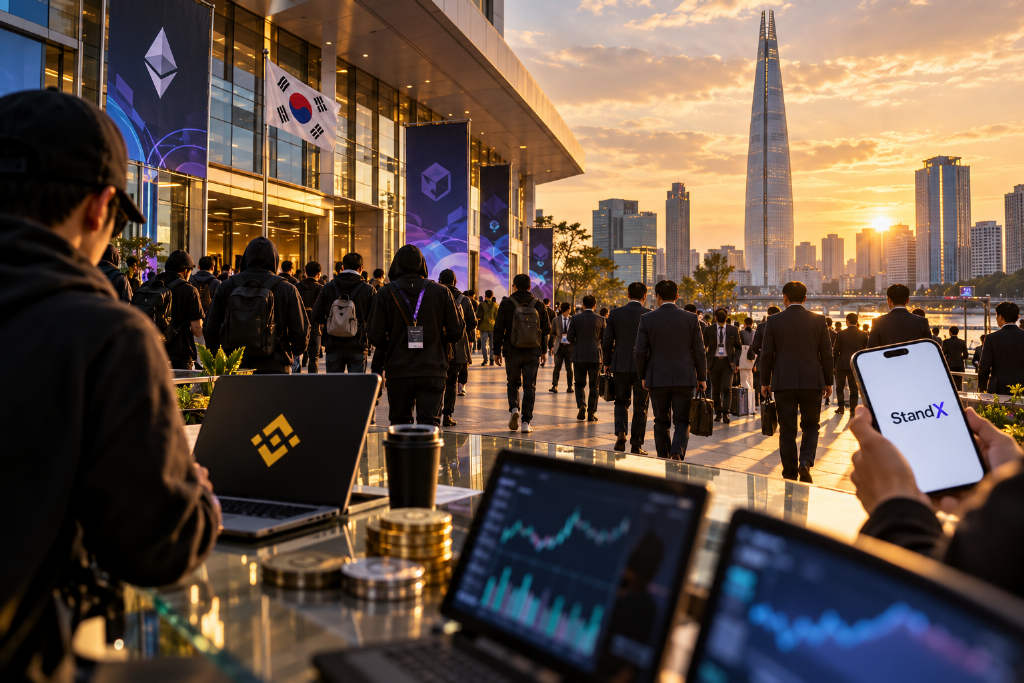
In the first section, IOSG Ventures argued that the main venue at KBW was not actually emptier. Attendance was slightly higher than last year, though still below the pre-event expectation of more than 14,000 people. The point, it said, was not that the event had gone cold, but that the people in the room had changed. Local media described it as “hoodies meeting suits.” With fewer side events, attendees were also more concentrated.
Using the roughly 185 side events listed on the official site, the article grouped them into several buckets: about 35 ecosystem and public-chain sessions, about 27 DeFi and trading events including Perp-DEX Day, about 22 gaming, entertainment and NFT events, about 20 RWA and institutional sessions, about 16 AI events, and about 10 focused on stablecoins and payments. The remaining roughly 55 were broader social gatherings, parties and closed-door dinners. Out of 290 speakers, 115 came from finance, policy and asset-management service firms, close to 40%.
Moody’s, S&P Global and Franklin Templeton appeared on the main stage to discuss ratings and data frameworks. Samsung Securities, Korea Investment Securities, Kyobo Life, Hyundai Card and LG CNS entered as new institutional partners. The article’s reading was blunt: the main venue is starting to resemble a financial industry conference.
It tied that shift to a broader reshuffling of local capital in South Korea. Naver Financial and Dunamu, the parent company of Upbit, are moving ahead with a share-swap merger. Mirae Asset has acquired Korbit. Korea Investment Securities and OKX Ventures each took 20% of Coinone. Hana Bank holds 6.55% of Dunamu. Traditional finance, the article said, is not just showing up. It is buying access points.
At side events in Seoul, AI dominated the conversation. Yellow discussed agentic trading, and the most common questions in the room were about trust and where humans still fit in the loop. Pharos used its “AI Meets RealFi” event to launch Vault Launchpad, framing agents alongside tokenized yield products. On the main stage, 0G talked about a trust layer for agents, and multiple speakers cited x402 data saying cumulative transactions had passed 200 million by mid-2026, with more than 850,000 buyers.
The article said the consensus was straightforward: agents cannot open bank accounts or swipe credit cards, so stablecoins remain the most practical settlement tool available to them. The disagreement was just as clear. Real agent-driven transaction volume is still small, and ticket sizes are low. Side events rarely focused on payments directly. Only about 10 of the listed side events, or around 5%, were tied to stablecoins and payments. Yet inside institutional sessions and bank meeting rooms, that was the hottest subject.
On regulation, South Korea’s digital asset framework law is still in final coordination, and the question of who gets to issue remains unresolved. The biggest dispute is whether banks must hold a 51% stake in issuers. Even so, some players have already moved. NHN KCP demonstrated payment and settlement using a won stablecoin on the main stage. The Bank of Korea’s Project Hangang has entered a second phase with nine participating banks and is described as a middle-ground model between a CBDC and a stablecoin. On distribution, Naver × Upbit, Kakao × Kaia, Toss’s offline terminals and bank alliances are all competing for real-world use cases.
The article also flagged a comment from a South Korean lawmaker in October that 54% of trading in yen stablecoins takes place in South Korea. If that figure is accurate, it would suggest Korean users are already using stablecoins, just not a domestic one. Once legislation is finalized, the competition may come down to who already controls users and merchants.
The piece then shifted to Singapore. It said the clearest change this year came on day two, when organizers added TOKEN2049 Institutional, an invitation-only closed-door event for roughly 250 executives from traditional finance and digital assets. BlackRock, Morgan Stanley, Goldman Sachs and Franklin Templeton were all on the list. The agenda centered on custody, tokenization, liquidity and trading infrastructure.
On the main stage, Nasdaq CEO Adena Friedman spoke about 24/7 trading. Franklin Templeton CEO Jenny Johnson openly criticized “digital twin” tokenization that simply ports traditional funds on-chain without changing the structure. Around the event, Coinbase announced it had completed the Deribit integration, while OKX and ICE applied to the U.S. Securities and Exchange Commission to list tokenized trading for 63 U.S. stocks.
The article contrasted Seoul and Singapore this way: in South Korea, traditional finance is buying entry points such as exchange equity and licenses; in Singapore, it is choosing rails. Institutions are no longer debating whether to touch crypto. They are debating which chain to use, which custodian to work with and which settlement layer to build on.
AI was also the main draw at side events in Singapore, especially where it intersected with trading and tokens: agents running strategies, research tools connected to execution, and token launches wrapped in AI narratives. The main stage reflected the same theme. “The Agent Economy: Why AI Needs Crypto” featured NEAR’s Illia Polosukhin, Base’s Jesse Pollak and Gauntlet’s Tarun Chitra. Arthur Hayes introduced an AI agent network called FLOP, pitched around commercial payments between agents, though no white paper or supply plan had been released by the time of the event. Eric Trump described a scenario in which agents use crypto wallets to book flights.
The article ended on a narrow but important point. No speaker claimed that agents are already generating meaningful transaction volume today. Everyone was talking about what will come later. That matched what the authors said they saw in Seoul: attention has arrived first, while the products are still on the way.
Market makers and the trust problem in crypto
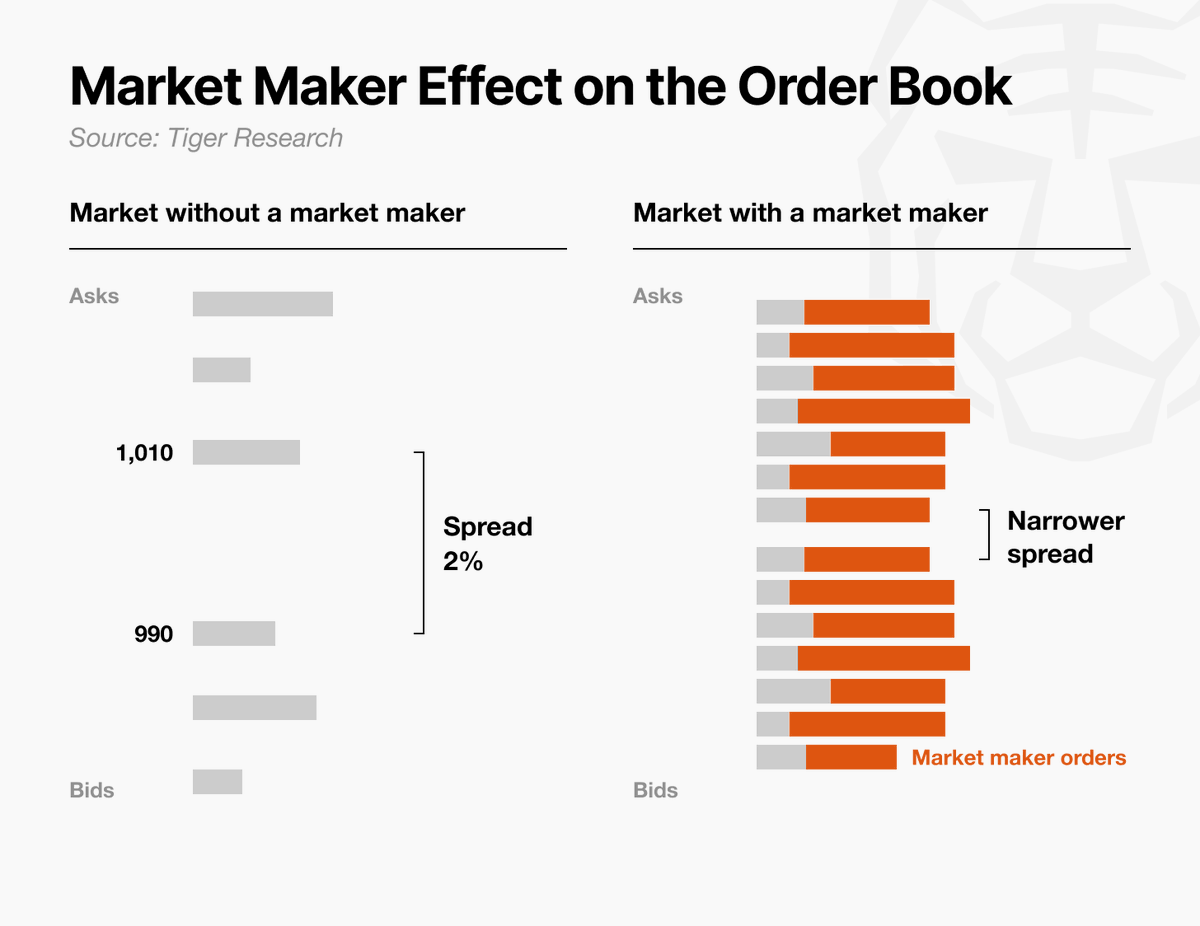
The second section summarized a long English-language piece from Tiger Research on the trust crisis around crypto market makers. It opened with a familiar pattern: a token lists, the price spikes, then collapses, and the trading volume disappears almost overnight. Investors often blame market makers for that sequence, but Tiger Research argued that much of the stigma comes from firms that call themselves market makers while actually engaging in price manipulation.
It cited enforcement examples from both the United States and South Korea. In the U.S., the FBI has brought charges against firms offering manipulation-as-a-service. In South Korea, some people who claimed to provide liquidity but in practice inflated trading volume were sentenced to prison. Tiger Research said those actors were not genuine market makers. They were illegal operators paid to help dump tokens. Because there is no clear qualification standard, the label “market maker” gets used loosely, damaging the reputation of the entire sector.
The report described market makers as core participants that support normal trading by posting both bids and offers. In a broad sense, liquidity provision is not limited to licensed institutions. Any order that does not execute immediately and instead sits on the order book waiting for a counterparty is creating a trading opportunity for others. By that definition, anyone posting resting orders is a liquidity provider.
According to the article, the actual work of a crypto market maker is not fundamentally different from that of a market maker in traditional finance. The real difference lies in the market structure and the regulatory framework. In equities, market makers usually sign formal contracts with exchanges and operate under mature rules. In crypto, there is still no complete system governing contracts between market makers, centralized exchanges and token issuers.
In traditional finance, market making is a formally regulated business. Approved financial institutions sign contracts with exchanges, provide continuous quotes under agreed terms and receive fee incentives. Exchanges disclose which firms make markets in which stocks, and years of law and case history have created a clearer standard for lawful conduct.
Crypto, the article said, faces two major problems. First, it lacks contract rules: there is no unified framework defining lawful market making, entry requirements, obligations or compensation. Second, it has structural risks specific to the sector, including centralized exchanges acting as market makers themselves or market makers signing undisclosed contracts directly with token issuers.
South Korea faces similar issues. Even though centralized exchanges are strictly prohibited from market making on their own books, there is still no formal process or standard for deciding what counts as lawful market making. The article stressed that placing orders and trading with one’s own capital is legal in itself and does not automatically require a market-making license. Ordinary risk management by a legitimate market maker can easily look like manipulation to outside observers.
It pointed to a case in the Korean stock market. In 2021, the Financial Supervisory Service said frequent quote changes and cancellations by market makers at nine securities firms amounted to market disruption and notified them of fines totaling KRW 48.7 billion, or about $35 million. Market-making activity then stopped. About a year later, in July 2022, the Securities and Futures Commission concluded that the firms had not violated the law. The investigation found that changing and canceling quotes was unavoidable in fulfilling market-making obligations and managing risk. Their order modification and cancellation ratios ranged from 95.68% to 99.55%, close to the New York Stock Exchange level of about 94.6%, and regulators had not set a clear standard beforehand.
By the time that conclusion arrived, the market had already gone a year without market makers. Tiger Research said crypto faces the same problem. The same trade can be seen by one party as liquidity provision and by another as price manipulation. Even lawful market makers cannot know in advance whether their trading will later be judged illegal, and some firms leave the market because of that uncertainty.
The proposed fix was not simply to watch cancellation rates. The article said regulators and market participants need ex ante standards that ask whether trades show genuine intent to transact, whether they follow contractual and internal risk-management rules, whether they actually reduce price risk, and whether they are based on two-sided quoting rather than an effort to push prices in one direction.
CZ says this is the best time to build
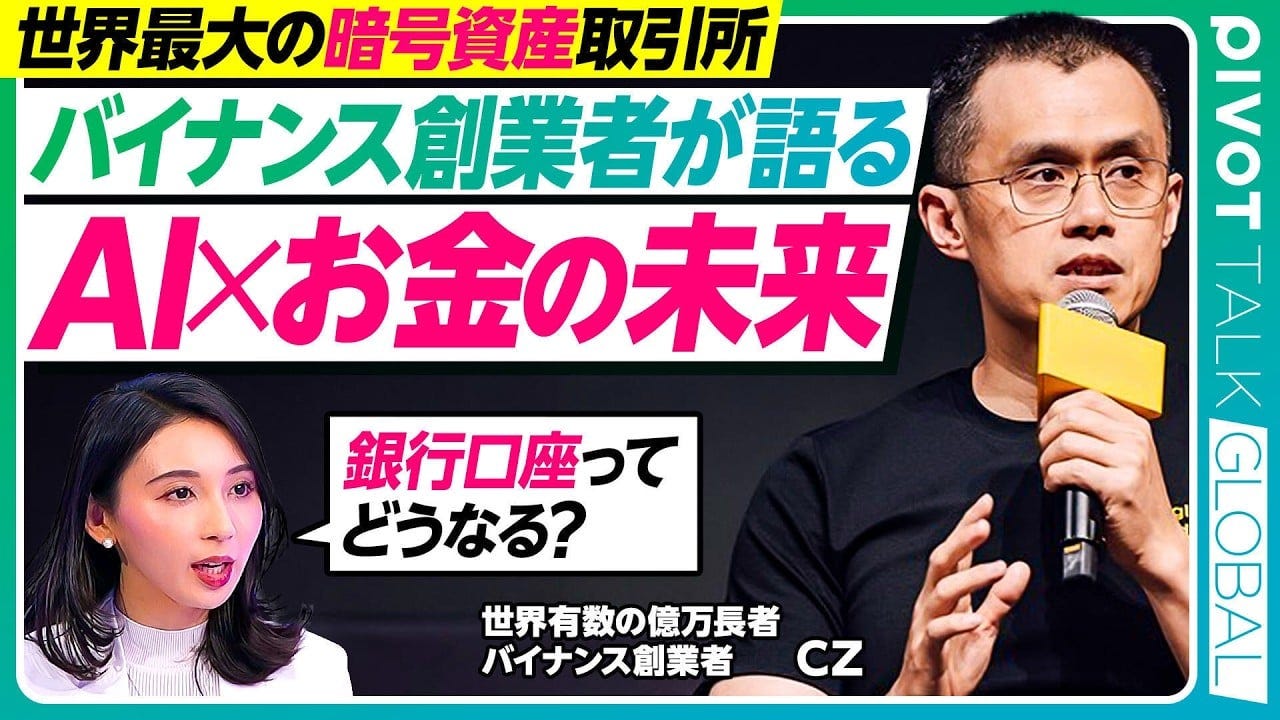
The third section was a podcast note built around comments from Changpeng Zhao, or CZ. He said Japan has followed a distinctive regulatory path. From 2017 to 2021, rules tightened sharply and many strong domestic and overseas founders were pushed out. Over the past two to three years, however, he said the Japanese government has shown a striking ability to correct course and reopen.
CZ said Binance itself returned to Japan in 2022 through a compliant acquisition, secured a fully compliant license, and entered deep joint-venture and ecosystem cooperation with SoftBank’s Masayoshi Son and leading local financial groups.
For founders, he argued, raising capital globally through crypto and token mechanisms is one of the most efficient and lowest-barrier financing methods in human history. He acknowledged that weak regulation abroad had allowed speculative scams to flourish in some places. But in Japan, he said, the culture places a high value on trust and founders tend to be disciplined and focused. He added that he has invested in many strong Japanese teams and has almost never seen malicious rug pulls. If policy gives enough room and clear guidance, he said, Japanese founders can use Web3 financing networks to rise quickly in global markets.
CZ grouped the issues attracting the most attention from policymakers into two broad areas. The first is the regulatory framework for centralized exchanges and compliant stablecoins. Most countries, he said, have gradually clarified the logic around exchange licensing, and the competitive focus is now shifting quickly to stablecoins. More than 99% of global stablecoins are backed by U.S. dollar assets, and the dollar is extending its position in the digital world through that channel. If the yen, one of the world’s core international currencies, moves too slowly here, it could end up at a disadvantage in future digital settlement networks. He said Japanese banks and JPYC have already started positioning around yen stablecoins, calling it the right strategic battleground.
The second, and in his telling much larger, area is full-spectrum asset tokenization, or real-world assets. Every country wants to tokenize real assets on-chain, he said. That includes government bonds, high-quality listed equities, real estate funds and rare earth resources, but also strategic natural resources.
He gave one example from his recent discussions with a government about tokenizing abundant water resources. In his description, a neighboring country faces an acute shortage of fresh water. By issuing water-resource tokens, the neighboring country could pre-purchase token allocations, while the producing country could use the proceeds to fund modern freshwater transport infrastructure directly. In the past, he said, that kind of cross-border infrastructure financing could take years and require cumbersome multilateral bank approvals. Through asset tokenization, capital raising and rights confirmation could be completed globally within minutes.
StandX airdrop checker triggers a backlash
The fourth section, citing Foresight News, said sentiment around StandX turned after the project opened its airdrop checker. The most widely shared screenshots came from users who had farmed trading points. One user, @BuTongRen6, who said he ranked first on Kaito’s StandX creator leaderboard, reported about 396,900 trading points, more than $5,000 in fees paid, cumulative losses of about $20,000, and a final allocation of 904.41 DUSD.
Another user, @wenxue600, who said he had organized a “squad,” reported about 459,900 trading points, losses in the thousands of dollars, and an allocation of 375.23 DUSD. He said he would return the entire airdrop to members who registered through his referral link. Users with lower point totals reported even smaller amounts. Airdrop blogger @AirdropAlchemis posted a 4.85 DUSD allocation and said it was lower than what he usually gets from a single giveaway. User @zaijin338191 said about 29,300 trading points and 55,700 holder points translated into 31.91 DUSD. In the English-speaking community, @Crypto_Pranjal said an average ranking around 4,000 only resulted in 1.96 DUSD.
Some users tried to reverse-engineer the conversion rate from the fees they had paid. @xiaoyon52351223 said the airdrop looked roughly equal to one-tenth of the fees before the first points halving on May 24, and only one-fortieth if calculated using the fee rate after the second halving on Aug. 10. Those were user estimates after the fact. As of publication, StandX had not disclosed the total airdrop amount or the conversion formula between points and DUSD.
In its Oct. 15 shutdown notice, StandX said allocations would be calculated based on pre-deposits, Alpha, mainnet trading, market making and referrals, with sybil and wash-trading filters applied. After the checker went live, however, multiple users who said they had only deposited funds and had not farmed trading activity reported receiving nothing. @Ron521520 said more than 100 accounts under his control had deposited hundreds of thousands of dollars in total, yet the checker showed “No allocation.” He concluded that users who did not generate trading fees would get no airdrop at all. Early pre-deposit participant @GXingPing also said he joined only the first deposit campaign to earn points and received no allocation.
The Kaito plan also appeared to fall short of expectations. StandX had replied on Oct. 15 that all users who received StandX token allocations through the Kaito plan would also receive a DUSD airdrop. But X user @SeyiVibez123 said he held more than 1,500 STANDX token allocations on Kaito while the StandX checker still showed no allocation, and he asked the team to correct it under the project’s post.
The report noted that deposit users had not necessarily left empty-handed before this. Holding DUSD generated yield, and AG said when announcing the shutdown that most past revenue had already been returned to users through SIP-2 and SIP-3 subsidies. User @0xCryptoUni, who said he only mined and did not trade perpetuals, said he got no airdrop but had already withdrawn principal and still made several dozen dollars.
When StandX announced on Oct. 15 that it would not issue a token, community reaction had briefly been positive. Some users said the team had managed to shut down “with dignity,” arguing it had not chosen to squeeze out one last token launch. Others thanked the team for arranging each step publicly and transparently. After the airdrop results appeared, the tone changed. Phrases such as “reverse farming” and “beggar-level payout” became common in the replies. Crypto KOL @MengLayer posted his own 9.67 DUSD allocation and mocked KOLs who had earlier praised the decision not to launch a token as a sign of principle. Some users resurfaced Binance Wallet’s earlier promotional post for StandX and called on people to leave comments under posts by CZ and He Yi. Others said they would avoid future projects from the same team no matter how well they were marketed.
Not everyone rejected the outcome outright. User @oceansbaby_, who received 6.96 DUSD, said losses from being liquidated on StandX were far larger than the airdrop, but added that StandX “really doesn’t have extra money left to distribute.” As of publication, neither StandX nor CEO AG had responded to the airdrop results, and AG’s latest X post was still dated Oct. 15.
According to the plan cited in the report, StandX airdrop claims will open at 08:00 on Nov. 1. Remaining perpetual positions will be closed at mark price on Jan. 15, 2027. DUSD redemption and withdrawals will end on Jan. 31.
How Metric handles near-$200 million daily volume with $17.3 million in TVL
The fifth section summarized an English-language article on Metric, a decentralized exchange project built around active liquidity pools. It began with a structural issue for DEX liquidity providers. When prices move on centralized exchanges, DEX pools often continue quoting stale prices. Arbitrageurs then trade against those pools until prices catch up with the broader market, and LPs end up selling assets away from fair value. That effect is known as loss-versus-rebalancing, or LVR.
The article said that from January through September 2026, 62 major Uniswap V3 pools across Ethereum, Arbitrum and Base posted a cumulative net loss of $35.6 million from LVR after fee income was taken into account. LPs may collect trading fees, but losses to arbitrage can still exceed those fees.
LVR measures the loss LPs suffer relative to simply holding the same tokens and rebalancing at market prices. Part of that value is captured by arbitrageurs, and fee income only offsets some of it. To reduce the problem, the market has produced several approaches, including batch execution, dynamic fees, concentrated-liquidity market makers, oracle-priced DEXs and proprietary automated market makers. Oracle-priced DEXs use external price feeds to adjust pool pricing curves more quickly, reducing the gains available from stale quotes.
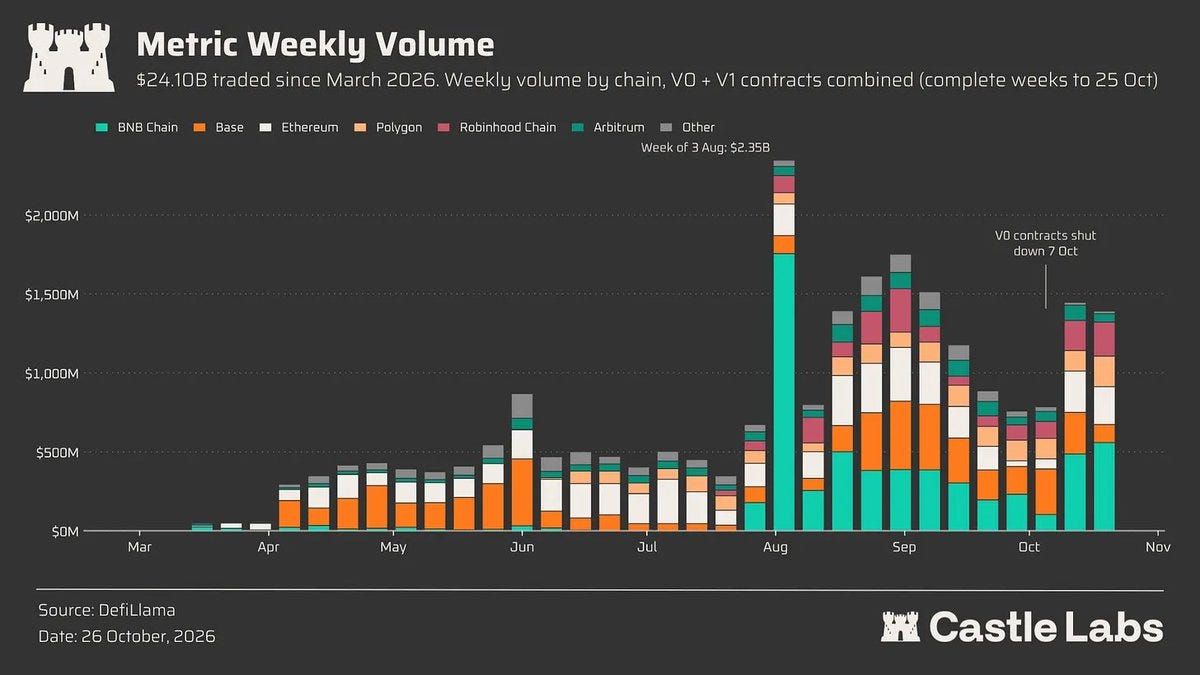
Metric launched in March 2026 and operated quietly for its first seven months. The team initially deployed $2.5 million of its own capital as liquidity and connected its pools to aggregators, handling more than $20 billion in cumulative volume across multiple blockchains. On Oct. 15, 2026, Metric formally emerged as a DEX deployed on Ethereum, BNB Chain and Robinhood Chain, with Active Pools as its core product.
These pools use external price sources to set a reference price and execute trades around that level, with curators managing the pools. The main advantage, according to the article, is that the pool does not need to discover prices on its own. It can use external market prices directly, reducing stale quotes and the arbitrage losses LPs face. Price providers can include Chainlink, Pyth or continuous quotes from market makers.
Each pool reads a bid, an ask and a reference price between them. If the price source cannot provide a valid quote, trading pauses, though LPs can still withdraw funds. LPs deposit capital into different price bands around the reference price, and those bands move automatically as the reference price changes. That removes the need for the constant manual repositioning seen in Uniswap V3. The article said this improves capital efficiency and lets LPs earn in a more passive way.
Still, the design does not eliminate inventory risk. If order flow keeps leaning in one direction, the pool can end up holding more and more of an asset that is falling in price.
Metric has processed more than $20 billion in cumulative volume through aggregators, the article said, and is now handling about $150 million to $200 million in daily volume with roughly $17.3 million in TVL. That implies capital turnover of 8x to 10x, meaning each $1 of liquidity supports about $8 to $10 of daily trading on average. For comparison, Uniswap’s cross-chain TVL is about $4 billion and its daily volume is about $3 billion, for turnover below 1x.
In a WETH/USDC pool comparison covering Oct. 15 to Oct. 26, and measured one minute after each trade, Metric LPs earned about 0.44 basis points per dollar of traded volume, while Uniswap V3 LPs lost about 1.01 basis points per dollar of traded volume. Uniswap LPs collected about $150,000 in fees but lost about $162,000 to arbitrage.
Measured against liquidity size, Metric LPs earned about 78 basis points, or roughly $3,000 on $351,000 of liquidity. Uniswap LPs lost about 5 basis points, or roughly $41,000 on $82.5 million of liquidity. The article cautioned that this came from a short observation window and may not represent long-term performance.
It also said Metric does not remove impermanent loss. Over the same period, the pool ended up holding about 13.9 more ETH while ETH fell 3.8%, reducing the value of the liquidity position.