ChainFeeds publishes its Sept. 18 research briefing
ChainFeeds on Sept. 18 released a new research briefing that combined the day’s headline items with five longer reads published in its Sept. 17 roundup. The package covered changes in Aptos validator economics and network distribution, the conditions under which Ethena could begin ENA buybacks, the burst of Meme trading activity around Arc’s mainnet launch, ZEC’s move into the top 10 by market capitalization, and the regulatory route that may take shape in the U.S. after the CLARITY Act stalled in the Senate.
The briefing also listed several tokenization-related developments. Those included a U.S. Securities and Exchange Commission innovation exemption that approved limited tokenized stock trading, comments from Robinhood’s CEO that tokenization is about to spread across the U.S., a statement from the Uniswap founder that the SEC exemption creates a compliant route for permissioned liquidity pools and that improvement proposals will be submitted, remarks from SEC Commissioner Hester Peirce that the tokenized stock exemption is not aimed at DeFi and that decentralized systems do not need to apply for it, and comments from the SEC chair that work is underway to prepare U.S. equities for 24-hour trading and that tokenization could improve settlement efficiency.
Aptos validator economics tighten as node count and geographic spread shrink
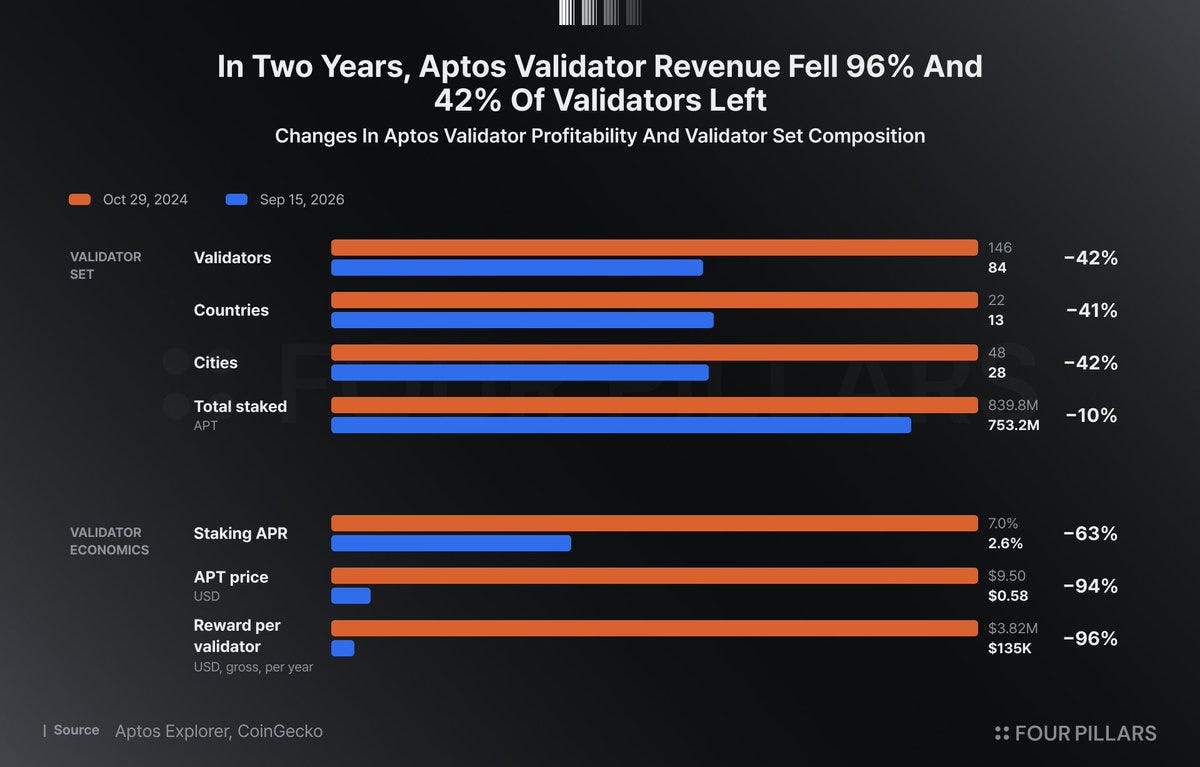
In a piece titled What Aptos teaches about decentralization when validators are no longer profitable, Rejamong wrote that Aptos had 146 validator nodes spread across 22 countries and 48 cities in October 2024. By September 2026, that had fallen to 84 nodes, down 42%. The number of countries dropped to 13, down 41%, and the number of cities fell to 28, also down 42%. Most nodes are now concentrated in the Americas and Europe, with only one node left outside those regions, in Tokyo.
The article pointed to two main reasons. One was that performance upgrades raised the operating requirements for validators. The other was that lower staking rewards, combined with a decline in the token price, sharply reduced validator income. As upgrades such as Baby Raptr and AIP-131, also known as Velociraptr, moved forward, Aptos compressed block time to under 50 milliseconds. That performance gain made network conditions and physical location more important to validator outcomes. Because Aptos ties rewards to proposal success rates, validators located farther from other nodes may earn less even with the same amount staked. The article said that dynamic pushed some geographically dispersed operators either to shut down or relocate to Europe and the Americas.
The income side changed even more clearly. Aptos’ annualized staking reward rate fell from 7% in October 2024 to 2.6% in September 2026, a 63% decline. AIP-119, proposed in April 2025, reduced the reward rate from 7% to 5.19% starting in June that year. Then, in February 2026, the Aptos Foundation proposed a tokenomics reform that cut the rate again to 2.6%. Over the same period, APT fell from $9.50 to $0.58, a 94% drop.
As some nodes exited, the average stake per validator rose from 5.75 million APT to 8.97 million APT, up 56%. The article said that increase was still not enough to offset the combined hit from lower rewards and a lower token price. When both factors are considered together, annual validator reward income in dollar terms fell by about 96%. The report also noted that better on-chain performance came with higher hardware requirements, while AI-related demand pushed up memory prices, adding to fixed operating costs.
Its conclusion was narrow and specific. Measuring decentralization, it argued, should not stop at current node counts or staking distribution. The more important question is whether enough operators, with enough diversity, can keep participating when token prices fall and reward policies change. In that setting, exchanges and institutions with stable core businesses and long-term service demand may be able to keep supporting network operations through weak market periods. At the same time, lowering hardware requirements and reducing barriers for smaller operators still matters. Over the long run, the article said, decentralization depends on three things: validators that can survive market downturns, lower operating costs, and open access for new participants.
Ethena’s fee switch would start ENA buybacks once USDe reaches the threshold
In What changes in ENA’s value logic after USDe returns to $7.5 billion, 0xWizard wrote that Ethena has generated $1.04 billion in cumulative revenue since launch, with $284 million of that coming in the past 12 months. Even so, ENA holders have not yet received any share of that revenue.
The article said governance approved a fee switch on Sept. 2. Once USDe’s 14-day average supply rises above $7.5 billion, the protocol will begin distributing revenue, with the portion routed through the fee switch used mainly to buy back ENA on the open market. USDe supply currently stands at about $4.75 billion, leaving a sizable gap before the trigger is reached.
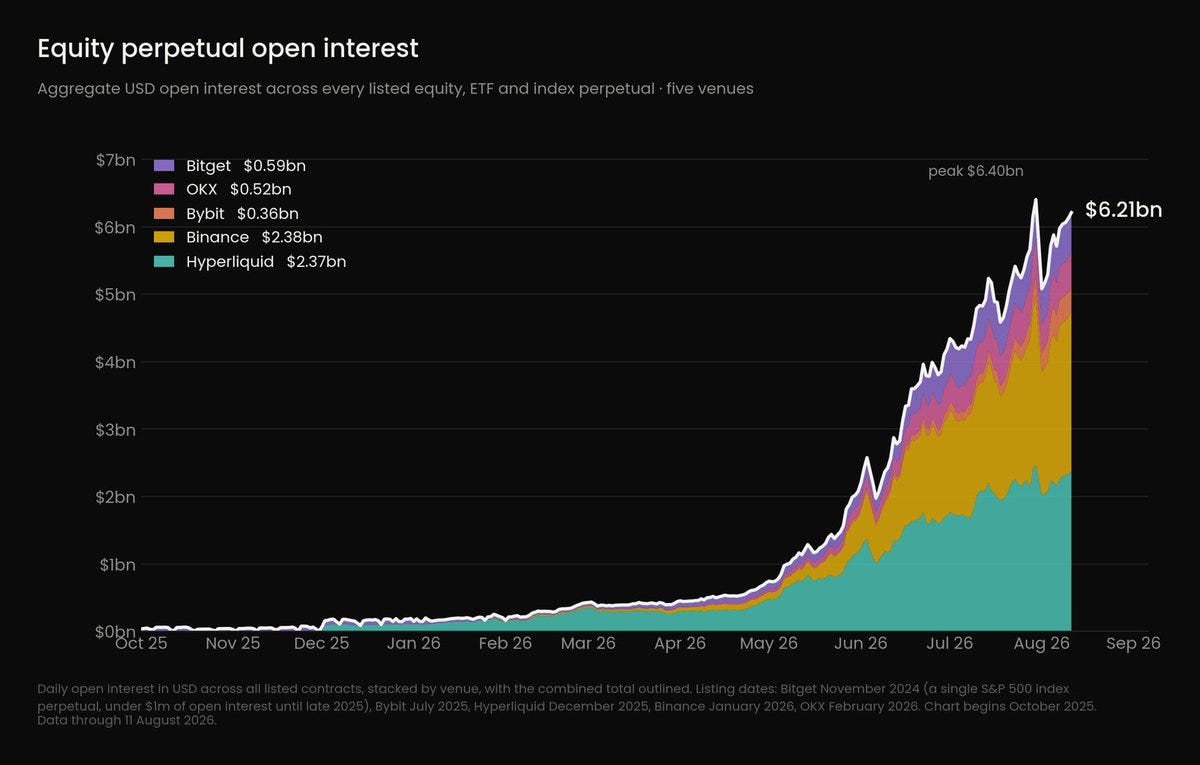
The report listed several possible catalysts for supply growth: stock perpetuals, a recovery in funding rates for crypto perpetuals, and new distribution channels through Ethena Pay, deployment on TRON, and collateral integrations at centralized exchanges. By late August, open interest in stock perpetuals across major trading venues had reached about $6.2 billion, roughly 10 times the level seen in March. Over recent months, average annualized funding rates for those positions were about 14% on Hyperliquid and about 17.5% on Binance, above the 4% to 7% range for ETH and BTC. The article added that stock perpetual funding rates have lower correlation with crypto market funding rates, which could make them a source of yield that is not fully tied to crypto bull and bear cycles.
On Aug. 28, Ethena said it would expand USDe reserves into basis trades tied to stock perpetuals and expected the first partner trading venues to deploy in the coming weeks. Ethena also estimated that over the next 12 to 24 months, the allocation to RWA perpetuals in reserves could exceed the current crypto asset allocation, which stands at about 13%.
Once USDe supply reaches $7.5 billion, the fee switch would formally begin and part of protocol revenue would be used to purchase ENA in the open market. The share of revenue allocated would rise in steps as supply expands. At $7.5 billion, $10 billion, $15 billion, and $20 billion in supply, the protocol would allocate 5%, 10%, 15%, and 20% of revenue, with 95% of that amount used for ENA buybacks. Assuming a 6% protocol yield, the annual buyback size would be about $21 million, $57 million, $128 million, and $228 million, respectively. With ENA’s market capitalization at about $1.43 billion, the article said a $10 billion USDe supply would imply annual buybacks equal to about 4% of current market value, while a return to $15 billion would imply about 9%.
Arc mainnet becomes a new Meme trading trench as activity spikes
In Meme traders rush into Arc’s new trench as mainnet day-one transactions top one million, PANews cited Arc block explorer data showing that on-chain activity had already picked up before the mainnet launch. Daily transactions topped 400,000 on both Sept. 14 and Sept. 15, compared with only tens of thousands a few days earlier. Over the same period, about 21,000 new addresses were added, versus only a few hundred or fewer per day before that.
To secure early positions in what traders viewed as likely leading tokens, some participants were willing to pay steep premiums in advance. USDC premiums briefly reached 80% to 100%. A number of early entrants posted large paper gains. According to on-chain analyst Ai Yi, after Arc mainnet went live on Sept. 16, address 0xE73…60BF2 was found to have bridged USDC from the Robinhood network to Arc through Long as early as Sept. 8, then accumulated LONG, BITCOIN, and USDC. Its cost basis for LONG was as low as $0.0000136. The address spent $487.6 in total and was sitting on an unrealized profit of $578,000, a return of 118483%.
Lookonchain tracked another trader who bought 12.1 million ARGUS on Arc Chain for about $1,200, later sold 1.8 million tokens for a profit of about $30,900, and still held about 10.1 million ARGUS worth about $332,000. Data cited in the article put the address’s cumulative profit on ARGUS at about $361,000, or 302x.
The report also stressed the other side of those early gains. Competition for early supply intensified on-chain PVP. As capital rushed into first-wave positions, some Meme tokens saw market capitalizations rise quickly and price swings widen. For traders who paid high premiums to get in early, the article said the token’s market value would need to at least double just to cover the premium paid at entry. Some participants instead chose to provide liquidity through LP positions in an attempt to capture early trading flow.
On launch day, inflows accelerated again. Arc block explorer data showed that as of publication, daily transactions on Sept. 16 had already exceeded 1.16 million, with 278,000 recorded in the past hour alone. Total addresses on the chain were about 216,000, with more than 78,000 added that day. Arc now holds more than 380 million USDC, equal to about 0.05% of total USDC supply.
Within the launchpad competition on Arc, only three tokens had so far reached market capitalizations above $10 million: ARGUS, LONG, and TOLLY. On Fomo, a social trading platform tracking the top 10 trending tokens, only two came from the Arc ecosystem.
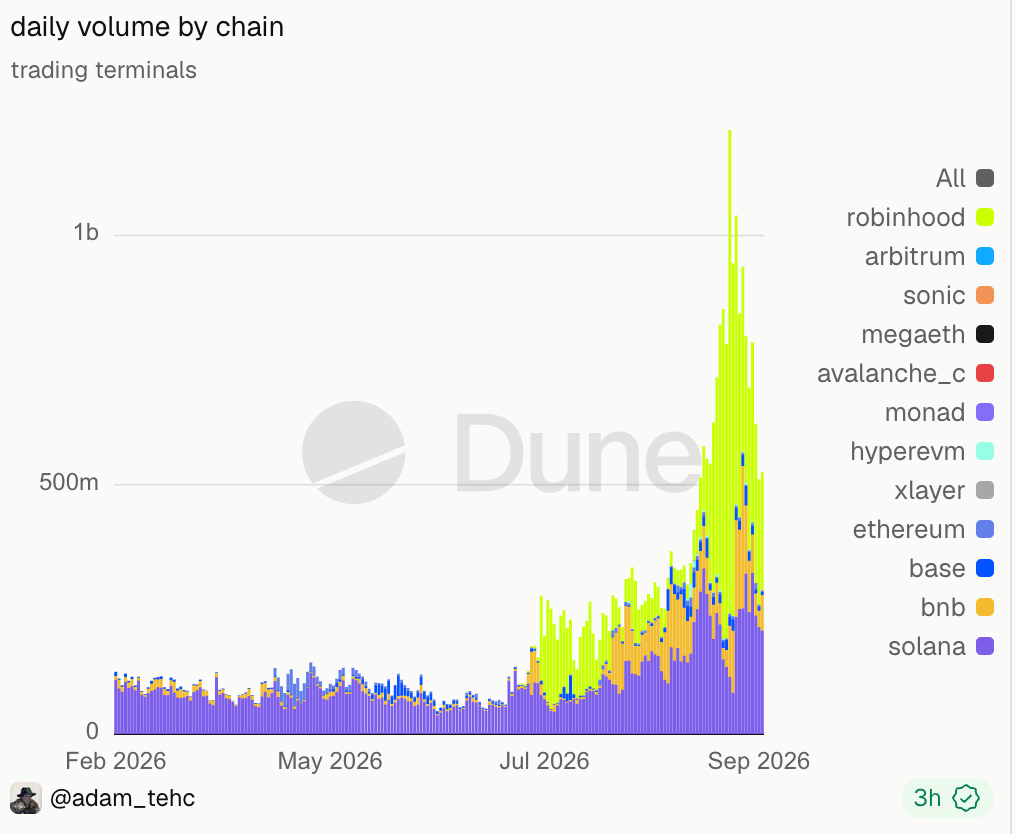
Dune data showed that Meme trading volume hit a single-day high for the year of about $1.2 billion on Sept. 4, then declined steadily to about $520 million. Trading activity has also weakened to varying degrees across Robinhood Chain, Solana, and BNB Chain. In the case of Robinhood Chain, token launches have continued to increase, but capital intensity has not held up. Its daily trading volume is now about $400 million, less than one-third of its historical peak of $1.5 billion.
Token performance has cooled as well. GMGN data showed that most on-chain Meme tokens have been in pullback mode recently, including PONS, AI, 牛来, MarsCoin, STONK, and ZCAT. The article linked the slowdown to two factors. One was Arc’s mainnet launch, which pulled market attention and on-chain liquidity toward the new chain. The other was policy and macro uncertainty. It said the failure to advance the Clarity bill added to short-term uncertainty around crypto risk appetite.
ZEC climbs to roughly $23.2 billion in market value and enters the top 10
In ZEC surges into the top 10 by market capitalization. Is there still room to get in?, TechFlow wrote that as of Sept. 17, ZEC’s market capitalization had climbed to about $23.2 billion, placing it among the 10 largest crypto assets globally. CoinGecko data showed ZEC at about $1,369 at the time of writing, up 20.4% over the previous 24 hours, while Bitcoin was up less than 1% over the same period. A year ago, ZEC was around 80th in the market cap rankings and traded below $50.
The article said ZEC has been repackaged in English-language crypto circles as a “private Bitcoin,” with the price rising more than twentyfold. A few weeks ago, when ZEC was around $1,000, some analysts were already discussing the risk of a local top. A few weeks later, against a backdrop of rate hikes and the failure of the Clarity bill to pass, it had still added another 30%.
As the rally extended, bullish commentary became more visible. BoDoggos founder Nick O’Neill publicly said that having no 20% ZEC allocation in a crypto portfolio was “irresponsible.” The article described that as a personal view shaped by his own positioning, but said it captured the mood on English-language crypto Twitter. Paradigm co-founder Matt Huang took a more restrained line, calling ZEC a “private complement to Bitcoin” and confirming that Paradigm holds ZEC.
The narrative around ZEC has shifted as well. Rather than treating it as an old privacy coin waiting for a comeback, supporters are now framing it through Bitcoin. Bitcoin has entered discussions around exchange-traded funds, corporate balance sheets, and government reserves, but its public ledger exposes addresses, balances, and fund flows. Zcash keeps the 21 million supply cap, proof-of-work, and halving structure, while adding optional privacy for transactions. The article used that to explain why ZEC has led the current privacy trade instead of the move spreading evenly across all privacy coins.
It also noted that ZEC now has a U.S.-listed exchange-traded product, allowing institutions to buy exposure through securities accounts. Its privacy features are optional, and viewing keys can be used to disclose transaction information to designated institutions. For compliance-oriented capital, the article said, that design is easier to fit into the existing financial system than a model in which all transactions are hidden by default. The phrase “financial privacy in the age of AI” has also been revived as part of the asset narrative. Naval Ravikant had previously described ZEC as insurance against Bitcoin risk, while Barry Silbert and the Winklevoss twins have continued to voice support. Over the past two weeks, discussion on English-language crypto Twitter has shifted from whether ZEC has value to how much of a portfolio it should represent.
The article said the strongest source of buying came from Grayscale. The Zcash exchange-traded product ZCSH began trading on NYSE Arca on Aug. 25. According to a filing Grayscale submitted to the SEC, the product’s assets under management exceeded $500 million two weeks after listing, with cumulative net inflows above $70 million and an additional $100 million seed investment. The article also made a distinction: AUM includes gains from ZEC’s price appreciation and should not all be counted as fresh institutional buying, while the $70 million in cumulative net inflows represents actual new money entering the product. For an asset with much thinner liquidity than Bitcoin or Ether, it said, that amount can affect marginal pricing.
On Sept. 8, options on ZCSH also began trading on NYSE Arca. Institutions can now hold ZEC exposure through familiar brokerage accounts, hedge risk, or sell options to generate income. The article described that as the first time a privacy coin that long depended on native crypto exchanges has had a relatively complete set of trading tools in the U.S. securities market.
Token-holder voting supplied another set of numbers that spread easily across the market. About 2.4 million ZEC took part in the NU7 vote, representing 66% of eligible tokens. Of those votes, 99.9% supported cutting the average block interval from 75 seconds to 25 seconds, and 98.9% supported keeping Bitcoin-style halving.
After the CLARITY setback, the SEC and CFTC move closer to center stage
In What happens to crypto regulation after CLARITY fails, BlockBeats wrote that on Sept. 15 the U.S. Senate failed to pass the procedural motion needed to advance the Digital Asset Market Clarity Act, or CLARITY Act. The vote ended 49 in favor and 50 against, short of the 60 votes required to end debate. That does not mean the bill has been finally defeated, but with the November midterm elections approaching, the article said the difficulty of moving it forward in the near term has risen sharply.
That leaves a practical question for the industry: if Congress cannot legislate in time, who regulates next? The article’s answer was the SEC and the Commodity Futures Trading Commission. Over the past few months, both agencies have been preparing for that possibility. SEC Chair Paul Atkins had previously said that before Congress completes market structure legislation, he and CFTC Chair Michael Selig plan to use their joint Project Crypto as a “bridge” toward formal legislation. In March, the SEC and CFTC also jointly issued interpretive guidance on how securities law applies to crypto assets, in an effort to draw at least some regulatory boundaries in advance.
One day before the Senate vote, Atkins publicly backed CLARITY while also saying that the SEC would continue advancing its crypto regulatory agenda even without congressional legislation. Based on his comments, crypto asset issuance, custody, and reforms to related market infrastructure will remain priorities in SEC rulemaking.
The article said the SEC has already started moving in that direction this year. In March, it issued interpretive guidance for crypto assets that further explained how federal securities laws apply to different types of tokens and proposed categories including digital commodities, digital collectibles, digital tools, stablecoins, and digital securities. The CFTC joined that interpretation and said it would keep its enforcement of the Commodity Exchange Act aligned with the framework. In August, Atkins said the SEC was also pushing “tailored” rules and exemptions for crypto markets, including measures meant to make capital formation and on-chain trading fit more cleanly within the existing regulatory system.
At the same time, Atkins said congressional legislation remains “indispensable,” in part because formal legislation would make the rules more durable and less vulnerable to reversal when regulators change. The article drew a distinction between what agencies can do and what CLARITY was trying to do. The SEC and CFTC can answer how crypto assets should be regulated under existing law. CLARITY, by contrast, was trying to answer what kind of legal framework the U.S. should build for crypto markets in the future. Those are not the same thing. The SEC can interpret securities law, revise registration rules, and grant some exemptions. The CFTC can build market oversight systems within its statutory authority. But neither agency can fully redraw the powers Congress gave them through administrative action alone.
That is why Atkins has pushed SEC crypto rule changes while still saying market structure legislation is indispensable. He has said regulators can build a bridge first, but a more durable framework still requires Congress. In the near term, the article said, the market may not need to wait for Congress to see more rules emerge. The SEC and CFTC are already moving, and their importance may rise further as the legislative window for CLARITY narrows. Over the longer term, though, the classification of digital assets, the division of authority between the SEC and CFTC, and the final structure of U.S. crypto trading markets are all questions that remain difficult to settle without Congress.