Five themes led ChainFeeds’ Aug. 29 research note
ChainFeeds’ latest research briefing brought together project updates, market commentary and a long-form interview. The package focused on five areas: Ethena’s effort to reshape ENA supply and tie token buybacks to protocol revenue, the fading appeal of South Korea’s domestic crypto industry despite fast retail trading rebounds, Grayscale’s view that the most important crypto shift is happening inside institutions and enterprise IT teams, a chart-driven case for bitcoin’s next bull phase, and ETH Systems’ argument that Ethereum still lacks the privacy layer large financial institutions need.

Ethena moves on ENA overhang and proposes a revenue-linked buyback system
In the section titled “What’s behind ENA’s surge? Ethena Foundation’s four-part self-rescue playbook,” Foresight News said the biggest bearish narrative around ENA over the past two years had been the steady stream of token unlocks. Seed investors, Series A participants, team allocations and advisor allocations were releasing month after month, creating structural sell pressure regardless of improving fundamentals.
The report said the Ethena Foundation has now made two adjustments on the supply side. First, it completed purchases of all locked ENA tokens held by some major seed investors. Those investors had sold ENA over the past nine months, and the move means their remaining locked tokens were bought back in one transaction and will no longer flow into the secondary market. Second, the foundation reached an agreement with major investors to release unvested tokens in a way that removes the future monthly overhang tied to VC unlocks.
According to additional reporting cited from English-language media, unlocks for the remaining original investors will be accelerated starting Oct. 5, 2026. After that, no investor tokens will remain locked. Team tokens are the one category left untouched and will stay under the original vesting schedule.
The article said ENA had also faced a separate issue: USDe had already become the third-largest stablecoin, and the Ethena protocol was generating tens of millions of dollars in monthly fees, yet ENA holders received little direct economic benefit beyond governance rights. To address that, the foundation has introduced a governance proposal that would allocate 95% of protocol net revenue to programmatic ENA buybacks in the secondary market.
The mechanism comes with explicit triggers. Buybacks would begin when USDe circulating supply reaches $7.5 billion. The buyback ratio would then rise in steps as supply passes milestones including $10 billion and $15 billion. The design is meant to directly link USDe expansion with ENA demand: more USDe supply, more protocol revenue, and more buybacks.
The fee switch itself is not new. The report said the idea had been under discussion as early as November 2024. In September 2025, the foundation said the activation conditions had been met, at a time when USDe supply was above $6 billion and cumulative revenue had exceeded $250 million. Ethena had also previously deployed about $890 million through its DAT buyback program, but that was described as a one-off use of reserve capital. The current proposal is meant to turn buybacks into a long-term mechanism linked to protocol income.
The briefing added that the Ethena Foundation and Ethena Labs have signed a master framework agreement under which intellectual property and value generated by the protocol will belong exclusively to the foundation and be governed by ENA holders. Equity investors in the Labs entity will no longer have rights to residual cash flow.
The secondary market backdrop was also part of the story. In June 2026, Coinbase Ventures publicly disclosed that it had bought ENA in the secondary market and was working with Ethena on on-chain financial products. On Aug. 6, Arthur Hayes bought 10.9 million ENA, bringing his total holdings to 22.64 million tokens worth about $4 million. He said that if rising dollar liquidity helps push BTC higher, a recovery in bitcoin basis yield could draw capital back into USDe, and he added that ENA could have the potential to rise 5x over the coming months.
On Aug. 25, Hayes said over-the-counter brokers had started asking about borrowing dollars. He added that rates were still low, but the change could be a sign that basis trading is returning.
The piece also laid out the constraint on the buyback thesis. USDe supply has fallen from about $15 billion at its peak in October 2025 to roughly $4 billion now. Since revenue-funded buybacks depend on sustained protocol income, whether USDe can return to growth will directly shape the real size of the mechanism.
South Korea still rebounds fast in trading, but misses the cycle’s fastest-growing sectors
In a separate essay, “Why South Korea’s crypto golden age is fading,” 100y.eth💜 | a41 argued that perpetual futures, prediction markets, stablecoins and real-world assets have been the four fastest-growing areas of the global blockchain industry in this cycle. The article’s answer to how many of those can properly develop in South Korea was blunt: zero.
The essay said South Korea remains a highly attractive market for global crypto protocols. Even after a prolonged bear market dragged down volumes at exchanges such as Upbit and Bithumb, trading rebounded quickly to 2.5x to 3x previous levels as sentiment improved. That, the author argued, shows how quickly Korean retail liquidity can come back.
The picture is different for the domestic crypto industry itself. Compared with past cycles, South Korea’s local ecosystem has lost part of its appeal. During the 2021 bull market, the country had a strong presence across the global crypto sector, backed by a large investor base, active communities and companies or projects spanning L1, DeFi, P2E, NFTs, infrastructure and wallets. The article marked the 2022 Terra collapse as the turning point.
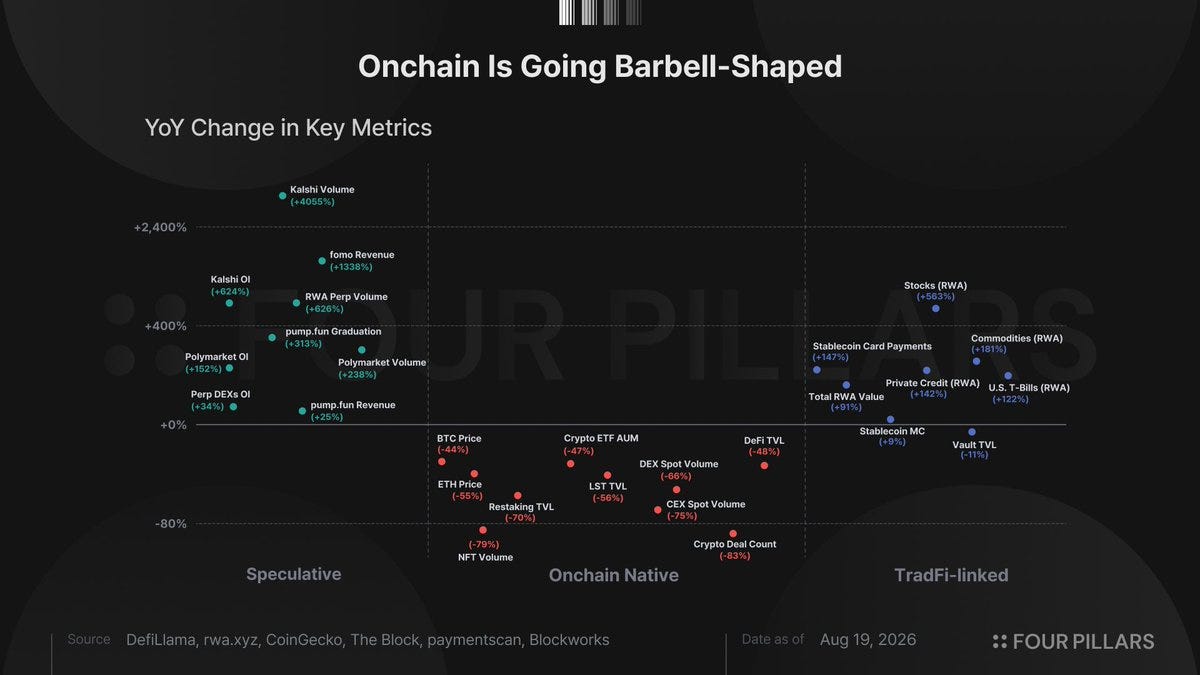
At the same time, the global blockchain industry kept moving. Bitcoin’s 2025 peak was almost double its 2021 high, yet the on-chain native products that exploded in 2021 and 2022 did not post comparable growth. As South Korea’s crypto industry slowed, the wider market moved into a more polarized structure: overall scale expanded, but the main beneficiaries were products driven by speculation on one side and products linked to the real economy on the other.
The report said year-on-year data at recent market lows showed clear divergence. DeFi TVL dropped sharply. Spot volumes on DEXs and CEXs, LST TVL, NFT trading volume and the number of crypto funding deals also fell. In other words, the on-chain native products that sat at the center of the previous bull market had an even harder time this cycle than bitcoin, which serves as the market’s benchmark fact.
A small set of sectors still posted explosive growth. Perpetuals and prediction markets expanded through speculative demand, while stablecoins and RWA kept growing by connecting crypto markets with the real economy. The author described the result as a barbell structure, with speculation on one side and integration with real-world economic activity on the other.
The article then explained why South Korea is struggling to host those sectors under a clear legal structure. Perpetuals are not explicitly banned by law, but the Financial Services Commission takes a conservative stance on crypto-asset-based credit, and the legal basis for formally offering crypto derivatives domestically is missing. Prediction markets are generally treated as illegal gambling, and the Korea Communications Standards Commission recently blocked domestic access to Polymarket. The Digital Asset Basic Act, which is expected to include stablecoin regulation, has been repeatedly delayed, leaving companies without a legal basis to issue and circulate stablecoins. South Korea does have an STO framework, but the article said it is tied mainly to fractional investment products and differs materially from what global markets usually mean by RWA.
The broader point was that global markets are already turning these segments into new financial infrastructure. Perpetuals are presented as a trading innovation native to crypto markets. Prediction markets are starting to show potential as risk-hedging venues and even as the basis for a new kind of insurance product. Stablecoins and RWA, in the author’s view, have partially broken away from dependence on crypto market sentiment, found their own product-market fit and are gradually becoming back-end rails for the next financial system.
Grayscale CEO says the real story sits below the price surface
A separate Fortune commentary highlighted a different part of the market. Grayscale’s CEO wrote that digital assets had started to rebound after spending most of the summer in a slump. Bitcoin rose about 20% last week, the article said, marking its strongest three-day stretch since 2023. The market narrative swung quickly from crypto obituaries to rebound talk, but the author argued that both views miss the deeper change: digital assets are going through a long-term expansion.
Bitcoin remains the most popular digital asset and still accounts for about 60% of total market capitalization across the asset class, the piece said, and it may continue to play a central role in many portfolios. But digital assets are not the same thing as bitcoin. The two main forces widening adoption are rising institutional demand and growing corporate use of blockchain technology.
The article compared the moment to earlier periods in traditional finance, when new asset classes and their associated technologies were first doubted, then debated, then gradually accepted before becoming part of the existing system. Digital assets, the CEO argued, have clearly entered that process.
Institutional capital is already having a larger effect on the market. In 2025, daily inflows or outflows in bitcoin ETPs often exceeded $500 million, around 12 times the value of newly mined bitcoin produced by miners in a day. That changes the traditional supply-demand structure. Even after this year’s sell-off, institutional demand has started to reappear: U.S.-listed spot bitcoin ETPs returned to net inflows for three straight weeks through late July after eight consecutive weeks of outflows, though year-to-date aggregate flows were still negative.
This drawdown has also been milder than the 70% to 80% declines often seen in earlier crypto winters. An EY survey of more than 350 institutional investors in 2026 found that 73% planned to increase digital asset allocations. The article said that points to a market where institutions may have a stronger hand in determining marginal prices.
As regulatory clarity improves, investment tools mature and governance frameworks develop, more institutions are able to evaluate digital assets the way they would assess other long-term allocations.
Adoption inside companies is moving as well. About 60% of Fortune 500 executives in 2025 said their firms were advancing blockchain-related projects, according to the article. Companies including Fidelity, Visa and Stripe are continuing to build stablecoin businesses, while most financial services institutions are testing digital asset technology in internal back-end systems. For large organizations with cautious capital deployment and long investment cycles, those infrastructure decisions are not simply reactions to market mood. They are based more on long-term judgments about practical use.
The CEO also argued that artificial intelligence and public blockchains are not competing systems. They may complement each other. AI agents will need machine-native micropayments and instant cross-border settlement, the piece said, and blockchains can provide the rails. At the same time, the bias and control risks tied to centralized AI development could be addressed in part through decentralized approaches and blockchain-based identity tools. The conclusion was direct: the most important thing to watch is not short-term price action but the long-term change taking place inside Wall Street institutions and corporate IT departments.
Bitcoin bull-market arguments return through chart-based signals
Anthony Pompliano, in another English-language market note, said bitcoin had disappointed many investors over the past year after falling more than 50% from its record high of $125,000. His view was that the bear market may already be over and that the market could be entering the early stage of the next bull cycle.
He pointed to several indicators. One was the relationship between bitcoin’s electricity cost and RSI, which have historically bottomed at roughly similar times. If that pattern holds again, he argued, a new uptrend may have started.
Another was bitcoin’s correlation with gold, which the article said had climbed to a record high. That matters more in a market where debasement trades are returning. With government spending continuing to rise and the dollar’s purchasing power under long-term pressure, bitcoin’s scarcity case has gained attention again.
The article also revisited bitcoin’s past tendency to track M2 money supply. There has been a notable divergence recently, with M2 still growing while bitcoin has fallen, but the author said similar episodes have appeared before. Historically, the gap was often closed not by M2 slowing down, but by bitcoin catching up on the upside.
From a technical perspective, the note said bitcoin appears to be finding support near the bottom of a long-term structural range, a pattern that could support higher prices over the coming weeks and months. R89 Capital’s reading was also bullish, with the firm saying the chart shows a clear constructive structure and that bitcoin could make another run toward $90,000.
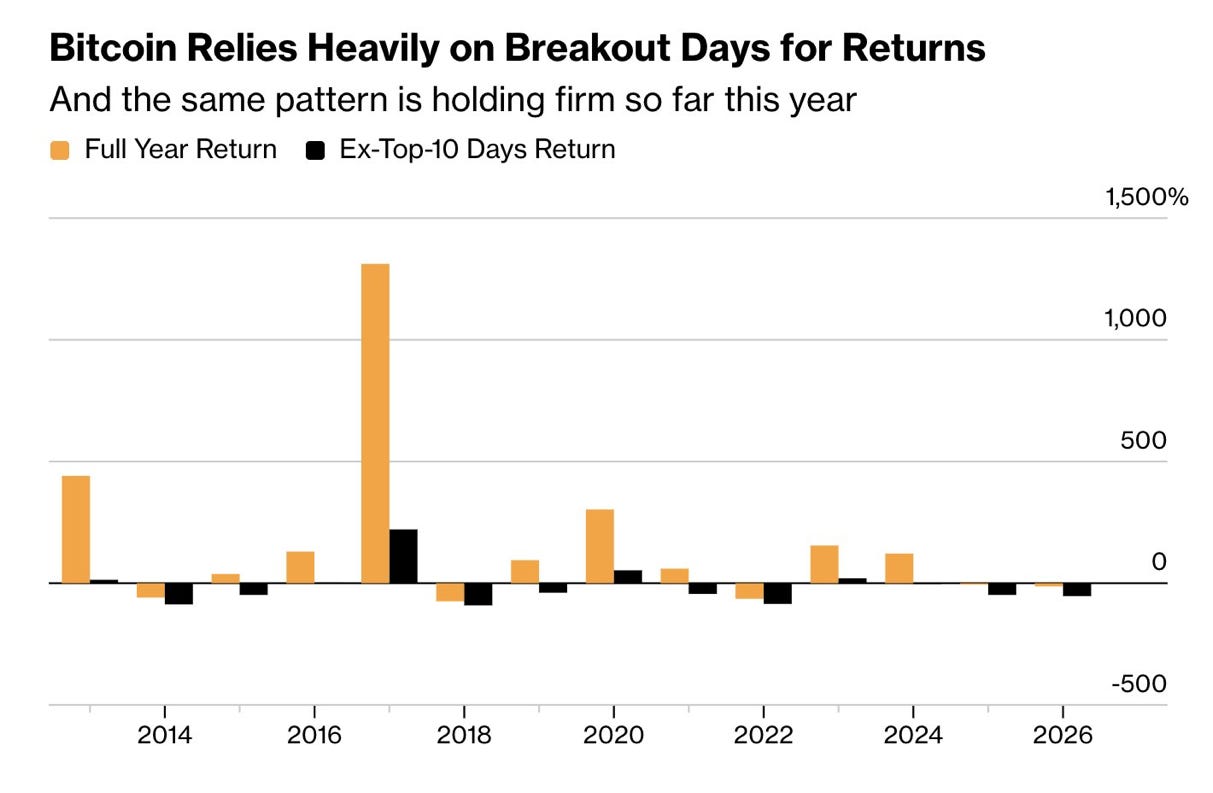
The central investment point was about time in the market rather than market timing. A Bloomberg chart cited in the article showed that, much like the S&P 500, a large share of bitcoin’s annual returns comes from a small number of sharp rebound days. Investors who sell before those dates and miss the move can materially damage long-term returns. The argument, then, is not that an investor should call every top and bottom, but that staying invested matters more.
The article said historical experience shows that accumulated time in the market often beats frequent timing attempts, especially in highly volatile assets. Missing a handful of key upside days can materially reshape long-term performance. This bitcoin bear market was shorter and shallower than those in prior cycles, but the market’s focus, the piece argued, should not remain fixed on the earlier drop. A new bull phase may already be here, even if sharp volatility remains.
Pompliano’s note also referenced Arthur Hayes, who has continued to stress the importance of liquidity conditions for bitcoin. Hayes has argued that fiscal policy, monetary expansion and declining dollar purchasing power could remain the main drivers of upside. He said bitcoin could reach $250,000 in the future and also discussed allocation across gold, bitcoin and public equities, as well as the idea of tokenizing AI compute itself.
ETH Systems says Ethereum still needs institutional-grade privacy rails
The interview with ETH Systems’ co-founder turned to infrastructure rather than price. The speaker said Ethereum is excellent as a base technology and has been highly stable as a credibly neutral decentralized settlement layer, but it does not include native privacy protection at the protocol level. That gap has led many builders to work on solutions at both the base and application layers. In the co-founder’s view, privacy is one of the most important missing pieces not only for Ethereum but for the public-blockchain stack more broadly.
The team’s core focus is institutions. Large institutions, the speaker said, care most about two things: continuity and security for core business operations, and strict compliance requirements. Those constraints have historically pushed traditional institutions toward private networks or consortium-chain environments that they can fully control.
Yet Ethereum offers deep global liquidity, new forms of commercial coordination and a large opportunity to improve existing business models. Without modern cryptography as a bridge, the speaker said, institutions cannot tap public-chain liquidity while also meeting compliance standards and protecting trade secrets. Privacy-preserving computation is the capability they need in order to use public Ethereum in a serious way.
The co-founder said the past five to six years had been spent working deeply in zero-knowledge proofs, including developer tooling and infrastructure, with close collaboration alongside early members of the Ethereum Foundation’s PSC, or Privacy & Scaling Explorations. The speaker said they had also written a short book on proof systems, worked on polynomial commitment schemes and led tooling efforts aimed at lowering client-side proving complexity. Over the past several years, the co-founder served as a privacy strategy adviser at the Ethereum Foundation, focused mainly on a new access-layer architecture. The institutional privacy working group, the speaker said, was launched during that period together with Mo.
While the speaker’s earlier work centered more on personal sovereignty and user-level privacy, that principle remains intact. Still, the past few years made something clear: institutional demand for privacy is real and, in many business settings, more urgent than what retail users require. The speaker linked that shift directly to gradually clearer regulatory frameworks around the world. Many major institutions are highly sensitive to commercial blowback created by exposing too much data on-chain. The team has been building the architecture publicly within the foundation over the past year and formally spun it out as an independent entity about a month ago.
As the lead of the institutional privacy working group at the time, the team saw its mission as connecting two worlds that had long stayed apart: large traditional institutions on one side and Ethereum-native builders on the other. In early conversations with financial institutions, the co-founder said, many had a major information gap and saw Ethereum simply as a fully transparent public chain with no room for business privacy. But the ecosystem, in fact, already has a deep set of solutions across cryptographic primitives, specialist security vendors and layered privacy protocols.
The work therefore ran in two directions. One was to explain the full Ethereum privacy stack to institutions in a systematic way. The other was to translate back to crypto teams and protocol engineers what real trillion-dollar commercial users are actually looking for. To do that, the team mapped the privacy market in detail, organized institutional needs across specific business processes, legal compliance constraints and trading scenarios, and then matched those needs to existing approaches such as zero-knowledge proofs, secure multi-party computation and homomorphic encryption. Through proofs of concept and architectural white papers, the team aimed to show which components are still missing and how those cryptographic building blocks can be assembled.