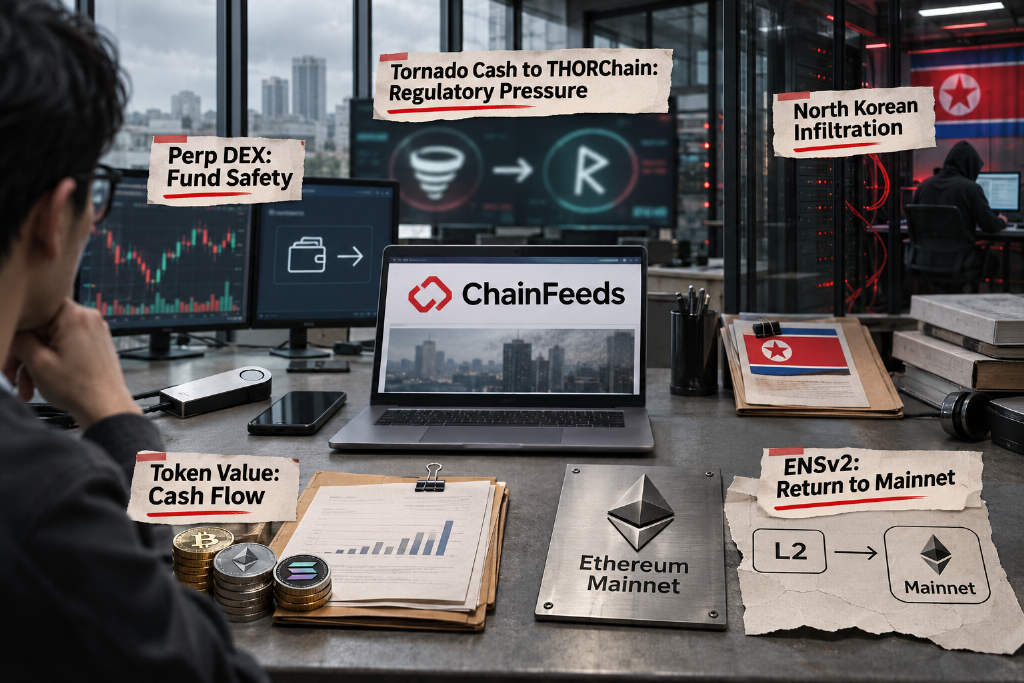
ChainFeeds on Nov. 3 published a new edition of its research digest, bringing together five pieces on token value, Perp DEX custody design, Ethereum’s scaling path, North Korean infiltration of the crypto sector, and the regulatory pressure building around decentralized protocols.
After the narrative trade, token value comes down to belief or cash flow
In a piece titled What ultimately supports token value as crypto moves past narrative speculation?, donn argues that the industry has become highly efficient at creating tokens, but far less capable of creating assets worth holding for more than a year. Pump.fun’s pump-and-dump machinery has been automated, token launches are routinely bundled, FOMO-driven KOLs have learned how to distribute through linked wallets, and the average holding period for retail participants can be measured in seconds.
The article reduces durable token demand to two questions: how strong the collective belief behind the asset is, and whether the economic value available to token holders is credible.
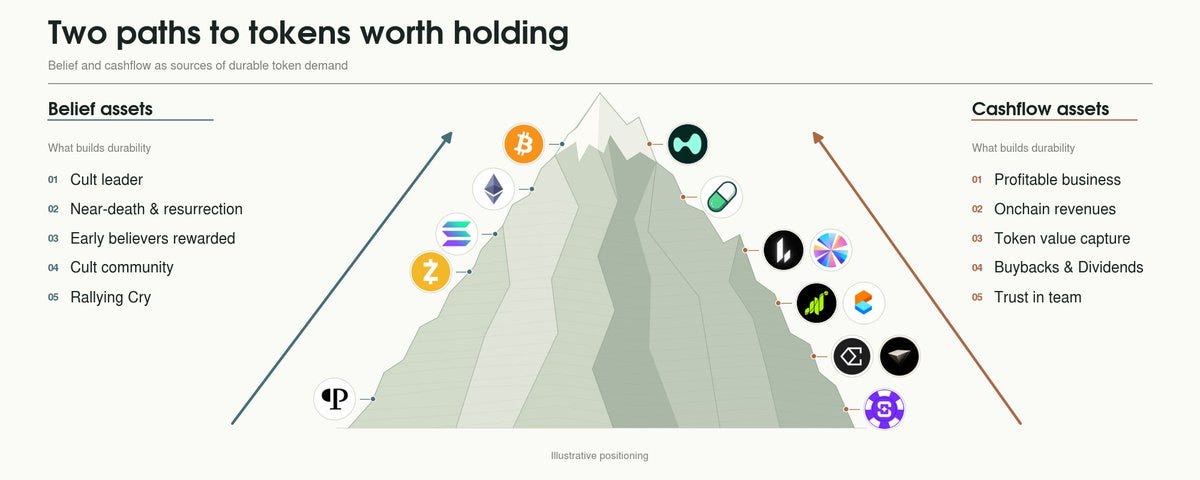
The first category is belief-based assets. These have no cash flow. Their value comes from a shared conviction that the asset itself is worth something. BTC is presented as the clearest example. The piece says that even someone who does not personally believe in Bitcoin may still buy it if they believe enough other people do. The digest’s introduction also places BTC, ZEC and HYPE on the path built around strong social conviction.
The second category is cash-flow assets, which the author describes as rare for two reasons. One, it is easier to use tokens and narratives to attract capital and provide exit liquidity for early investors than it is to build a business with positive free cash flow. Two, if a team already runs a profitable business that does not need outside funding to grow, it can simply keep the profits instead of issuing a token. DexScreener, Axiom and Trojan are cited as examples of teams that chose to retain 100% of profits.
Hyperliquid, in the author’s view, showed the market another route: build a business with strong cash generation and let the token share in that economic value, which may produce a better outcome than taking short-term profit directly. The digest’s teaser says HYPE, LIT and PUMP are growing along this cash-flow path.
The piece lays out five tests for judging whether a cash-flow token is worth holding over the long run:
- whether the project has sustainable economic surplus, meaning profit;
- whether that revenue can be verified on-chain;
- whether the income belongs to token holders or is captured by an equity entity;
- whether the token captures value directly through buybacks or distributions;
- whether holders have reason to trust a team that says profits will be reinvested now and shared later.
HYPE and PUMP are given as examples, with the article saying both generate roughly $1 million to $2 million in revenue per day throughout the year. It also argues that automated buybacks and distributions are stronger than discretionary buybacks, and that trust matters more in crypto because token holders usually lack legal protection.
Perp DEX withdrawal safety: only Lighter allows an exit without operator cooperation
In A close look at fund safety across four Perp DEXs: can users withdraw on their own?, jaehaerys starts with Binance’s Oct. 29 hot-wallet loss of about $6.3 billion and asks a basic question: if an attacker controls an exchange’s internal systems, can user funds be moved without the attacker ever obtaining private keys?
According to the article’s summary of Binance’s disclosure, a DevOps engineer’s laptop was compromised, giving the attacker access to internal service systems that were then used to initiate withdrawals. Binance said there is no evidence that private keys were leaked. That leaves open the possibility that the attacker did not need the keys at all and instead used Binance’s own systems to produce valid withdrawal signatures. Binance later found additional compromised components but has not yet released a full post-mortem. About $3 billion has been frozen, and Binance said it will cover all losses.
The piece also cites a TRM report saying the attacker used Binance’s signing system to approve an EIP-7702 delegation that handed control of a hot wallet to the attacker’s contract. Researchers said the signing system may have relied on a blacklist of known malicious actions rather than a whitelist of verified safe actions, which would explain why a new authorization pattern slipped through. Binance has not confirmed that account, and the explanation does not address losses on Bitcoin, Solana and Tron.
The article notes that Bitget suffered a similar incident a month earlier, losing more than $350 million after attackers compromised a backend system that fed transaction data into the signing system and then used legitimate signatures to complete withdrawals.
Against that backdrop, the piece breaks down how four Perp DEXs hold funds and what users can do if the operator fails or is compromised.
Lighter: forced withdrawal and emergency exit exist on-chain
Lighter holds about $1 billion in assets in Ethereum contracts, including $556 million in USDC, $430 million in LIT, or about 151 million tokens, plus smaller amounts of ETH and other assets. Under normal operation, funds can leave the contract in batches only after a zero-knowledge proof is verified.
Standard withdrawals can be sent only to the wallet tied to the account, and that wallet-account binding is fixed at the first deposit. The platform also supports fast withdrawals and transfers to other accounts, but those actions require the user’s own wallet signature. On that basis, the article says that even if someone obtained Lighter’s sequencer, prover or validator keys, they still could not directly drain user balances.
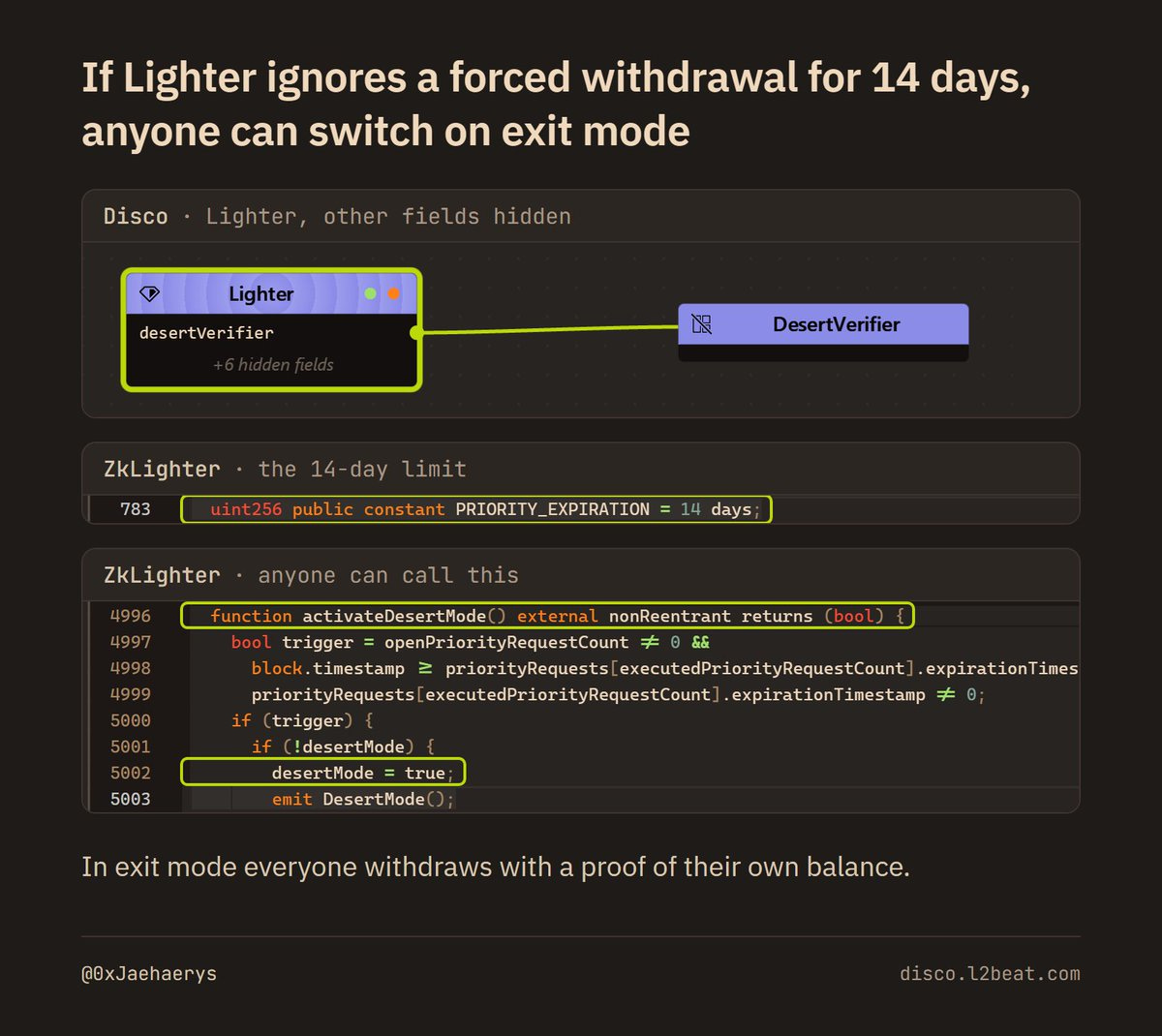
The stronger claim is that users can exit without relying on the platform. They can submit a forced withdrawal request directly on Ethereum. If Lighter does not process it within 14 days, anyone can switch the contract into Desert Mode, the protocol’s emergency exit mechanism. Once in that mode, upgrades stop and users can prove balances with zero-knowledge proofs based on data already recorded on Ethereum and withdraw.
The article does not present Lighter as trustless in every respect. The operator still provides index prices and mark prices, and the zero-knowledge proof system does not verify whether those prices were signed by an oracle. A bad price could still trigger unfair liquidations. It also says two Guardian keys can pause batch processing and withdrawals for up to 24 hours and 72 hours, respectively. Those powers do not block emergency exit, but they do leave the platform with some control.
Aster: withdrawals depend on operator action and Aster-controlled keys
Aster holds about $500 million in vaults across BNB Chain, Ethereum, Arbitrum and Solana, including $100 million in USDF, its stablecoin. In addition, the BNB Chain vault contains about $1 billion worth of ASTER and APX tokens.
The article says Aster uses a pooled-fund model, with user ownership recorded on Aster Chain, which is currently run only by Aster validators. Every EVM vault withdrawal must be initiated by an Aster operator address and signed by two Aster keys. Users also sign withdrawal requests, but based on the verified contract code, the user signature is checked by an address supplied by Aster keys. That proves only that a user requested a withdrawal; it does not protect the pool itself.
If Aster’s keys or backend systems were compromised, the funds could be moved directly. Each EVM vault has an hourly withdrawal cap of $30 million on BNB Chain and Ethereum and $20 million on Arbitrum, but the same multisig can change those limits immediately.
Variational: users can deposit by themselves, but not withdraw by themselves
Variational holds about $290 million in USDC on Arbitrum. Of that, $223 million sits across 208,000 user settlement pools, another $54 million is in market maker OLP addresses, and $12 million is in the treasury.
Users can deposit into the pools on their own, the article says, but they cannot withdraw on their own. Every withdrawal must be initiated by one of 17 operator keys, 16 of which are ordinary wallet addresses. Any one of those keys can move USDC out of any pool, and the contracts impose no withdrawal amount cap. In theory, the piece says, a single key could empty all pools within minutes. If the backend stops running or an administrator pauses the oracle, there is no user-controlled exit path in the contracts.
The digest’s takeaway is blunt: among the four reviewed platforms, only Lighter lets users leave without platform cooperation.
ENSv2 launches on Ethereum L1 as more projects rethink L2 deployment
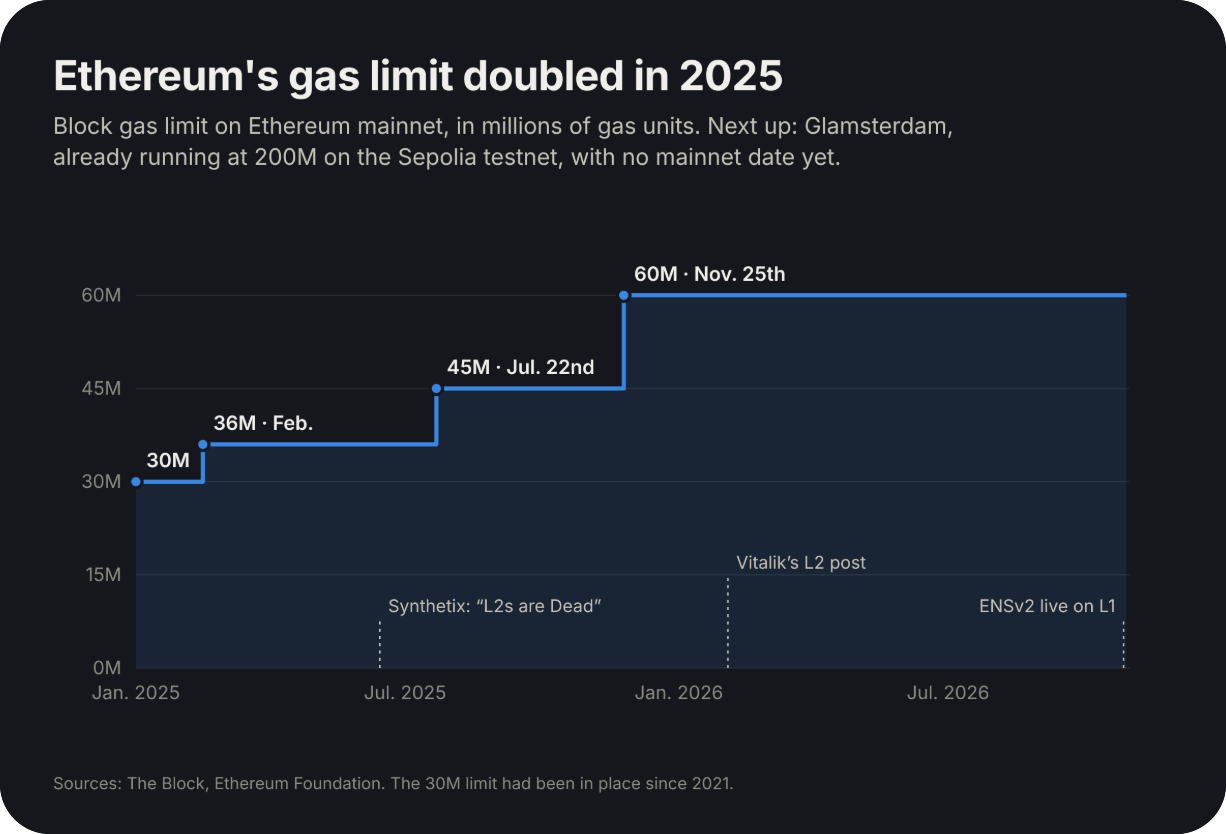
In Why are more projects moving back from L2 to Ethereum mainnet?, Bankless uses ENSv2 to illustrate a broader shift: some applications are moving core contracts back to Ethereum L1 instead of keeping them on appchains or rollups.
ENS, the Ethereum Name Service, completed what the article calls the biggest upgrade in its history. ENSv2 went live on Ethereum L1 on Oct. 27 rather than on the L2 that had once been planned. Roughly nine months earlier, ENS had already scrapped Namechain, the rollup originally meant to host the upgrade.
ENSv2 is described as a full rebuild of the protocol. After the upgrade, each ENS name can have its own subname registration system, owners get more granular permission controls, and fees can be paid in stablecoins such as USDC.
The article traces the reversal in strategy. ENS first proposed moving to L2 in May 2024, then developed that idea into its own rollup, Namechain. On Feb. 6 this year, ENS founder Nick Johnson explained the change by saying, “Ethereum L1 is scaling, and it is scaling faster than almost everyone predicted two years ago.” The piece adds that ENS registration gas costs had already fallen 99% over the prior year as Ethereum kept scaling. Johnson also argued that deploying on L2 introduces trust assumptions that do not exist on L1. Ethereum co-founder Vitalik Buterin publicly backed the decision the same day, calling it a good choice.
ENS is not alone. The article points to Synthetix as an earlier example. Although it was among the first protocols to deploy on Ethereum rollups in 2021, it published a June 2025 post titled L2s are dead, long live Ethereum, citing issues including liquidity fragmentation. Synthetix then began winding down its L2 deployments and launched a new perpetuals exchange on Ethereum mainnet in December that year. Founder Kain Warwick later said he had spent two years pushing the L2 narrative but concluded it had not delivered the result Synthetix wanted.
Vitalik Buterin also said in February that progress toward fully decentralized L2s had been much slower and harder than originally expected, while Ethereum L1 itself kept scaling. In that framing, the original role assigned to L2s inside the Ethereum ecosystem no longer fits as neatly.
More projects followed. Superseed said on Aug. 15 that it would gradually shut down its chain and move the ecosystem back to Ethereum mainnet, replacing chain-level fees with an application-level revenue strategy. In September, prediction market protocol Trueo said it was returning from Base to Ethereum. In October, the list grew again: ShapeShift moved its rFOX staking plan from Arbitrum back to mainnet; Blast said it would wind down because operating costs had exceeded on-chain revenue; Nillion deployed the Blacklight network to Ethereum L1 and plans to retire its L2; and Abstract said it would shut down on Dec. 15, arguing that a standalone chain serving only consumer use cases was not sustainable.
The article says a deeper architectural shift sits underneath these moves. Applications are increasingly separating where state is stored from where computation is executed. In Synthetix’s new perpetuals exchange, order matching happens off-chain, but user funds remain on Ethereum L1 and final settlement also happens there. Derive V3 follows a similar pattern: off-chain matching for speed, zero-knowledge proofs for risk verification, and user funds held in Ethereum L1 contracts. ENSv2 fits the same logic. The NFT domain itself lives on L1, while low-cost, gasless subname resolution can still happen through L2 or off-chain systems, with CCIP-Read allowing names to point to data stored elsewhere.
Put differently, the article argues, the parts that matter most — custody, ownership and settlement — are moving back to L1, while computation-heavy work can run in cheaper and faster environments. That differs from the traditional rollup model, where user state and computation are usually bundled together and asset recovery depends on the rollup’s exit path.
The piece closes by noting that the line between L1 and L2 may blur again. The Ethereum Economic Zone, or EEZ, aims to give Ethereum mainnet and rollups synchronous composability so contracts on different chains can interact in a single transaction. GnosisDAO voted in August to turn Gnosis Chain from an independent L1 into an EEZ rollup. At the same time, Ethereum researchers have proposed an “Ephemeral Rollup” L1.5 design that pushes the separation of state and computation even further.
From a fake PDF to the Ronin hack: how North Korean operators entered crypto
In From a PDF to $6.3 billion: how North Korean hackers breached the crypto world, TechFlow revisits the long-running role of North Korean hackers and IT workers in the industry. Its framing is stark: this is a war that does not require gunfire.
The article opens in early 2022. A senior engineer at Sky Mavis, the company behind Axie Infinity, received a LinkedIn message from someone posing as a recruiter and offering an attractive compensation package. After several rounds of interviews that appeared legitimate, the engineer received an offer letter in PDF format. Opening the file quietly installed spyware inside Sky Mavis systems.
At the time, the Ronin Bridge used a proof-of-authority setup with nine validator nodes and required five signatures to approve withdrawals. By compromising the engineer’s machine, the attackers penetrated Sky Mavis’ IT infrastructure and obtained four validator keys. The fifth signature came from an overlooked weakness. In November 2021, Sky Mavis had asked Axie DAO to help sign transactions during a period of heavy load. That temporary authorization was turned off in December, but the access itself was never revoked. In March 2022, $620 million disappeared from Ronin. A month later, the FBI attributed the attack to North Korea’s Lazarus Group.
The article then widens the lens. In October 2024, CoinDesk published an investigation saying more than 24 crypto companies had unknowingly hired North Korean IT workers, with at least 12 companies confirming that suspected North Korean nationals had appeared on their payrolls. The projects named included Cosmos Hub, Injective, ZeroLend, Fantom, Sushi, Yearn Finance and Truflation.
MetaMask security researcher Taylor Monahan said at least 40 DeFi protocols had employed North Korean IT workers at some point over a seven-year span. According to the article, these workers used forged passports, visas and carefully constructed resumes to pass screening, applying through Telegram, Discord and Indeed. They targeted startups with loose hiring processes and crypto-based payrolls, and they almost never turned on their cameras while working remotely.
The United Nations estimates that North Korean IT workers generate as much as $600 million a year for the regime, while the workers themselves keep only 10% to 30%, the article says.
It also cites defector Jang Se-yul, speaking to Business Insider, as saying North Korea’s cyberwarfare program dates back to the 1980s under the internal codename “Secret War.” In a setting where conventional military power lagged far behind U.S. and South Korean forces, cyber operations were seen as the cheapest and highest-return asymmetric weapon.
Training one North Korean hacker takes about nine years, according to the article. The pipeline begins at Kim Chaek University of Technology, formerly called the University of Automation, which admits 100 students each year from roughly 5,000 applicants. Political background is the first filter. North Korea’s songbun system divides citizens into three main classes and 56 subcategories, all recorded in household files. Students take six 90-minute classes a day, study programming languages and operating systems, dig into Windows architecture, and are required to write malware on their own rather than rely on existing tools. After graduation, they are assigned to state-focused operational groups and spend about two years overseas under the cover of legitimate employment, learning local language and culture. Monthly pay can reach $2,000, the article says, twice the salary of a North Korean ambassador.
From Tornado Cash to THORChain, the next regulatory fight may center on censorship resistance
In From Tornado Cash to THORChain: the next regulatory battle for decentralized protocols, Joel Valenzuela argues that decentralized exchanges are being blamed for crimes they did not commit. Hackers, including groups believed to be linked to North Korea, stole funds and then used DEXs to swap them into other assets. But the DEXs did not carry out the theft or the initial transfer. In the author’s view, the real failures were weak centralized exchange security, failures by law enforcement and government agencies, and vulnerabilities in the underlying blockchains.
On that basis, the article says it is unreasonable to shift responsibility onto DEXs and demand transaction censorship. It adds that nearly all cross-chain decentralized swap protocols have already imposed some form of blocking on stolen funds, with NEAR Intents and Chainflip cited as examples. THORChain and its sister protocol Maya Protocol have not. The author presents them as among the few remaining systems still resisting an industry-wide consensus that transaction censorship is both necessary and acceptable. If that line falls, the article says, permissionless money may still exist, but people may no longer be free to use it.
Government pressure, the piece says, has already started. Possible next steps include shutting down websites and GitHub repositories, removing hosting services, and even arresting node operators.
Tornado Cash is used as the reference case. The U.S. government sanctioned addresses tied to the Ethereum-based privacy protocol and arrested developers, yet the protocol itself kept running because the contracts were immutable and users continued to access them.
THORChain could face a similar campaign, but the article points to two differences. First, THORChain’s founding team had long avoided directly operating websites where users swap assets, trying to keep protocol development separate from front-end services and strengthen the argument that they were only writing open-source code. More recently, however, THORChain also deployed its own swap interface, making the legal boundary between software development and service operation harder to draw. Second, Tornado Cash is just a set of smart contracts on Ethereum, so stopping it would require coordination across a large validator set spread over many jurisdictions. THORChain runs its own node network with fewer than 120 nodes, which means governments may be able to apply pressure more directly without controlling Bitcoin or Ethereum.
The article says there is still major uncertainty over whether THORChain can keep operating under that kind of pressure. The network has fewer than 120 nodes, is relatively small, and lacks the long history of resisting outside pressure that Bitcoin and Ethereum have. It also suffers from frequent outages. Whether downtime comes from censorship or technical failure, the user experience is the same: the protocol cannot be used.
That stability problem also affects the mix of legitimate and illicit activity. If normal users leave because of repeated outages, the share of illegal flow in the remaining volume could rise. The author proposes a “10% rule”: if 90% of THORChain volume comes from normal users, the protocol can still function and grow even if 10% is tied to hacks; if that ratio flips, and ordinary users begin to worry that using THORChain will get their funds flagged or frozen, the market may start treating it as a venue used mainly for crime. At that point, the article says, the FBI may not need to shut the network down directly. Getting markets and service providers to blacklist it could be enough to drive away legitimate users and leave the protocol to decay on its own.
The digest’s headline news section also noted that Arthur Hayes said dollar liquidity is recovering and that Bitcoin may stay weak until the Federal Reserve or banks expand balance sheets; Strategy bought 811 BTC last week, bringing total holdings to 849,327 BTC; CZ said Binance did not borrow, sell assets or raise funds and is using its own balance sheet to cover hack losses; tokenization firm tZERO plans to go public through a SPAC merger at a $350 million valuation; and Bloomberg reported that North Korea denied involvement in Binance’s $6.3 billion theft.