
ChainFeeds on Sept. 10 published a research roundup spanning Ethereum layer-2 economics, Bitcoin market structure, token valuation screens, and Anthropic’s IPO plans. The edition was dated Sept. 10, 2026 and said the selected information was compiled by the ChainFeeds team together with AI.
Headlines and research themes in the daily brief
The newsletter’s headline section for Sept. 10, 2026 listed several items: the LAPTOP team said it would inject 4 million tokens into Aerodrome to incentivize liquidity; the U.S. Treasury Secretary again urged the Senate to advance the CLARITY Act; BitMart appointed A&M as its external financial adviser and said a user feedback portal would go live within five business days; Solana prediction market World launched its standalone platform; and Arthur Hayes said Flop Labs would roll out a KOL ranking program.
The research section featured five main stories: a look at projects building on Robinhood Chain, an argument on why L2 growth does not necessarily enrich Ethereum, glassnode’s latest Bitcoin weekly report, a token screen focused on revenue growth versus price performance, and a piece on Anthropic’s attempt to reach a $2 trillion valuation.
Robinhood Chain’s app layer: launchpads, tokenized stocks and credit markets
In one English thread, blocmates. wrote that after two years in which almost anything that surged in crypto was quickly labeled a meme coin, traders were starting to pay attention again to projects with more practical use cases. The post said that after repeated rugs, relentless selling, influencer scams, insider dealing, bundled launches, and “3435” copies of the same meme coin code, parts of the market had grown tired of the pattern. Against that backdrop, it pointed to a cluster of Robinhood Chain projects that it considered more interesting.
The more established names in the post were PONS, AI and CASHCAT. PONS was described as the leading native launchpad on Robinhood Chain, with market capitalization at one point nearing $900 million. AI was framed as a representative project in the current MemeFi narrative. It is paired with tokenized NVDA, and 80% of the fees generated by buys are used to purchase NVDA shares and deposit them into the community treasury.
Long was presented as a launchpad that lets users pair meme coins with tokenized stocks. AI launched through Long and was paired with NVDA. The post also cited several other tokens that drew attention on the platform. BONER was paired with HIMS and at one point reached an $80 million market cap; HIMS’ CEO was said to have followed BONER’s official account. MEME was paired with AMC, and Robinhood CEO Vlad was said to have followed that project’s account as well. NUDES was paired with SNAP, with the post arguing that Snapchat’s association with sharing private photos became part of the trading narrative inside meme culture. MOO was paired with Micron Technology’s MU, leaning on the phonetic similarity between the two.
The thread’s broader point was that Long connects meme coin attention with tokenized equities on Robinhood Chain, turning the stocks themselves into part of the liquidity and narrative engine behind the meme trade.
It also highlighted Longbow and Twofold. Longbow called itself the “credit layer of Robinhood Chain” and was described as operating like a traditional overcollateralized DeFi money market. Users can lend USDG and earn interest paid by borrowers, or borrow against assets on Robinhood Chain, including meme coins, RWA tokens and tokenized stocks. Its core token is BOW. Users can stake BOW to receive USDG from protocol revenue, while also getting borrowing rebates and enhanced deposit yield.
Twofold, meanwhile, was described as using Uniswap V4’s DualPool mechanism so a single pool of capital can earn both lending yield and DEX trading fees. According to the post, funds deposited into a Twofold pool sit in Steakhouse lending vaults when idle. When a trade arrives, the capital temporarily leaves the vault, supplies liquidity for that trade, earns DEX fees, and then returns to the lending vault. Part of pool profit is also directed to a TWO staking vault and shared with TWO stakers.
From Base to Robinhood Chain: why L2 success may not flow back to Ethereum
Another English thread, by _gabrielShapir0, argued that layer-2 networks have been a clear business success by almost every commercial metric, but that does not mean Ethereum captures much of the value. Robinhood Chain was presented as the newest example. The post said Robinhood moved its core stock trading business on-chain, placed stock tokens inside a self-custody wallet available in more than 120 countries, enabled 24/7 trading, connected to Uniswap on day one, and allowed those tokenized stocks to be deposited into lending pools.
The post compared that with other L2s. Base was said to hold $14.42 billion in asset value, while Arbitrum One stood at $12.6 billion. Running an L2, the author wrote, has become an excellent business in its own right. Robinhood Chain alone was estimated to generate roughly $3 million to $4 million in daily revenue, and that figure covered only on-chain revenue.
The central question was what Ethereum actually gets back. Using Base as the example, the post said that over the 30 days through Sept. 7, 2026, Base — the largest Ethereum L2 by value secured, according to the framing in the piece — processed about 292 million user operations while paying Ethereum only around $8,800 in total fees for data, proofs and state updates, or about $290 a day. Arbitrum One paid about $2,700 over the same period.
On that basis, the post argued that even if Robinhood Chain is generating $3 million to $4 million in daily revenue, the amount it may be paying Ethereum could still be only a few hundred dollars a day. The author tied that mismatch to the nature of data availability space, describing it as a commodity with substitutes. L2s can move to external DA layers, or even use committees organized by operators themselves, and the switching cost is low. At the same time, Ethereum’s own scaling roadmap keeps increasing blob supply.
The author’s conclusion was direct: if the seller keeps promising more supply and the buyer has ready substitutes, scarcity rents are hard to sustain. In that framing, L2s have proven that “sequencer plus distribution” is a strong business model, but they have not proven that the business belongs to Ethereum.
The thread also revisited the Stage 2 assumption in Ethereum’s rollup roadmap. For years, the roadmap rested on the idea that L2s would eventually move to Stage 2. The author argued that Stage 2 is unlikely to become the norm, not because operators lack conviction, but because operators with regulatory obligations, boards, licenses or commercial reputations are structurally unable to give up powers such as freezing accounts, blocking transactions or carrying out emergency intervention.
That leaves L2s with what the post called an “option” on Ethereum as a final settlement layer. They have reason to keep the option available, but less reason to exercise it, while Ethereum offers that option at almost no cost. The takeaway in the post was that L2 revenue and growth should no longer be treated as direct evidence of Ethereum’s own fundamentals, and that protocol design should not revolve around customers that may pay only a few hundred dollars a day to Ethereum. The preferred direction, according to the author, is to keep improving L1 scaling, censorship resistance and privacy tools.
glassnode: spot momentum cools, while institutional Bitcoin inflows pick up again
glassnode said in its weekly note that Bitcoin was trading near $79,100, up 0.7% on the week, within a range of $77,300 to $81,300. After the late-August rebound, the report said, the market had moved into a sideways phase.
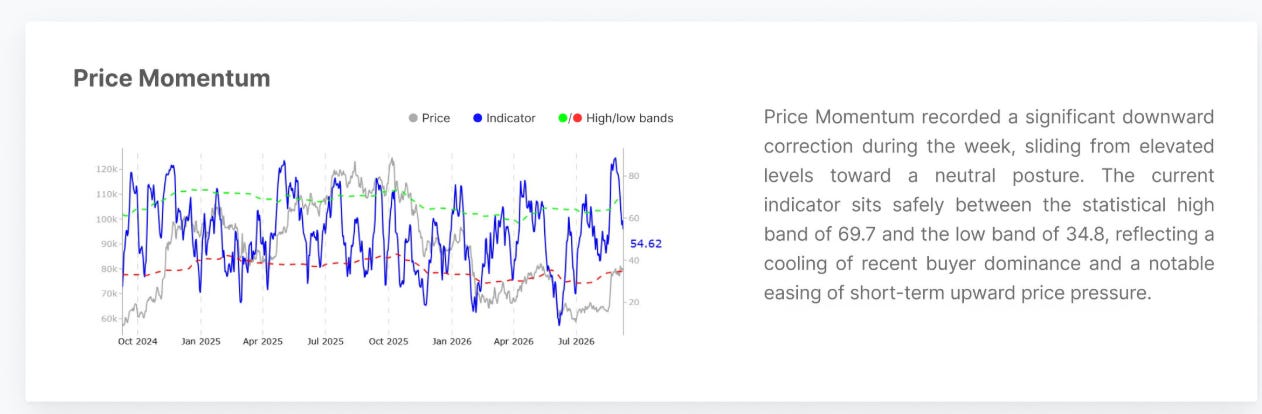
In spot markets, momentum dropped 30% to 54.6 and fell back from last week’s elevated reading to the middle of its statistical range. Spot trading volume was largely flat at $5.3 billion. Spot cumulative volume delta, or CVD, narrowed from -$84.9 million to -$29.6 million. glassnode said that pointed to easing sell pressure, though not yet to clear aggressive buying.
Derivative positioning, by contrast, kept building. Futures open interest rose 1.0% to $37.1 billion and remained above the upper bound of its statistical range. At the same time, long-side funding paid dropped 32.8% to $1.3 million. The report’s reading was that leverage is increasing, but the market is not showing the same strength in bullish chasing. Perpetual CVD recovered from -$423.2 million to -$62.1 million.
Options markets sent the clearest signal in the report. Options open interest increased 2.1% to $40.1 billion, also moving above the upper end of its statistical range. Volatility spread widened to -20.9%, while 25-delta skew fell from 0.79% to -2.05%. Both indicators dropped below the lower bound of their statistical range. According to glassnode, that means implied volatility is trading below realized volatility and demand for calls is unusually strong relative to puts.
Institutional demand, the report said, had started accelerating again. U.S. spot Bitcoin ETFs posted $681.2 million in net inflows, up from the prior $247.8 million, even as ETF trading volume fell 19.2% to $12.1 billion. ETF MVRV rose from -0.54 to 1.31 and moved above the upper end of its statistical range, implying ETF holders as a group were back in profit.
On-chain activity was softer. Entity-adjusted transfer volume fell 12.8% to $5 billion, fee volume dropped 4.8% to $213,000, and active addresses were broadly flat at 635,600. glassnode said those indicators remained within normal statistical ranges.
Capital flows were the strongest part of the report. Monthly realized cap change accelerated to 0.8%, while Hot Capital share climbed to 30.1%. Both were clearly above the upper end of their statistical ranges, which the report interpreted as evidence that price-sensitive new capital is still entering the Bitcoin network. Network profitability also remained elevated: 69.3% of Bitcoin supply was in profit, NUPL stayed well above its upper statistical bound, and the realized profit/loss ratio rebounded to 1.0, meaning realized gains and realized losses were roughly balanced.
From 300 tokens to 2: a screen for revenue growth not yet reflected in price
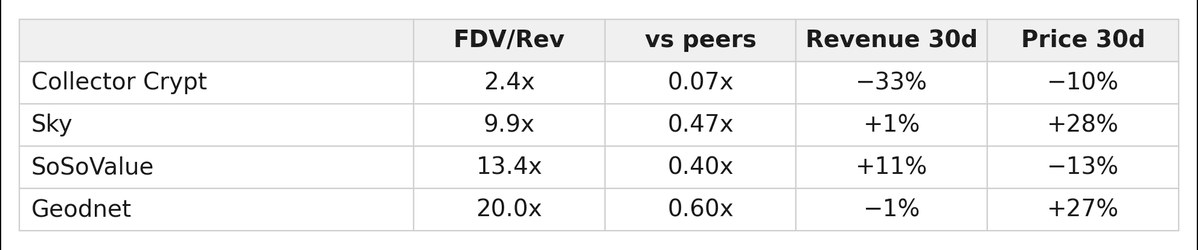
In another English thread, Edgy laid out a framework for hunting potential bargains among the top 300 tokens by market capitalization. The screen used three conditions: the token had to be cheap relative to similar projects, its revenue growth had to outpace the market, and its price had to lag its fundamentals.
The author compared the most recent 30 days with the previous 60 days. Price data came from CoinGecko, revenue data from DeFiLlama, and Claude was used to assist with the analysis. One key distinction in the method was the use of revenue rather than fees. Fees are what users pay in total; revenue is what the protocol actually keeps.
Jito was used as the example. The post said that for every $100 in fees generated by Jito, only about $6 remains with the protocol, while most of the rest is paid to validators as MEV tips. On a fee basis, Jito might look cheap at 4.5x. On a revenue basis, the valuation rises to 73x. Lido was said to retain about 6% of fees, and Uniswap about 8%. That is why, in the author’s view, fee-based screens can surface “cheap” names that are not actually cheap at all.
After the first cut, only 38 of the 300 tokens were considered genuinely measurable. While 117 had revenue data on DeFiLlama, only 38 were large enough, were not base-layer chains, and actually retained some revenue for the protocol itself. Morpho, Ondo, Celestia, The Graph and EigenCloud were excluded because they generate fees, but those fees do not accrue to the token.

The list then passed through a sequence of filters. Eighteen remained after the relative valuation screen. Nine remained after requiring revenue growth above the sample median. Three remained after requiring price performance below the sample median. After a stress test aimed at filtering out one-day revenue spikes, only two survived. The median project in the sample posted 18% revenue growth and 25% price appreciation. To pass, a project had to beat the first number on revenue growth while staying below the second on price performance.
The post also argued that using fully diluted valuation instead of circulating market cap removes several names that would otherwise look attractive. Hyperliquid was the main example: it traded at 28x revenue on circulating market cap, but 120x on FDV because only about one quarter of supply is in circulation.
In the end, just two names met all three conditions: Orca and Jupiter, both Solana DEX tokens. SOL rose 42% over the past month, so part of the effect may simply reflect DEX revenue catching up after the move in Solana itself. Still, the author said both protocols’ revenue growth outpaced Solana, while both tokens lagged SOL by a wide margin.
Jupiter posted $6.4 million in revenue over the past 30 days, up 44%, and retained 34% of fees, which the post described as one of the healthier ratios in the sample. JUP rose 22% over the same period, versus a 25% sample median, which meant it passed the last screen by only 3 percentage points.
Orca was cheaper and much smaller. Its revenue over the past 30 days was about $700,000, its market-cap ranking was No. 293, and revenue doubled over the period. The post added that the increase was spread across the month rather than concentrated in a few days.
Meteora also got a mention. It missed the revenue-growth threshold by 0.04 percentage points: revenue growth was 18.33%, while the cutoff was 18.37%. Its valuation was about 7.9x.
Anthropic’s reported $2 trillion IPO push
The final story in the roundup followed Anthropic’s IPO plans. Citing the Financial Times, Faizan Farooque wrote that Morgan Stanley had been discussing pricing with potential investors, though it remained unclear whether it would secure the lead-left role. After helping finance Anthropic, JPMorgan, Citigroup and Barclays were also expected to win important positions.
The piece said the lead-left slot matters because the bank in that role typically has significant influence over pricing, allocations and the broader sales effort. What the banks are competing for is not only prestige. A $2 trillion valuation for Anthropic would top SpaceX’s $1.77 trillion valuation from its June listing and set a new record for the IPO market. SpaceX raised $75 billion in its initial offering, later expanded to $85.7 billion after underwriters exercised the greenshoe option.
Anthropic’s own valuation climb has been rapid. Reuters previously reported that the company raised $30 billion in February at a $380 billion valuation. A May financing round of $65 billion pushed the valuation to $965 billion. At that time, Anthropic estimated annualized run-rate revenue at more than $47 billion. On the figures cited in the article, the company’s private-market valuation has more than tripled since February.
The timing matters for AI-linked equities. The article said SpaceX’s blockbuster listing showed investors were willing to support a massive valuation built in part on AI expectations, and Anthropic may push that enthusiasm further. For Wall Street, there is also a second prize. The Financial Times said Morgan Stanley and Goldman Sachs are both seen as contenders for top roles in any future OpenAI IPO. Securing a high-ranking role on the Anthropic deal could help cement a bank’s standing as an adviser to the next wave of trillion-dollar AI startups.
The piece also stressed how high the bar has become. Within a few months, investors would be asked to pay more than double Anthropic’s May valuation, which puts growth assumptions at the center of the deal. Anthropic’s annualized revenue in July was about $65 billion, below the more optimistic estimates from some investors that approached $80 billion. Competition is also intensifying, with OpenAI releasing a new flagship model and the two companies chasing enterprise and developer customers.
The IPO timetable has shifted as well. The Financial Times had earlier said Anthropic could file as soon as September and start trading in late September or early October, but Reuters later reported a delay. Under the current schedule described in the article, Anthropic is expected to file toward the end of September, begin its roadshow around mid-October, and potentially complete the listing before the U.S. midterm elections in November.
Reuters also reported that Anthropic was close to finalizing a roughly $15 billion revolving credit facility involving Morgan Stanley, Goldman Sachs, JPMorgan and Citigroup. That would create another financial tie between the banks and Anthropic before the IPO formally begins. The article ended by noting the scale of the ask: public-market investors would be supporting a company valued at $380 billion in February and $965 billion in May, now seeking a $2 trillion label. At the same time, Anthropic’s revenue growth, adoption of its technology by companies including Amazon’s AI unit, and its ability to raise large pools of capital were all cited as signs of strong demand for its technology.