
Changxin Technology moved quickly from reporting an unusually strong profit figure to committing fresh capital back into DRAM production and development.
On the evening of Sept. 28, Changxin Technology (688825.SH) released two investment announcements: a 24.1 billion yuan technology R&D project and a 10.8 billion yuan second-phase project for a memory wafer back-end testing base. The two plans bring the day’s total planned investment to 34.9 billion yuan. Of that amount, 18 billion yuan is expected to come directly from IPO over-allotment proceeds, with the remaining funding to be covered through capital increases and loans.
First-half profit reached 77.605 billion yuan
For the first half of 2026, Changxin reported revenue of 150.31 billion yuan, up 873.64% from a year earlier. Net profit attributable to shareholders came in at 77.605 billion yuan, compared with a loss of 2.332 billion yuan in the same period last year. Core business gross margin was 84.84%, while net operating cash flow totaled 131.156 billion yuan.
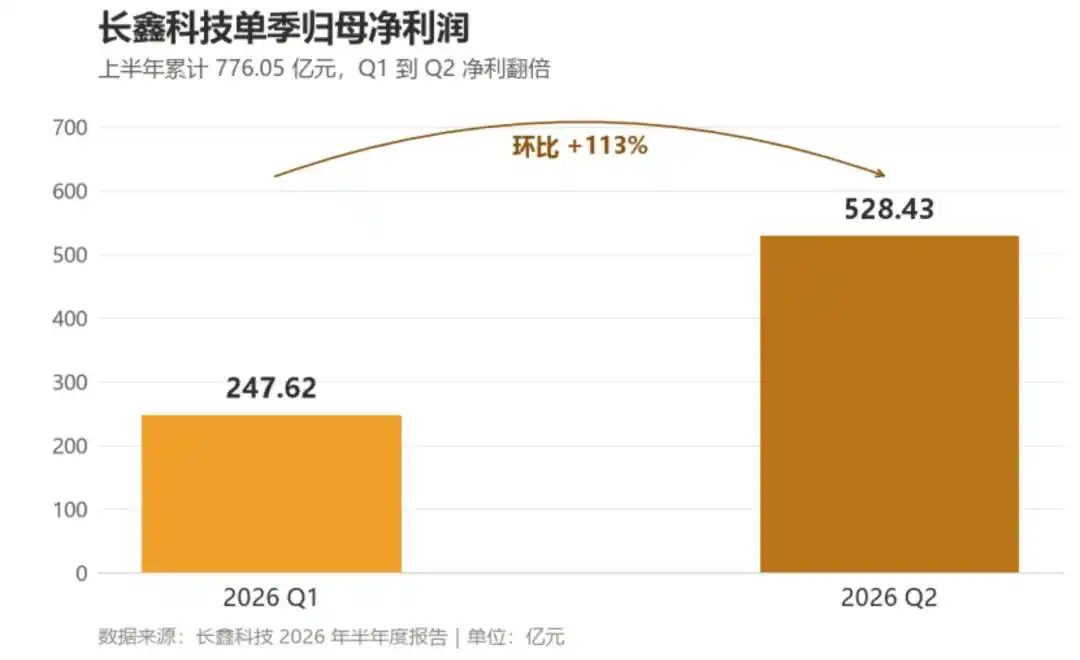
The quarter-on-quarter trend was also highlighted in the report. Net profit attributable to shareholders was 24.762 billion yuan in the first quarter and 52.843 billion yuan in the second quarter, a 113% sequential increase. The article said that by mid-year, profit gains from higher prices were still accelerating rather than peaking.
According to CFM Flash Market data cited in the piece, the global DRAM market reached $147.024 billion in the second quarter of 2026, up 55.9% from the previous quarter and marking a record high. After Samsung, SK hynix and Micron, Changxin Memory’s market share was said to be approaching 10%, placing it fourth globally, while its quarter-on-quarter sales revenue growth ranked first in the world.
R&D and testing take the bulk of the 34.9 billion yuan plan
The larger of the two projects is the 24.1 billion yuan R&D program, which has a 30-month construction cycle and is focused on DRAM process iteration. The report said the company completed a major step in September, when its fifth-generation DRAM process technology platform entered mass production. Using quadruple patterning, the platform reduced the half-pitch of the active area in the memory array to 11.95 nanometers, putting Changxin into the top tier of global mass-production processes.
Changxin’s R&D spending in the first half of the year totaled 6.859 billion yuan, up 87.38% year on year. On that basis, the 24.1 billion yuan project equals about 3.5 times its first-half R&D outlay.
The second project, the 10.8 billion yuan back-end testing base phase two, has a 37-month construction period. The company said in the announcement that as capacity continues to ramp and the product lineup expands, insufficient external packaging and testing capacity, along with limited supporting resources, has begun to constrain output. Once completed, the facility will take on DRAM wafer testing and module assembly, adding to Changxin’s back-end testing capacity under its IDM model.
The article stressed that the 34.9 billion yuan figure refers to the total planned investment for both projects. Of that, 18 billion yuan is planned to be funded with over-raised IPO proceeds. The report described the move as one that adds no new debt and does not dilute shareholders.
GigaDevice raises expected transaction cap with Changxin Group
On the night of Sept. 29, GigaDevice said it would raise its estimated 2026 cap for routine related-party transactions with Changxin Group from 5.711 billion yuan to 7.854 billion yuan. The reason listed in the filing was straightforward: foundry prices for DRAM products have risen with market conditions. The company also said estimated related-party transactions for January through April 2027 would reach 4.411 billion yuan.
The report compared those figures with GigaDevice’s own revenue base. The 4.411 billion yuan estimate covers only four months, yet it already exceeds the company’s full first-quarter 2026 revenue of 4.188 billion yuan and is close to half of its full-year 2025 revenue of 9.203 billion yuan. Actual related-party transactions between the two sides in 2025 were only about 1.18 billion yuan, meaning the quota expanded 6.7 times within a year.
Execution progress was another point in the article. From January to August 2026, actual transactions reached 3.596 billion yuan, leaving 4.258 billion yuan of headroom under the 7.854 billion yuan ceiling. The report said that implied procurement could still accelerate in the latter part of the fourth quarter.
U.S. memory stocks fell while Changxin shares also slipped in A-shares
The report contrasted Changxin’s spending plans with market pricing across global equities. Around the time the announcements were released, U.S.-listed memory names fell together: Micron closed down 2.61%, SK hynix fell 5.03%, SanDisk lost 3.65%, and the Philadelphia Semiconductor Index dropped 1.61% after being down as much as 3% intraday.
The backdrop, according to the article, was a jump in U.S. Treasury yields. The 10-year yield rose to 5.27% intraday, the highest since 2007, while the 30-year yield hit 5.57%, the highest since 2002.
In China’s A-share market, Changxin Technology closed down 4.27% on Sept. 28, with a total market capitalization of 3.65 trillion yuan, still ranking first on the A-share market cap leaderboard. The article framed this as a divergence: a domestic leader continuing to spend aggressively on expansion while overseas memory assets faced valuation compression.
On fundamentals, the report said some memory makers and server customers had already locked in long-term contract price ceilings, narrowing room for additional increases in non-contract orders quarter by quarter. It added that institutions broadly expect DRAM prices to keep rising in the third quarter, though at a slower pace.
The timeline points toward 2029
The article placed the 34.9 billion yuan commitment within the long-cycle history of the DRAM industry. Its argument was that major shifts in industry structure often happen through expansion decisions made during weaker parts of the cycle. In Changxin’s case, the second-phase testing base has a 37-month construction cycle, putting the start of operations roughly in 2029, a window the piece linked to a possible easing of the current shortage and a renewed search for a supply-demand bottom.
The report also cited product positioning. It mentioned the world’s first commercial mass production of LPDDR6, first launched in the Xiaomi 18 Fold, with a peak rate of 12800Mbps and capacity of up to 16GB. It also said Changxin’s 10667Mbps LPDDR5X had been deployed in the Nubia NaviX Ultra, describing it as the first mass-produced domestic application at that speed tier.
The article ended by pointing to three variables worth watching next: when a sixth-generation process after 11.95 nanometers will appear, how quickly the 7.854 billion yuan related-party transaction quota is used next year, and where the industry cycle stands when the testing base begins operating in 2029.
The original piece said it was compiled from public information and did not constitute investment advice. It was sourced from the WeChat account Laika Think Tank (ID: laikazk), written by AA and edited by G3007.