

ChangXin Technology has published the results of its IPO subscription, giving the market a clearer look at who secured shares in one of the year’s most closely watched deals.
On July 20, the company released its preliminary offline placement results and online lottery results. The announcement showed about 7.7 million winning numbers in the retail tranche, while 285 institutional investors received a final offline allocation of 2.173 billion shares. The final online allotment rate was about 0.4714%, and the offline placement ratio was about 0.1756%.
ChangXin formally opened subscriptions for both online and offline investors on July 16. A total of 9.4288 million retail investors joined the online subscription, alongside 285 offline institutional investors managing 10,907 accounts. Effective online subscription volume reached 816.92 billion shares, while effective offline subscription volume came to about 12.38 trillion shares.
Given the heavy demand, ChangXin activated a clawback mechanism and moved 10% of the shares remaining after the final strategic placement, or about 502 million shares, from the offline tranche to the online tranche. That raised the online allotment rate from about 0.4099% to about 0.4714%. The article says the figure was the highest among this year’s new listings and also set a record for STAR Market IPO allotment rates.
At the same time, 30 strategic investors, including the National Social Security Fund, were allocated a combined RMB 14.437 billion worth of shares, with lock-up periods ranging from 12 months to 36 months.
The market expects ChangXin to list on July 27 and potentially become the highest-valued technology stock in the A-share market.
Most market valuation estimates cited in the report place ChangXin above RMB 1 trillion. Huaxi Securities put its neutral valuation at RMB 2 trillion to RMB 3 trillion, saying RMB 2 trillion, or 30 times earnings, would be a reasonable level, while an optimistic case could reach RMB 3 trillion. A research report from SDIC Securities laid out four scenarios — conservative, neutral, optimistic and ultra-optimistic — corresponding to valuations of RMB 1 trillion, RMB 1.5 trillion, RMB 2.3 trillion and RMB 4.25 trillion.
Retail demand pushed the online tranche sharply higher
According to the announcement, after the over-allotment option and the online-offline clawback mechanism were applied, the final offline issuance totaled 2.173 billion shares, accounting for about 28.25% of the total issuance assuming full exercise of the greenshoe option. Of that, about 652 million shares were in the unrestricted offline tranche, while 1.521 billion shares were in the restricted offline tranche.
The online issuance expanded from an initial 669 million shares to 3.851 billion shares. Its share of the total deal rose from 10% at the start to 50.07% of the total issuance assuming full exercise of the over-allotment option.
That left retail investors with a much larger slice of the offer after strategic placement and the clawback adjustment. The report says the final online tranche of 3.851 billion shares far exceeded the roughly 800 million-share online issuance of China Resources New Energy earlier this year. It was described as the largest online issuance among 2026 IPOs and a record for STAR Market IPOs, making it the largest online tradable float in the board’s history.
The enlarged online book also drove the allotment rate far above the levels usually seen in new listings. The announcement showed that 9.4288 million retail investors took part, with effective subscription volume reaching 816.92 billion shares. About 7.7 million winning numbers were generated. The final online allotment rate was 0.47141739%, which the article describes as roughly five winning allotment numbers for every 1,000 numbers assigned.
Based on subscribed market value, the report says an investor would need roughly RMB 1.06 million in Shanghai market value to win one lot. It adds that this allotment rate was about 15.7 times the 0.03% average for STAR Market IPOs this year and marked the highest new-share allotment rate ever recorded on the board.
Caijing said many online investors and people around them had already posted screenshots showing they won shares in the offering. The company also reminded successful subscribers in its announcement that they needed to complete payment on July 20, 2026, the T+2 settlement date.
The article also ran through possible gains for retail investors. On the standard STAR Market basis of 500 shares per winning lot, a winning subscription in ChangXin would require an estimated payment of RMB 4,330. If the stock were to match this year’s median first-day gain of 289.48% for STAR Market IPOs, the profit from one lot would be about RMB 12,500. If it were to match the average first-day gain of 489.83%, the profit would be about RMB 21,200.
Using ChangXin’s issuance market value of about RMB 579.2 billion, the article says that if the company reaches a post-listing market capitalization of RMB 2 trillion, the implied share price would be RMB 29.9 and profit on one lot would be about RMB 10,600. At RMB 3 trillion, the implied price would be RMB 44.86 and the profit per lot would be about RMB 18,100. If the market value climbs to RMB 4 trillion, profit per lot could reach about RMB 25,600.
285 institutions shared the offline allocation
Alongside the retail results, ChangXin also disclosed the offline placement outcome for institutional investors.
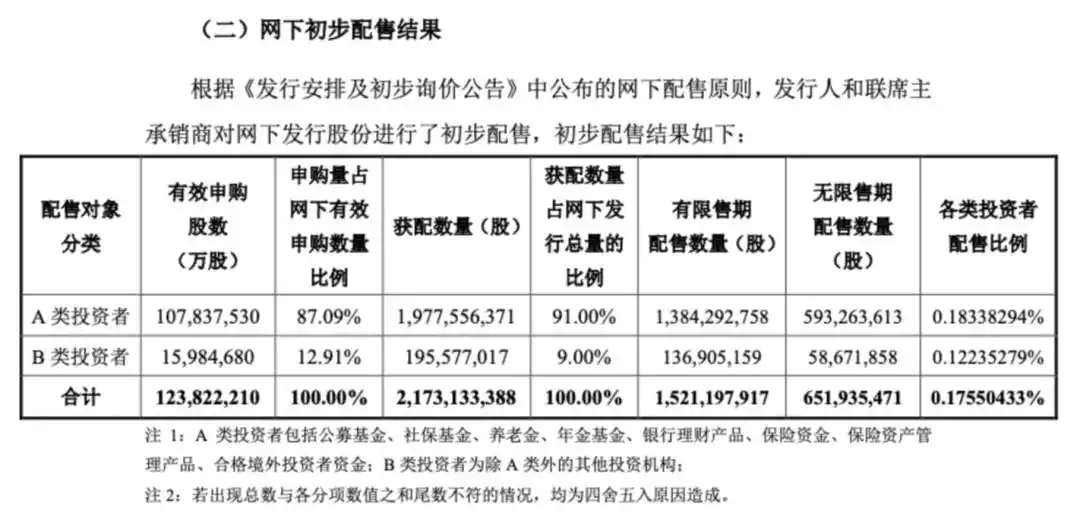
The company said 285 offline institutions managing 10,907 valid placement accounts joined the bookbuilding process, with effective subscription volume of about 12.38 trillion shares. Final allocation totaled 2.173 billion shares, implying an allocation ratio of about 0.1756%, below the 0.4714% online allotment rate for retail investors.
Of the offline allocation, 30% can be sold freely on the first day of trading with no lock-up, while 70% is subject to a mandatory six-month lock-up and will be released in one batch when that period ends.
Offline institutions were split into Class A and Class B investors. Class A investors — mainly mutual funds, social security funds, pension funds, annuities, bank wealth management products, insurers and QFII — received 1.978 billion shares, or 91% of the offline issuance. Class B investors — mainly private funds, broker proprietary desks, trusts and finance companies — received 196 million shares, or 9% of the total.
Among all institutions participating in the offline offering, Taikang Asset Management received the largest allocation. Across 614 products, it was allocated 174 million shares worth RMB 1.504 billion. Among mutual funds, E Fund, China Southern Fund and ICBC Credit Suisse ranked first, second and third by allocated shares, receiving 169 million shares, 139 million shares and 117 million shares. The corresponding allocated amounts were RMB 1.461 billion, RMB 1.202 billion and RMB 1.012 billion.
Liang Wenfeng led private fund allocations
Among private funds, Liang Wenfeng received the largest allocation.
The article says 153 funds under Ningbo High-Flyer Quant, which Liang founded, received placements. They included products such as High-Flyer CSI 500 Enhanced Xinxiang No. 16, High-Flyer CSI 300 Puhui No. 1, High-Flyer Golden Selection Market Neutral Exclusive No. 7 Phase 5 Private Securities Investment Fund, High-Flyer Quant 1000 Index Exclusive No. 14 Phase 2, and High-Flyer Quant Haoyue No. 24. Together, those products were allocated about 15.354 million shares worth about RMB 133 million.
Another quant institution under Liang, Zhejiang Jiuzhang Asset, had 41 products allocated a combined 4.895 million shares worth about RMB 42 million. Across the two entities, 194 private fund products received placements totaling 20.2497 million shares, with a combined allocation value of about RMB 175 million. The article says that was the largest allocation among private institutions. If ChangXin reaches a market capitalization of RMB 3 trillion after listing, Liang’s institutions could make about RMB 730 million from the IPO subscription.
Public information cited in the report shows that both Ningbo High-Flyer Quant and Zhejiang Jiuzhang Asset are controlled by Liang Wenfeng. The article describes them as the two core licensed private fund entities under High-Flyer Quant. As of 2026, High-Flyer Quant remained in the RMB 100 billion-plus tier by assets under management and was described as one of China’s leading AI-driven quant private funds.
Among private institutions, the second- and third-largest allocations also went to quant firms. Yanfu Investment and Jiukun Investment received about 17.6 million shares and 16.1 million shares respectively, worth RMB 152 million and RMB 139 million.
Valuation expectations and market pullback
Based on earlier market assessments cited in the article, ChangXin could reach at least a RMB 1 trillion market capitalization after its IPO given its earnings trend. Some institutions also estimated that, using 2026 attributable net profit of RMB 150 billion to RMB 200 billion and a 20x price-to-earnings ratio, the company’s market value could exceed RMB 3 trillion.
Still, the article flags recent weakness in technology stocks. Since July, global tech shares have gone through a notable correction. It says overseas memory stocks such as SK Hynix and Samsung Electronics have fallen by nearly 40%, while A-share memory names have also dropped sharply, with GigaDevice and Demingli down more than 50% from their highs.
“Quant institutions’ participation in offline IPO subscriptions is an investment strategy used to improve product returns. Many mainstream institutions take part, but they must meet certain qualification thresholds and market value requirements,” a private fund investment manager told Caijing.
The same manager also told Caijing that “the sharp recent pullback in global tech stocks may affect ChangXin’s post-listing share performance to a certain extent.”
The article was originally published on the WeChat account Dushu Yizhi (ID: dushuyizhi007) and written by Kang Guoliang.