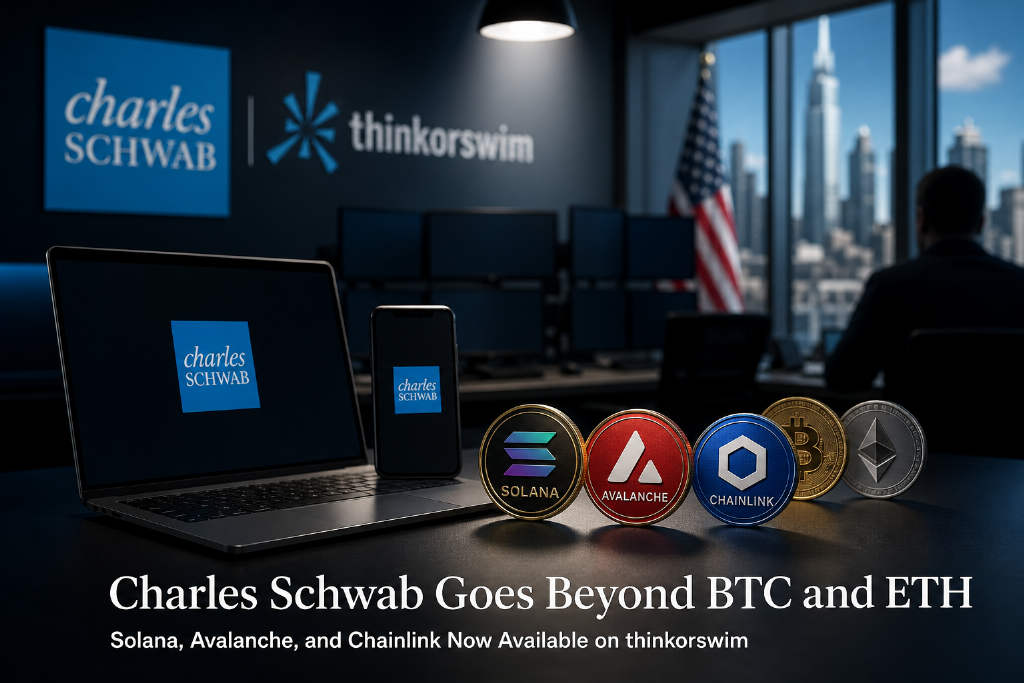
Charles Schwab said Thursday it plans to add Solana, Avalanche and Chainlink to its crypto trading platform in the coming months, extending its offering beyond Bitcoin and Ethereum. The company did not provide a launch date.
The expansion follows Schwab’s rollout of direct Bitcoin and Ethereum trading to select retail clients about three months ago. Before that, customers could gain crypto exposure through exchange-traded products and shares of companies including Coinbase and Strategy, but they could not buy cryptocurrencies directly.
Joe Vietri, Schwab’s head of digital assets, said in a statement: "With this expansion, clients will have more choices to build a digital asset allocation alongside the investing and banking experience they know and trust at Schwab." He added: "These additions are consistent with our approach to provide clients with access to familiar cryptocurrencies backed by an ecosystem of education, tools, resources, and support to make informed decisions about how crypto might fit into their broader investing goals."
What the three tokens do
Schwab described Solana as a network built for fast, inexpensive transactions and said it hosts applications for trading, payments and gaming. Avalanche, the company said, allows businesses and developers to create blockchains tailored to specific applications. Chainlink connects blockchains to outside information, supplying smart contracts with data such as asset prices.
Where trading will be available and what it will cost
Clients will be able to buy and sell the three cryptocurrencies on Schwab’s website, mobile app and thinkorswim trading platform, according to the company. Each trade will carry a fee of 75 basis points, or 0.75%. On a $1,000 transaction, that works out to $7.50. Schwab said the pricing is among the industry’s lowest.
Schwab’s timeline into spot crypto trading
In 2024, Schwab said it would enter the market once U.S. regulations offered a clearer path. The company later confirmed plans to start with Bitcoin and Ethereum in April 2026, followed by a phased rollout to clients in May.
Other digital-asset products under consideration
Schwab is also weighing other digital-asset offerings. CEO Rick Wurster said in 2025 that the company wanted to explore a dollar-pegged stablecoin, though it has not announced one.