
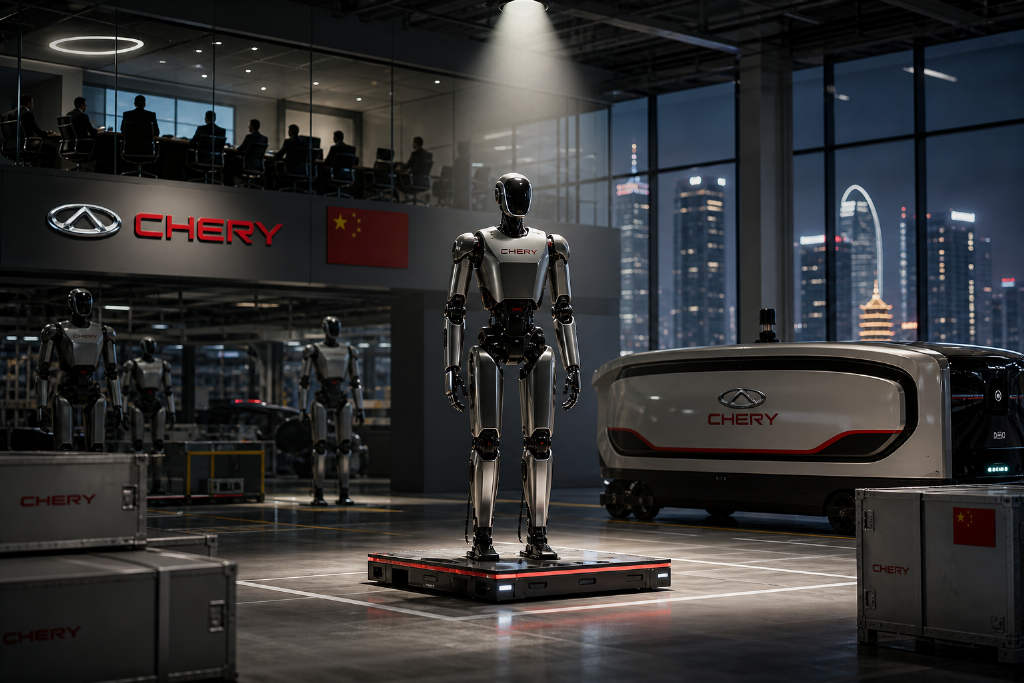
Mojia Robot, a robotics company under Chery, is making preparations for an IPO less than two years after its launch.
At the 2026 World Robot Conference, Zhang Guibing, Chery executive vice president, general manager of the international business group, and general manager of Mojia Robot, told Reuters that the company is preparing for a public listing. He said Mojia is discussing several possible listing venues, plans to lift global deliveries to 10,000 units in 2027, and wants to enter the top tier of the global robotics industry.
Zhang said access to the capital markets could provide funding for follow-on technology investment while also improving governance, transparency, and operating standards.
Phoenix Weekly Finance asked Mojia Robot and its parent company Chery Automobile (09973.HK) about the IPO timetable and possible listing venue. As of publication, no effective response had been received.
Angel round lifted valuation to RMB 2.5 billion
Mojia Robot was established in January 2025 with funding from Chery Automobile and initial registered capital of RMB 100 million. On Jan. 21, 2026, the company completed an external capital increase in its angel round, raising more than RMB 100 million in total and reaching a post-money valuation of RMB 2.5 billion.
Investors in that round included Bethel Automotive Safety Systems (603596.SH), Fuchun Dyeing and Weaving (605189.SH), AgiBot, IDG Capital, Wuhu Sci-Tech Innovation Group, and Fengming Venture Capital, among other industrial and financial backers.
After the capital increase, Chery Automobile held 76.80% directly. Three employee shareholding platforms held a combined 19.2%, with Chery chairman Yin Tongyue serving as the appointed representative. Outside shareholders together held about 4%.
Bai Wenxi, vice chairman of the China Enterprise Capital Alliance and a specially appointed mentor at the Graduate School of the Chinese Academy of Social Sciences, told Phoenix Weekly Finance that the 4% outside stake suggests leading venture funds and industrial capital are still making relatively small trial bets. In his view, there is still substantial dilution room for later Series A and Series B rounds. He said Mojia would need at least two to three more financing rounds before an IPO to support the capital expenditure required for 10,000-unit capacity.
Zhang Xinyuan, a think tank expert at the Shanghai Technology Exchange, told Phoenix Weekly Finance that Mojia’s RMB 2.5 billion post-money angel valuation sits in the higher range for early-stage humanoid robotics projects. If the company wants to keep bringing in strategic investors, he said, its shareholding structure still needs moderate optimization.
He added that a parent company retaining a high ownership ratio is not unusual in spin-off listing cases. More often, it reflects incubation led by an industrial parent. The key issue, he said, is whether governance is clear and business independence is sufficient.
Chery has prior listing precedents
Mojia’s move toward independent capitalization does not appear to be an improvised step by Chery.
Chery has prior examples in capital markets. Components maker Bethel (603596.SH) listed on the Shanghai main board in 2018 and became the first Chery-affiliated A-share listed company. Robotics and automation company EFORT (688165.SH) listed on Shanghai’s STAR Market in 2020 after being incubated through cooperation between Chery Group and the HIT Robot Research Institute.
Police robots are the main order story for now
Mojia’s most prominent commercial narrative at this stage centers on police robots.
At the global launch event for Chery Mojia, Chery Group chairman Yin Tongyue said the company’s "Smart Police" robots had secured contracts for 1,030 units and completed a concentrated delivery of 110 units, which he said marked Mojia’s full entry into a new phase of scaled commercial deployment.
Delivered Smart Police robots are already in use in scenarios including school-zone patrol posts in Wuhu, the Jiangyin Marathon, and events in Changzhou. Their tasks include directing traffic during morning and evening peaks, photographing illegal parking, handling non-motor vehicle violations, and providing traffic support for events.
An angel investor focused on artificial intelligence told Phoenix Weekly Finance that every new scenario for humanoid robots requires large amounts of on-site data and repeated algorithm iteration for adaptation. Police, retail guidance, and medical applications also impose high reliability requirements, meaning robots cannot stall frequently.
In that investor’s view, weak mass production leads to limited data, limited data slows scenario adaptation, and failure to enter scenarios reduces the incentive for mass production. That creates a circular bottleneck.
According to a Bethel announcement, Mojia Robot recorded revenue of RMB 3.0285 million and a net loss of RMB 5.1046 million in the first three quarters of 2025. As of the end of September, total assets stood at RMB 108 million and net assets were RMB 94.8954 million.
From 3,000 cumulative deliveries to a 10,000-unit target
At the 2026 World Robot Conference, Zhang said Mojia has delivered more than 3,000 robots globally to date, with 2,000 of those units going to overseas markets. He said deliveries of humanoid robots are expected to rise to 10,000 units next year.
Zhang had referred to plans for capacity in the 10,000-unit range earlier as well. In January 2026, at an event in Wuhu marking the concentrated delivery of 120 robot dogs from the Mojia robot park, he said the company had built two standardized robot production lines. One robot-dog production line already had annual capacity of 15,000 units.
Bai said capacity itself is not the core bottleneck. Scenario validation is. Mojia can share Chery’s established supplier base in motors, controllers, and structural components, giving it a cost advantage over pure startups. Still, moving from contracts for thousands of units to deliveries of 10,000 units will depend on whether paid scenarios can be validated at scale.
Overseas push started with Chery 4S stores in Malaysia
Mojia’s overseas business began in Malaysia. Its robot "Moyin" started working in a Chery 4S store there in 2025, taking on customer reception, product explanations, and standardized training, with support for 11 languages. In July 2026, Mojia also launched its first AI experience center in Vietnam.
Zhang said in media comments that when Mojia ships a robot to Malaysia, it does not have to build an after-sales support system from scratch. Instead, it can directly reuse the mature network Chery has built over 30 years. According to him, Chery’s overseas channels, parts centers, localized service network, data compliance teams, and regional subsidiaries are all reusable assets.
Bai said there is still a period of adjustment ahead in sharing and retrofitting robot and auto production lines. Even with Chery’s manufacturing system behind it, global capacity for key upstream humanoid-robot components such as high-precision reducers, torque motors, and joint modules is limited. He said the challenge is not only manufacturing capability and order acquisition, but also supply-chain stability and elasticity.
At the 2026 World Robot Conference, Mojia displayed footage of applications in 12 domestic and overseas auto 4S stores. Overseas stores in Malaysia, Thailand, and South Africa were shown in recorded form. Zhang said Mojia’s overseas business now covers more than 60 countries and regions.
Zhang Xinyuan said Mojia’s customers at this stage are, in essence, Chery automobile dealers rather than independent business clients. In his words, Mojia relies on Chery’s vehicle-sales channel through 4S stores to ship products overseas, and robot budgets may be bundled with whole-vehicle marketing expenses.
Auto industry money crowds into robotics
Zhang said at the World Robot Conference that China’s robotics industry now resembles the electric-vehicle sector several years ago, with many companies emerging quickly and competition likely to become very intense, especially on cost.
On Aug. 24, three Chinese EV startups disclosed important developments in robotics at nearly the same time. XPeng Group (09868.HK) said its humanoid robotics business, Pengxing, completed a first financing round of more than $900 million at a post-money valuation above $6.3 billion. Ren Shaoqing, head of smart driving at NIO, founded an independent embodied-intelligence company, and NIO (09866.HK) will invest as a strategic shareholder and pursue deep cooperation. On Leapmotor’s (09863.HK) earnings call, vice president Li Tengfei confirmed for the first time that the company has its own plans in robotics and said details would be released soon through a formal announcement.
The angel investor cited by Phoenix Weekly Finance said nearly 20 major automakers at home and abroad, including Tesla, BYD, Chery, GAC, Changan, XPeng, and Li Auto, have already entered the humanoid robotics track. In that investor’s view, such a dense influx of industrial capital will make the field extremely crowded over the next 18 to 24 months.
That investor said an industry shakeout is approaching and Mojia needs to secure enough funding before the window closes. In his view, an IPO is the fastest route.
The original report was published by the WeChat account Phoenix Weekly Finance and written by Xu Mengyi. MarsBit republished the piece.