
"It is like a war," SK Group Chairman Chey Tae-won said. "Everybody wants to buy memory chips."
In a CNBC interview, Chey described artificial intelligence as the force reshaping the memory business after years in which the sector was defined by classic semiconductor boom-and-bust cycles. In the past, memory makers expanded output when demand rose, only to face oversupply and steep price declines later. Chey’s view is that AI has changed the pattern.
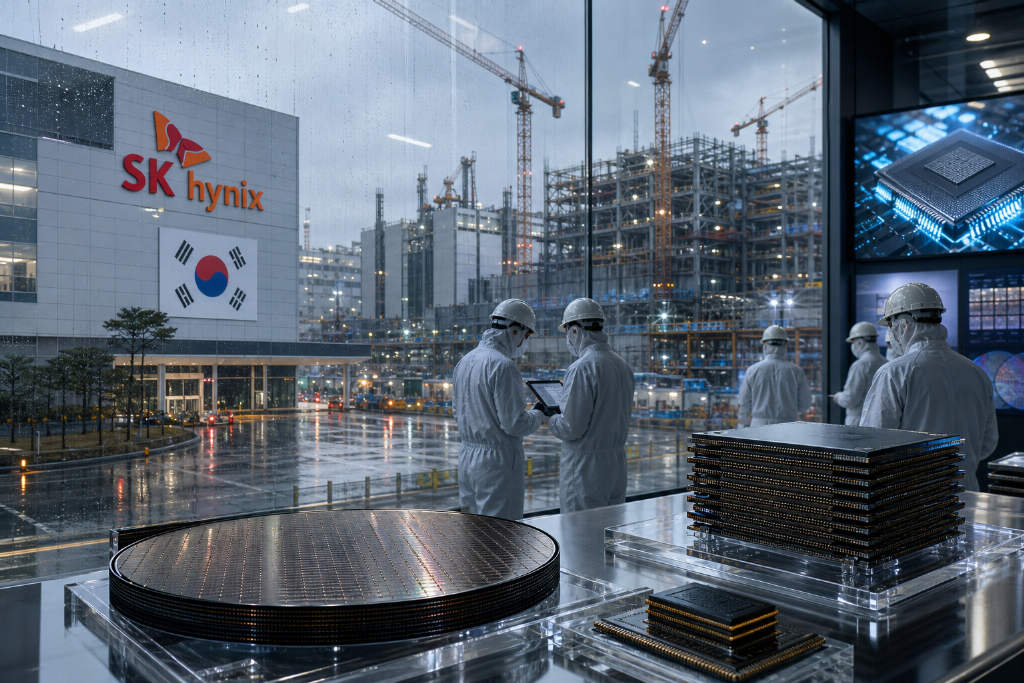
In 2025, SK Hynix held nearly half of the global high-bandwidth memory, or HBM, market, according to the report, and became one of the key suppliers to AI chip leaders including Nvidia. To position for the next wave of demand, SK Hynix is pushing ahead with what was described as the world’s largest memory wafer fab expansion program, with $72 billion earmarked to lift capacity to three times current levels by 2034.
Chey’s rationale was straightforward: AI needs more and more memory. Using 2025 as the baseline, he said the number of AI agents could grow about tenfold over the next five years. Over the next decade, total memory demand could reach nearly five times current industry capacity. At the same time, HBM is being co-designed with AI processors, which in his view means memory is no longer simply a standardized commodity.
He also acknowledged the risk side. The memory industry has a long history of overbuilding, while capacity expansion takes four to five years and customer demand is already nearing a doubling. Long-term agreements, joint fabs and "Memory as a Service" are among the tools SK Hynix is considering to spread that risk.
Chey does not think cyclicality will disappear, but he believes the cycle may become longer. That, he said, is one of the main reasons SK Hynix is willing to expand on such a large scale.
Why memory matters more inside SK Group
Asked how important memory is to a group with more than 100 subsidiaries, Chey said the AI era requires huge amounts of memory and AI itself is a heavy consumer. He compared AI to a four-year-old child: still small today, but likely to need more functions, more experience and more knowledge as it grows. All of that knowledge has to be stored somewhere.
He made the same comparison with humans, arguing that adults accumulate memory and wisdom over time, and AI follows a similar logic. That is why, in his view, AI requires large volumes of memory chips. He said SK Hynix is already the biggest subsidiary within SK Group.
Chey added that AI also needs energy and network support. SK Group has energy and telecom businesses, and those units are involved in building future AI data centers. From that angle, he said, the group has a relatively complete business portfolio. For now, though, SK Hynix is clearly the most important part of the group.
When asked whether he had seen today’s AI opportunity back in 2012, when SK entered semiconductors, Chey said he had not predicted an AI boom. At the time, SK already had energy, chemicals and telecom operations, but he wanted to add more globally oriented businesses. The world was moving into a digital era, he said, and he believed a digital society would need a great deal of memory because knowledge and data both had to be stored. That was why he decided memory chips could represent the future. He called it a very risky bet, and said it has turned out to be one of the biggest and most successful bets of his life.
The logic behind the $72 billion expansion
Chey tied the expansion case directly to AI agents. He said the future will be shaped by AI agents, and from a 2025 base their numbers could rise about tenfold within five years. Once they are spread across the world, they will need vast amounts of memory. Based on that view, he sees total memory demand over the next ten years reaching nearly five times current capacity.
That is why, he said, supply has to grow quickly to meet global demand.
On his network in AI, Chey said his friends in the field are mainly leaders of hyperscale companies, including Nvidia CEO Jensen Huang, Microsoft CEO Satya Nadella, Google CEO Sundar Pichai and Meta CEO Mark Zuckerberg. He said these people are basically customers of SK Hynix, and he meets them from time to time.
As for Taiwan Semiconductor Manufacturing Co., or TSMC, he said that of course includes C.C. Wei. About a month ago, Chey said, he met Wei in Taiwan and the two had dinner together, exchanging a lot of information and views about the future. He said Wei also believes AI is a real technology. Chey’s point was that more memory alone does not help if TSMC capacity is tight and GPUs cannot be built, while bigger foundry capacity without enough HBM is not enough either. In his telling, that makes cooperation essential.
Asked how he secures enough capacity from TSMC’s manufacturing lines when everyone is lining up for it, Chey said Wei knows which parts are critical because without them there is no AI production, especially on the GPU side. Demand is overwhelming whatever capacity exists, he said, but he believes TSMC will make substrate chips for SK Hynix.
Nvidia is the most important customer, but not the only one
Chey was direct about Nvidia’s place in SK Hynix’s business. Nvidia is the most important customer right now, he said. The company develops new products and technologies every year at a pace he admires, and SK Hynix is working with Nvidia on new chips and new technologies.
He also said Nvidia is one of the strongest companies in the world today and is likely to remain dominant. In his view, Nvidia’s strength goes beyond GPUs. Huang is also working with other companies to build an AI ecosystem, creating different kinds of partnerships rather than only growing Nvidia itself.
On the risk of concentrating so much around a single customer, Chey said there would be no AI ecosystem without Nvidia. Nvidia provides many of the solutions for AI infrastructure, and SK Hynix has to support that effort. Even so, he said, Nvidia is not the company’s only customer. Google, Microsoft and other hyperscalers are also customers, and some are designing their own chips. Nvidia is the largest today, he said, so SK Hynix wants to serve the biggest customer, but that does not mean it depends on only one name.
"Chip inflation" and the supply crunch
Asked whether customers are helping with capacity buildout, Chey said they are consistently asking for more chips and SK Hynix is trying to come up with solutions. The problem is time. Expanding output takes at least four to five years.
He said next year could be the hardest one because memory companies are not yet ready with the extra capacity even as demand continues to grow. This year, he said, demand will double, and almost all customers are asking for close to twice as many chips. That is why he described the situation as a war: everyone wants more memory chips because without them they cannot produce AI computing equipment and AI chips.
Chey said the shortage is spilling over into other industries. PC makers, smartphone makers, consumer electronics companies and even automakers are struggling to secure chips, with some prices rising too quickly. One of his jobs, he said, is to protect the broader memory market as much as possible by expanding capacity as quickly as he can.
On reported memory price increases of 40% to 50%, Chey called the situation "chip inflation." He said chip prices have climbed so much that even Apple has had to raise prices for flagship products, which in turn pushes up prices across society. He said he does not want to see that happen, but it already has, and he does not have a short-term fix. That is another reason for the large wafer fab investment.
SK Hynix has already announced a plan to double capacity within five years, he said, but for most customers even that is not enough. The constraint is physical reality. Some things simply cannot be done immediately, and that is what he called the current AI bottleneck.
When asked whether reliance on HBM and DRAM, which together account for about three-quarters of SK Hynix revenue, creates risk if AI chips adopt different technologies in the future, Chey said technology always evolves. DRAM is the base, HBM is built by stacking on top of it, and future options could include CXL, or Compute Express Link, and other technologies for AI data centers.
There may be several paths from here, he said, but the company’s objective is clear: expand memory capacity by every possible means. The end goal is to lower the cost of AI tokens. In his view, token prices are still too high and need to come down, otherwise people will spend too much money on them.
How SK Hynix says it will avoid overbuilding
The memory industry has repeatedly suffered from excessive capital spending and oversupply. Chey said SK Hynix has stayed careful. Although the company has just announced a large expansion plan, he said that plan rests on the existence of real demand, and the company checks demand before every expansion decision.
Customers have already signed some long-term agreements, he said, and SK Hynix has different ways to share risk with them, including joint wafer fabs and "Memory as a Service." In his framing, this goes beyond simply selling chips.
Chey said SK Hynix wants neither oversupply nor undersupply, so it keeps checking demand. HBM adds another layer of complexity. Demand for AI accelerators is high across countries and markets, he said, but expanding HBM is difficult because it consumes more than four times as much wafer space as conventional DRAM. That takes up a great deal of wafer capacity, making broader capacity expansion necessary.
He said customers, not just SK Hynix, want long-term contracts because they need assurance that memory supply will be available. If customers focus only on short-term profit, he said, that does nothing to ease today’s supply shortage. The company plans to review demand year by year and extend the agreements so both sides can keep confirming needs and avoid both overinvestment and underinvestment.
Asked whether hotels across South Korea are crowded with tech companies coming to sign long-term supply contracts, Chey answered yes. He then repeated that next year could be the worst year for chip shortages. A lot of people want to buy chips, but SK Hynix’s supply is limited. Every time he meets customers, he said, he feels sorry because if everyone wants all the chips, he cannot provide everything.
2026 and the U.S. manufacturing question
Looking back at a difficult 2023 and the near-bankruptcy episode in 1997, Chey said he does not believe this time is entirely different. One thing is different, though: the company now has to deal with a new "baby," meaning AI. He said AI has already changed society. It consumes large amounts of energy, electricity, materials, silicon and even water. It also creates intelligence.
In his view, AI can help reduce human labor, narrow differences between people and ease social tension. It could create more room for a happier society. He added, though, that there are dangers and those need to be watched carefully.
On where new fabs can be built, Chey said power and water matter, but ecosystem matters more. A large memory wafer fab needs support from roughly 600 to 700 different companies providing materials, chemicals and services. Without that, he said, such a factory cannot really survive. Every country wants a memory fab on its own soil, but ecosystem support is one of the biggest issues.
If he can bring that ecosystem with him, Chey said, he would build anywhere, including in the United States and elsewhere in the world. SK Hynix’s research team is studying where opportunities are realistic, how quickly new wafer fabs can be built and how memory shortages can be eased.
Asked about U.S. customers who want SK Hynix to build a full memory fab in the United States, Chey said the company is studying the matter but cannot yet announce a location. Site, timing, structure and many other details still need to be decided, and many contracts still need to be signed. He said the company is not looking only at the U.S. but at global expansion opportunities, and that he is willing to do it if the right location can be found. "To be honest, we have been studying it for over a month," he said.
As for whether the U.S. government or customers have directly asked him to build in the country, Chey said U.S. customers want local manufacturing. He said he has not spoken directly with the U.S. government. This is a commercial matter, he said, and if customers want it, he is willing to explore the opportunity with them.
What he sees as SK Hynix’s edge
Compared with Samsung Electronics and Micron, Chey said SK Hynix has a different history. The company spent more than a decade under court protection, and that left it "hungry." He described that as a fighting spirit and said the team works very well together.
Technically, he said, SK Hynix and its rivals are on roughly the same level. In resources, some competitors may be larger, but SK Hynix also has enough resources, funding and engineering capability, with no huge gap. What can change the competitive picture, he said, is teamwork and spirit.
U.S. listing, a new R&D center and a $10 billion AI company
Chey said listing in the United States was a major step and SK Hynix’s first move into the global financial market. New shareholders and financial backers create a large opportunity, he said, giving the company more financial and market options and helping it offer better incentives to potential engineering talent in the U.S.
For that reason, he said, the company decided to open a new R&D center in the United States and move forward with the Indiana wafer fab. SK Group is also considering many other investments, especially in AI.
Asked why it also wants to establish a $10 billion AI company in the U.S., Chey said SK wants access to U.S. technology. The company can bring its own memory technology, but it also needs system simulation and other AI technologies. Over time, he said, SK may be able to offer better solutions for AI data centers, AI infrastructure and AI software, because software has to connect with hardware.
He said the U.S. has excellent software engineers and a strong software industry, while South Korea, Taiwan and Japan have strong manufacturing capabilities. Those strengths can complement each other. That is why the AI investment company is being set up, he said.
A cycle that may not disappear, but may stretch out
Chey closed by returning to what he sees as the structural change in demand. In the past, he said, the memory business was tied mainly to population because population determined the number of hardware devices. Without those devices, consumption was naturally limited. A person would not buy dozens of smartphones in a single day, so the market had a built-in ceiling.
The AI era looks different to him. One person could eventually have 10 different AI agents working on their behalf, and every one of those agents would need more memory. That expands the size of the market.
He said he does not want to claim memory has become non-cyclical, but he does think the cycle will change and may become longer. He also acknowledged that he cannot see the full future with certainty. Still, the way the business is running now does not look like the old memory model to him. For SK Hynix, he said, this is a turning point and he sees a structural shift.
Right now, customers are telling the company they have large product demand, and his job is to deliver. He said he cannot say exactly when or how the next boom or downturn will arrive, but strong demand momentum in the near term is, in his view, clear.