
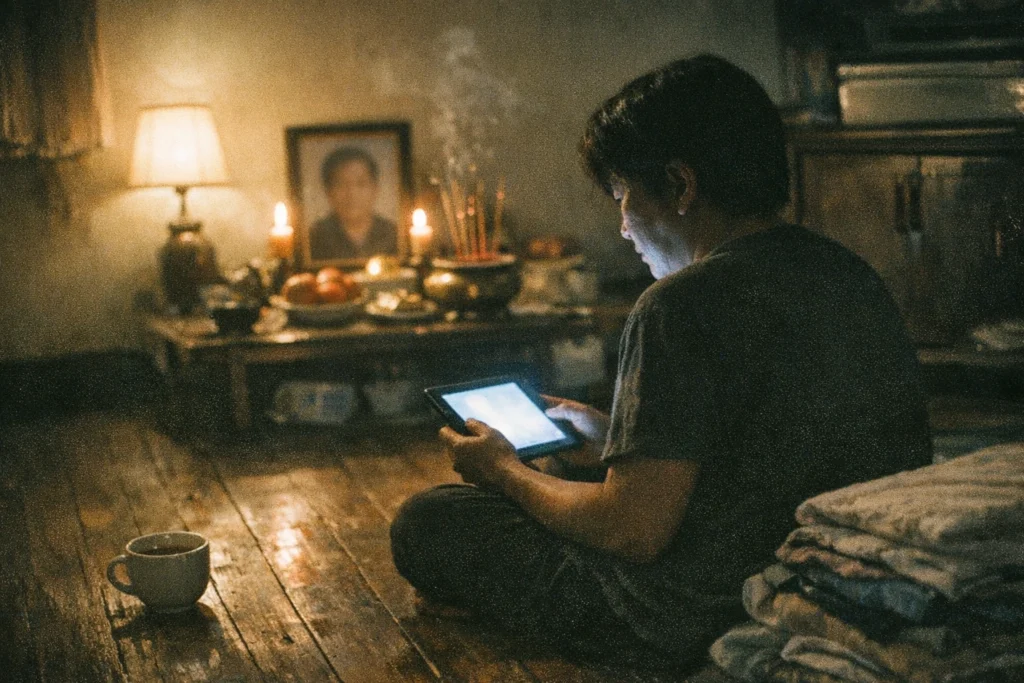
Six years ago, South Korean broadcaster MBC assembled a full production team and spent eight months rebuilding the appearance and movements of a deceased child for the documentary Meeting You. The result was a VR reunion in which mother Jang Ji-sung met her daughter Na-yeon, who had died in 2016 at age seven. Today, according to BlockTempo, similar services in China can start at just 10 yuan on Taobao.
The report describes a full commercial chain around AI-based re-creations of the dead. At the bottom end, services priced from 10 yuan to a few hundred yuan typically offer a short animated clip or synthesized voice. A middle tier provides AI voice products that use recordings left by the deceased for real-time text and voice interaction, with prices in the thousands of yuan. At the top end are full digital humans, built by feeding photos, voice, habits, and patterns of thought into large models, with customized work generally starting at 50,000 yuan.
A tiered market has already formed
BlockTempo said the sector is no longer limited to tech companies. Chinese funeral services company Fu Shou Yuan has introduced three products: a text-and-image version, a synthesized voice version, and a customized digital human. That effectively places the service directly after conventional funeral arrangements.
Pricing models are also shifting. Some platforms now offer “digital immortality” subscriptions, charging 1,980 yuan for the first year and 2,980 yuan for renewal in the second year. Critics cited in the report argue that the model monetizes grief by locking families into ongoing payments.
The contrast with the MBC project is stark. What once required a dedicated team and months of production is now sold in standardized packages. The Meeting You segment drew more than 20 million views on YouTube, but it also sparked heavy criticism. Some media commentators said it commercialized personal suffering, while Jang later said the experience felt like a good dream.
Researchers are focused on the business model, not only the technology
A paper from the University of Cambridge’s Leverhulme Centre for the Future of Intelligence, titled Griefbots, Deadbots, Postmortem Avatars, warns that the emerging “digital afterlife industry” may keep avatars running through subscription fees, insert advertising into conversations, or even use simulations of the dead to promote sponsored products.
Researchers and ethicists have also raised concerns about how these systems affect grieving families. Jessica Heesen, an ethics scholar at the University of Tübingen in Germany, described digital replicas of the dead as a kind of painkiller, saying they may keep survivors from confronting the loss itself. The report says discussion in Taiwan has pointed to the same risk: overreliance could lead to what it calls pathological grief, leaving family members unwilling to return to ordinary life.
One proposed response is to add a DDNR clause — short for digital do-not-reanimate — to a will, making clear in advance that a person does not want to be recreated by AI after death. BlockTempo cited a Japanese survey showing that more than 60% of respondents oppose being revived by AI after they die.
Japanese funeral industry participants quoted in the report draw a line between reappearance and resurrection. One practitioner said a deceased person recreated by AI is not the same as reviving the dead, adding that “not being exactly like the real person is what gives it value,” because if the replica becomes too close, surviving relatives may no longer know who they are speaking to.
Taiwan has already entered the legislative debate
On the regulatory front, Taiwan has moved faster than many might expect. Legislator Weng Hsiao-ling put forward a proposal on July 7 arguing that using “digital resurrection” to insult the dead should be punishable.
A report by the legislature’s legal bureau recommended adding provisions to the Criminal Code to address the use of computer synthesis and related techniques to create false images that abuse the deceased. Under that proposal, penalties could be increased to up to two years of imprisonment.
The report argues that deepfake-style content can be more damaging than traditional defamation. Photos and recordings are static and one-way. AI chatbots create an interactive simulation that can respond and display emotion, changing the nature of how a person’s image can be distorted after death. If such tools are used on deceased political figures or former heads of state, the consequences could be more severe.
Mainland China has taken a more direct regulatory approach. According to BlockTempo, the Cyberspace Administration of China has already moved to crack down on the industry chain built around AI resurrection services.
A core legal question remains unresolved
Even with regulatory discussions under way, the report says one crucial issue is still unsettled: who has the right to rebuild a person’s digital identity.
Current practice often relies on consent from surviving relatives. But families may disagree among themselves, and the person at the center of the issue can no longer speak for themselves. That leaves a gap around authorization, posthumous personality rights, and control over a deceased person’s digital likeness.
Prices and legal proposals at a glance
- Basic services on the Chinese market range from 10 yuan to a few hundred yuan for simple animated images or synthesized voice.
- AI voice products that allow real-time interaction cost in the thousands of yuan.
- Fully customized digital humans generally start at 50,000 yuan.
- Some providers use subscriptions, charging 1,980 yuan in year one and 2,980 yuan on renewal in year two.
- Taiwan has not completed legislation, but legal changes were proposed on July 7, and the legal bureau suggested penalties of up to two years in prison.
What began as a high-cost media experiment is now a commercial service with clear pricing, funeral industry integration, academic scrutiny, and an active legal debate over the limits of digital re-creation after death.