
China’s 2026 autumn school term has brought a broad set of changes to primary and secondary education. Artificial intelligence literacy classes are moving into more school timetables, revised textbooks are reaching every grade of compulsory education, science inquiry is being organized around hands-on work, and new requirements are affecting school transitions, class placement, high-school admissions and extracurricular childcare.
The changes are appearing both in everyday teaching and in school administration. Some are already visible in classrooms; others govern how students are placed into classes and how schools recruit them.
AI classes gain clearer schedules and limits
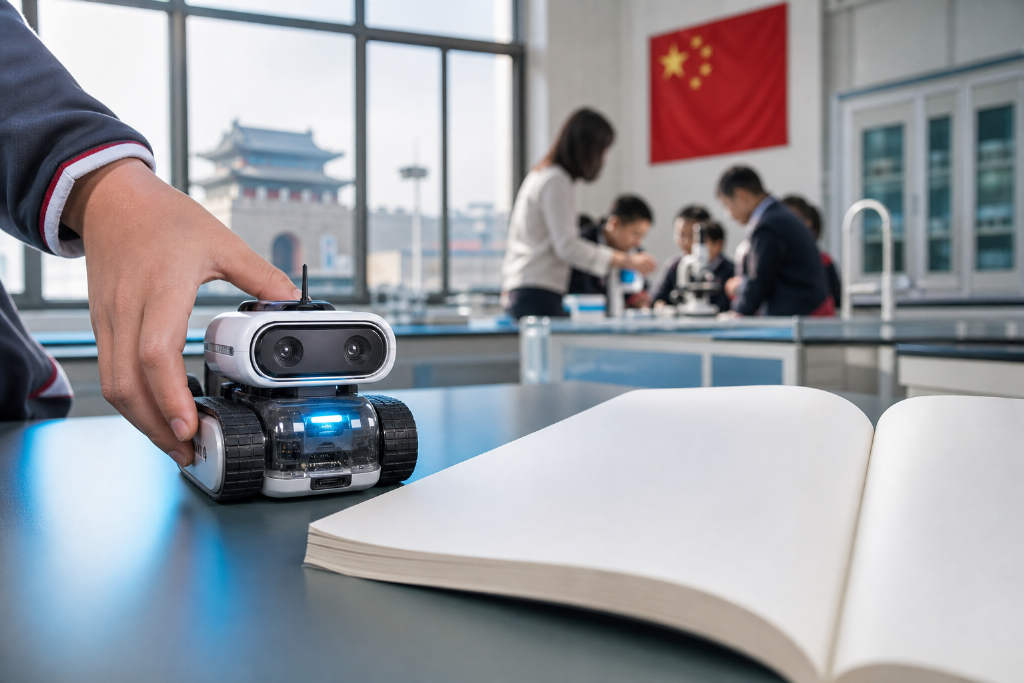
AI literacy education is expanding in primary and secondary schools. Jiangsu launched a provincewide project on Aug. 18 to achieve full coverage of AI literacy courses in primary and secondary schools. The province classified implementation as a “hard task” and required schools to offer the courses from the 2026 autumn term. During the summer, Jiangsu completed a series of teaching-capacity training programs for AI literacy courses, reaching nearly all full-time, part-time and subject research teachers. It also opened a digital resources section and offered on-site training, cloud classrooms and technical support for rural schools.
Shandong issued its Guidelines for AI Literacy Education and Teaching in Primary and Secondary Schools in August. The guidelines set progressive goals for different school stages. Students in grades one and two of compulsory education must receive at least six AI-related class hours each academic year, while students in grades three through nine must receive at least eight. The rules also set boundaries for AI use: teachers may not use AI to directly replace lesson preparation or instruction, and students may not use it to write assignments or complete projects on their behalf.
Beijing, which has conducted AI literacy education across its schools for a year, is upgrading course content. Zhongguancun No. 3 Primary School is incorporating AI image creation, video generation and computer vision into courses for different grades. Beijing No. 2 High School’s Economic and Technological Development Area School has introduced robotics and real-time motion-capture equipment. Guangqumen Middle School has used an enterprise AI research platform to develop courses related to autonomous driving. Resources from universities, research institutes and technology companies are entering schools through courses, laboratories and practical projects.
The focus is shifting from whether schools offer AI classes to what they teach, how teachers deliver them and how students use the technology in ordinary lessons.
Revised textbooks reach every compulsory-education grade
Textbooks revised under the 2022 compulsory education curriculum standards will cover every grade in primary and junior secondary schools in the autumn term of 2026. The replacement began in autumn 2024, when new materials were first introduced for primary grade one and junior secondary grade seven. More grades adopted them in 2025. By autumn 2026, all primary and junior secondary grades will be using the new textbooks, completing a three-year replacement process.
Changes to learning content and sequencing are among the most closely watched elements. Experts cited in the source said the total number of Chinese-language texts from primary grades one through six has been reduced. In mathematics, simple equations have been moved to junior secondary school, while ruler-and-compass construction has been added to primary education. The overall English vocabulary volume has changed little. Across subjects, the materials place more emphasis on students’ cognitive development and on the principles of teaching, with a gentler learning progression.
Several subjects also have revised structures. History textbooks place more emphasis on chronological links and the development of civilizations. The section on ancient Chinese history now includes the Yangshao, Longshan and Liangzhu cultures, while world history adds material on ancient civilizations in Africa and the Americas. Chinese-language textbooks have rearranged some units and texts to leave more room for in-depth learning.
For schools and teachers, the textbook change also requires teaching adjustments based on the updated curriculum standards.
Science education puts “learning by doing” into practice
The Ministry of Education issued its Guide to the Pilot Action for “Learning by Doing” in Science Education at the Compulsory Education Stage in August 2026. The guide will apply to primary and junior secondary schools from the 2026 autumn term. Every student in grades four through nine must complete at least one science inquiry practice task each semester, totaling no fewer than four class hours. Students in grades one through three will complete the inquiry activities required by their science courses without additional assignments.
The guide calls for students to take part in the full inquiry process. A task may include raising questions and hypotheses, designing a plan, collecting evidence, conducting hands-on work, producing and improving an outcome, communicating results and reflecting on the process. Teachers are expected to provide guidance suited to students’ grade levels and abilities.
The inquiry topics extend beyond conventional science experiments. The guide lists six themes: life and health, the ecological environment, the mysteries of Earth, aerospace, emerging industries and artificial intelligence. Local governments may design tasks around regional resources. Henan has added a local theme to the six listed areas, linking inquiry activities to local industries and situations from production and daily life.
Assessment is changing as well. Science inquiry practice will be assessed mainly through process records and presentations of results. It will be documented in students’ comprehensive quality files rather than tested in a separate exam. Schools may coordinate science, mathematics, information technology, labor education and comprehensive practical activities when organizing the tasks. Class hours will be drawn from existing courses, so the policy does not add to students’ total classroom burden.
School transitions start at a slower pace
On Aug. 24, the Ministry of Education released a ten-question-and-answer document on scientific transitions between kindergartens and schools. It focused on the transition from kindergarten to primary school and from primary to junior secondary school. Kindergartens may not teach pinyin, literacy or calculation in advance as primary-school content, a measure intended to prevent kindergarten education, teaching methods and environments from becoming overly similar to those of primary schools.
The first semester of primary grade one is designated as an adjustment period, with teaching starting from zero. Pinyin instruction must last at least six to eight weeks. Schools may not assign written homework or hold paper-and-pencil examinations during this period. Classroom teaching is expected to use more game-based and everyday-life activities as students adapt to the pace of primary school.
The transition to junior secondary school also calls for a lower starting pace. During the first month of the school year, junior secondary schools must slow the teaching schedule and help new students adjust to the number of courses, learning methods and changes in school life. Schools are also required to strengthen psychological adjustment for new students.
Families are included in the transition requirements. The Ministry of Education has asked parents to avoid advance tutoring and excessive problem drilling, and not to impose extra homework on their children. The transition between kindergarten, primary and junior secondary school is being addressed through changes in school arrangements and learning pace rather than relying mainly on students to prepare in advance.
Random class placement and wider “sunshine admissions”
The Ministry of Education’s General Office issued a notice in April on the 2026 special action for “sunshine admissions” in primary and secondary schools. It requires compulsory-education schools to organize balanced classes, bans formal or disguised key, experimental, fast-track and slow-track classes, and promotes random student placement together with balanced teacher allocation. Schools must disclose their class-placement plans, procedures and results to parents. Once the results are announced, they may not be changed without authorization.
Hunan has said that all compulsory-education schools in the province will use “sunshine class placement” for first-year primary and junior secondary students from the 2026 autumn term. Guangzhou is applying a “double random” system to new students entering starting grades at public and private compulsory-education schools, randomly assigning both students to classes and teacher teams. Guiyang and Guian are using information systems for one-click random placement. Fuliang County in Jiangxi is using computer-generated allocations and recording the entire process in audio and video. Langxi County in Anhui is conducting random assignments through an information system.
The “sunshine admissions” campaign is covering regular high schools for the first time this year. The Ministry of Education requires regular high schools to follow local admissions rules and implement joint admissions for public and private schools. Affiliated high schools of universities under central ministries, provincial high schools and city-level high schools in districts may not improperly recruit top students from counties. The policy also continues to require a reasonable allocation of high-quality regular high-school places to weaker junior secondary schools within the relevant areas, while banning cross-area recruitment of top students under the name of place quotas.
New rules cover teachers, school meals and childcare
Hunan’s new evaluation rules for professional titles of primary and secondary school teachers took effect on Sept. 1. They address an excessive focus on academic qualifications, seniority, papers and awards, and make teachers’ professional ethics and classroom performance important evaluation criteria. Classroom teaching records and teaching cases may be submitted as representative achievements for review.
Guangdong is expanding requirements for parents to supervise school meals. All schools and kindergartens at every level that provide formal education in the province must establish a parent meal-supervision system. At least one parent-meal visit must take place each month, with no fewer than two participating parents each time. Schools must also hold at least one meeting each semester on the parent meal-supervision program.
Shandong issued an opinion on strengthening oversight of extracurricular childcare providers. Such providers may not use childcare services as a cover for off-campus education and training aimed at primary and secondary students, nor may they publish advertisements for that training. The opinion also sets oversight requirements covering buildings, fire safety, gas and food safety.
The source article was published by the WeChat account “DuoJing” (ID: DJEDUINNO), written by Xie Qi and carried by MarsBit.