
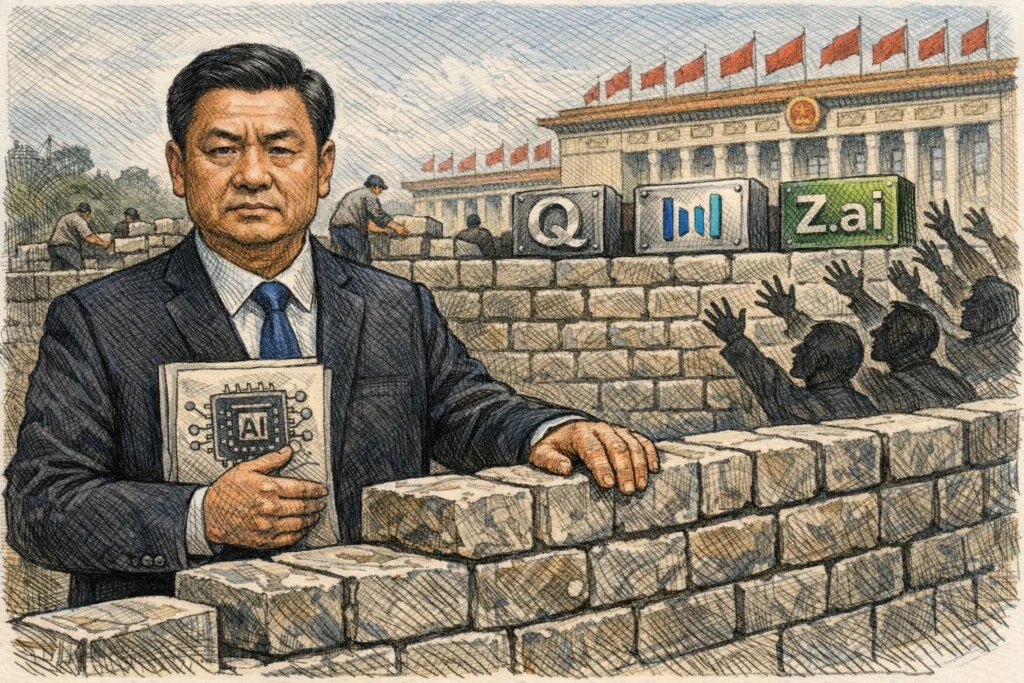
China’s Ministry of Commerce is considering tighter export controls on AI models and chip-related products and has already held discussions with Alibaba, ByteDance and AI startup Z.ai about restricting overseas access to their flagship systems, according to the Financial Times.
The report says the aim is to prevent China’s most advanced technologies and leading startups from being acquired or accessed by the West. It follows reports from about half a month ago that Beijing was considering controls on DeepSeek and Moonshot AI, on the grounds that Chinese AI models were being used by Silicon Valley companies as low-cost substitutes. This time, the scope described in the report is broader and reaches the Chinese open-source models with the widest global use.
Three companies were named in the discussions
According to the report, the ministry has spoken with three companies about limiting overseas access to their flagship systems: Alibaba, whose flagship model is Qwen; ByteDance, whose flagship model is Doubao; and Z.ai, which develops GLM-5.2.
Measures under discussion include reviewing export control lists covering AI and chip-related products, setting clearer standards for export license approvals, tightening end-user checks to verify who the buyer is and what the product will be used for, and raising the bar for sending advanced technology overseas.
Nothing has been finalized. The Ministry of Commerce has not released a formal proposal and has not published a timetable. The three companies named in the report have not publicly confirmed the matter either.
The report adds that some officials have privately indicated the scope of any controls may be limited to future-generation models, meaning versions that have not yet been released. Older versions that are already in wide circulation would, for now, not be handled retroactively.
Qwen’s scale in the open-source ecosystem was a central point
The report cites data showing that the Qwen family has more than 113,000 derivative models on Hugging Face. If all models tagged as Qwen are included, the total rises above 200,000, more than Google and Meta combined.
On downloads, Qwen has accumulated about 942 million, ahead of Meta’s Llama at roughly 476 million, according to the report. On that basis, the report describes Qwen as the most widely used open-source model in the world.
The pace of change was also highlighted. In January 2024, only about 1% of newly added fine-tuned models were built on Qwen. By February 2026, that share had climbed to 69%.
The report also points to AI Singapore, a national AI project in Singapore, which chose Qwen rather than Llama as the base for a regional model. It says Chinese open-source models, including Qwen and DeepSeek, now generate more overall activity on Hugging Face than U.S. models.
Any restrictions could hit overseas developers and smaller companies first
The report frames the issue as bigger than the output of a few labs. What Beijing is weighing, it says, is a system that has become central to the global open-source ecosystem. Once technology is distributed broadly, it becomes difficult to pull back, and that is presented as a key reason the ministry is studying tighter controls.
Over the past several years, European developers and many small and medium-sized companies have used free, open-weight Chinese models as cheaper alternatives to U.S. commercial services. If Beijing moves ahead with tighter restrictions on overseas access, that group could be among the first to feel the effects.
The report also notes that some observers see the discussion as possible leverage for trade talks with Washington, potentially tied to semiconductors or tariffs, rather than a measure that is certain to be implemented.
It closes on the contrast that China spent much of the past decade criticizing export controls as instruments of hegemony and unilateralism and as unfair tools used by the United States to preserve its technological edge. In AI, the same script may now be applied by Beijing in one of the areas it most wants to protect.