
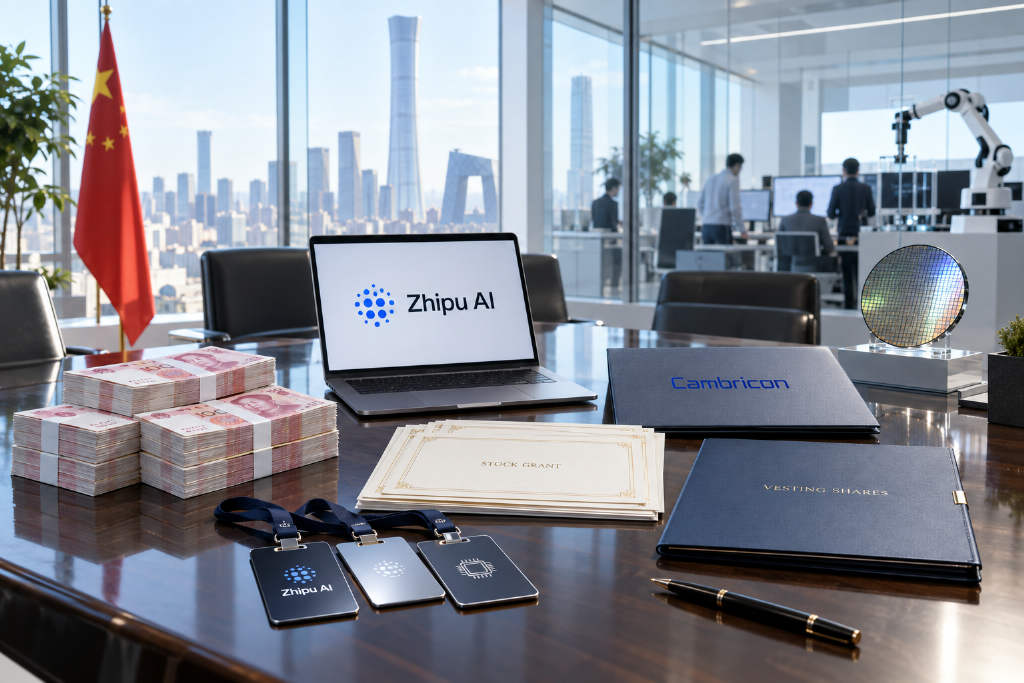
Companies across China’s AI chain are paying more and more to secure key talent.

A compensation review of Chinese technology firms shows that AI-driven wealth creation is no longer limited to founders. It is reaching researchers and even interns. According to 36Kr, PhD interns working on core projects at ByteDance, Tencent and Alibaba can earn 5,000-6,000 yuan per day. Maimai’s September report on AI talent mobility said newly posted AI jobs rose 789.47% year over year in January-July 2026, while average monthly pay for AI roles reached 63,160 yuan.
Those figures show how technology companies are valuing scarce talent. Mature companies can keep paying for experience. Newer firms are willing to spend before profits arrive. How much they pay, how they structure that pay, and who gets it all point to different stages of business development and different talent strategies.
The report selected 30 listed companies from three tracks: large AI models and AI applications, AI chips and semiconductors, and robotics and embodied intelligence. It also added three large internet companies for comparison. Using executive compensation disclosures, career records and equity incentive data from annual reports and other public filings, it examined how tech companies price key talent and how they try to retain it.
Key talent is expensive even before profitability
For newer companies trying to capture the window in large-model development, spending on talent often comes ahead of profits.
Zhipu AI and MiniMax are still loss-making, yet disclosed compensation for key personnel is already high. Zhipu stands out in particular. Its average monthly compensation came to 3.386 million yuan, above Tencent’s 1.043 million yuan. These companies are still in the red, but pay levels have already moved into the range of major internet platforms.

The report said the competitive window for large models may last only a few years. For these companies, waiting until profitability to recruit may mean missing a critical generational shift in model development.
Zhipu reported 2025 revenue of 724 million yuan and a net loss attributable to shareholders of 4.698 billion yuan. Even so, Chairman Liu Debing received total annual compensation of 157 million yuan, of which 156 million yuan came from share-based payment.
Pay levels diverge across the three AI tracks
Companies in semiconductors, large-model startups and robotics are all part of the AI chain, but they are not offering the same level of compensation.
Average executive monthly pay was highest in large AI model and AI application companies at 358,000 yuan. AI chip and semiconductor companies came next at 280,000 yuan. Robotics and embodied intelligence firms ranked last at 122,000 yuan.
The ranking changes when median executive pay is used. AI chip and semiconductor companies show a relatively higher median. Many of them are long-established businesses in chip manufacturing, storage and equipment, with a more mature industrial base and more stable job structures, which supports steadier compensation.

By contrast, pay in large-model, AI application and robotics companies is more uneven. The gap between firms is wider, and key talent moves more often.
The report argues that median executive pay also reflects commercialization progress in each segment. Chips and semiconductors are supported by industrial demand. Large-model and AI application companies are still searching for monetization paths. Robotics remains further away from broad commercial deployment, and its median compensation ranks lowest.
The highest pay does not always go to the highest title
A company’s top-paid executive is not always the person with the highest title. Responsibility for specific business lines and the scarcity of specialized experience can push a vice general manager or a supervisor above the chairman in annual compensation.
That does not mean total personal returns are higher than the chairman’s. For founders or managers who hold large stakes, annual salary is only one part of the overall payoff.
The structure of “high pay” can also look very different from one company to another. The report cited four sample firms. At SenseTime, 95% of Xu Li’s compensation came from salary, benefits and bonuses, meaning current-period remuneration was mostly cash. At Geek+ and UBTECH, the share of stock-based compensation for Zheng Yong and Deng Feng was 59% and 63%, linking more of their returns to equity incentive arrangements. At Zhipu AI, Liu Debing’s compensation mix was relatively balanced: 30% salary, 35% bonus and 33% stock compensation.

A higher share of stock compensation may point to larger upside, but it also means value realization depends on time and conditions. For companies, how they pay is part of how they keep people.
Retention relies on equity as well as cash
Retention is not just about executive pay packages. Companies can also use equity incentives to tie a broader group of employees to the business.
Public data cited in the report show that by the end of 2025, the equity incentive penetration rate among listed companies in the technology sector was about 73.6%, above the overall A-share market level of 58.8%.
Zhipu AI ranked near the top in both employee shareholding coverage and employee holdings as a share of total equity, at 51.2% and 16.55%.
AI chip and semiconductor companies were described as more willing to allocate equity and to include a larger share of staff. Advanced Micro-Fabrication Equipment Inc. China, or AMEC, had the highest employee shareholding coverage at 75.5%, which means roughly three out of every four employees held shares.

Cambricon’s 2026 restricted stock incentive plan draft shows the company will grant 5 million restricted shares to 945 employees. Based on its total workforce of 1,107 employees at the end of 2025, that implies a coverage ratio of 85.37%.
Coverage and ownership percentage do not always move together. In 2025, Muxi and Cambricon had similar coverage ratios at 55.81% and 58.72%, but employee holdings as a share of total equity were 9.15% and 0.58%, nearly 16 times apart. Hygon covered only 18.3% of employees, yet employee holdings reached 6.09%, above AMEC even though AMEC covered three-quarters of its workforce.
Some companies ranked low on both measures. Kingsoft Office, Roborock and Leader Harmonious Drive all had coverage rates below 15%, and employee holdings below 1% of total equity.
Broad coverage lets more employees share in corporate growth. Concentrating a larger equity stake in fewer hands can make the package more attractive to key personnel.
The appeal of equity becomes especially visible at the time of listing. On the first day of Unitree Technology’s listing, the intraday market value of Shanghai Yuyi, an employee shareholding platform that held 10.94% of the company before the offering, climbed to about 48.6 billion yuan at its peak.

Technical background remains a major factor in pricing talent
Technical capability and technical background remain central in executive pay decisions at technology companies.
Across the three sectors, 30 companies and several hundred executives in the sample, half of the top 20 earners had technical backgrounds.
The report gave several examples. AMEC’s Yin Zhiyao is both chairman and core technical staff. UBTECH’s Xiong Youjun is chief technology executive. Four ZTE executives who made the ranking all had technical backgrounds.
Still, the people capturing the highest pay are often those who not only understand technology but can also push it into practical use. Yin had worked at Intel and Lam Research, building experience in equipment R&D and management. After founding AMEC in 2004, he brought that background into company operations.
Moving into the management layer is not the only route for core technical staff to earn more. Among six sample companies that disclosed relevant pay data, average compensation for core technical personnel was higher than that of non-technical directors and executives in every case. At Hygon, average monthly compensation for core technical personnel was 230,000 yuan, about 1.9 times that of non-technical directors and executives. At Seres, the figure was 338,000 yuan, about 2.3 times.

These pay records are also a bet on the future
Behind the compensation data lies each company’s judgment about the value of talent.
The report says that judgment is also a bet. Talent costs are already written into the books, while commercial returns are still in the process of arriving. Zhipu’s average executive pay has already surpassed Tencent’s, but the company remains loss-making. Cambricon has granted stock to 945 employees, while setting a performance target of 100 billion yuan in cumulative revenue over three years.
These companies are effectively betting that they will grow into the businesses they assumed they could become when those compensation decisions were made. If they miss that mark, the people and the money already booked may become a heavy burden.
The article was sourced from the WeChat public account Jingxiang Studio, authored by Jingxiang Author.