
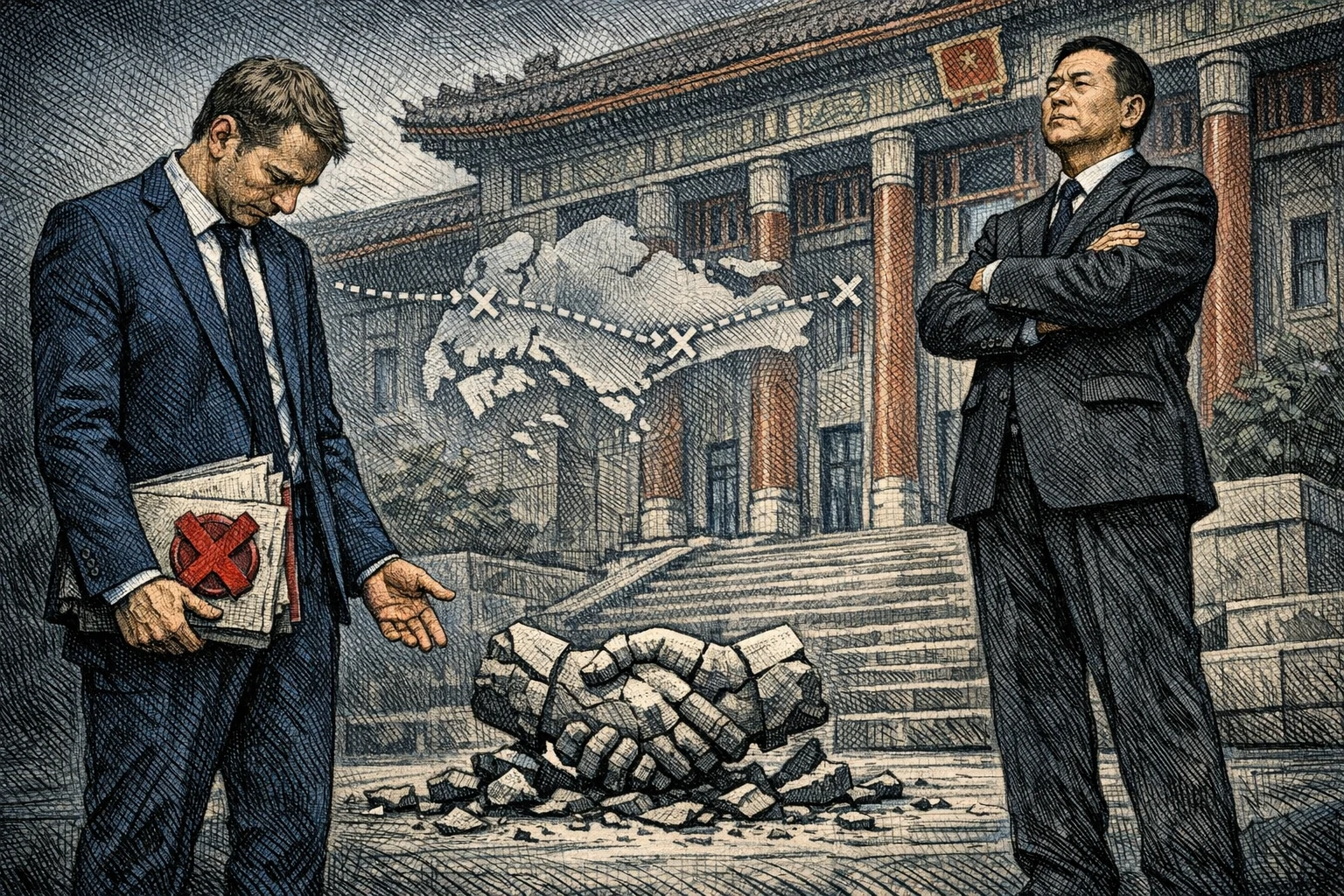
China’s National Development and Reform Commission has ordered Meta to unwind its acquisition of Manus, ending a cross-border AI deal valued at $2 billion to $2.5 billion. The order, issued through the office handling foreign investment security reviews, brought the transaction to a formal stop on April 27.
Regulatory order ends the acquisition
According to the official notice and local reporting on April 27, Chinese authorities decided to prohibit the investment and required the parties to revoke the deal. The report described it as the first time China has formally halted a major cross-border AI acquisition through its foreign investment security review framework. Meta had not publicly commented at the time referenced in the source, but the deal was already over as a legal matter.
The source also said Manus co-founder and CEO Xiao Hong and chief scientist Ji Yichao had been barred from leaving China since mid-January and were under investigation by the NDRC and other agencies. With the ban now in place, their status has drawn even closer scrutiny.
From a 10-day negotiation to a four-month freeze
The acquisition moved quickly at first. On December 29 and 30, 2025, Meta announced plans to buy Butterfly Effect, the developer behind Manus, after what the source said was a negotiation lasting only 10 days. The speed of the agreement drew attention across the AI sector, and Butterfly Effect’s 78-person team suddenly became one of the most expensive small AI teams in the market.
Chinese review followed almost immediately. On January 8, 2026, China’s Ministry of Commerce said it would examine whether the transaction complied with export controls, technology import and export rules, and outbound investment regulations. By mid-January, the two founders were restricted from leaving the country and the investigation widened. On April 24, the NDRC also sent notices to ByteDance, Moonshot AI, and StepFun, telling them to reject US capital unless explicit approval had been granted. The formal ban came three days later.
Why Manus drew such intense attention
Manus was developed by Butterfly Effect, a company founded in 2022 with headquarters in Hong Kong and R&D branches in Beijing and Wuhan. The source described Manus as the world’s first truly autonomous general AI agent, able to plan and execute complex tasks with minimal human input, including scheduling trips, analyzing stocks, processing files, and screening resumes.
After its public release in March 2025, Manus gained traction quickly. Invitation codes were reportedly traded in secondary markets for as much as 200,000 yuan. Its funding path also showed a sharp valuation jump: a $10 million pre-seed round led by ZhenFund in January 2023, then a Series B in April 2025 led by Benchmark at a $500 million valuation with $75 million raised. Eight months later, Meta offered $2 billion to $2.5 billion. The source added that Manus had reached $125 million in revenue in 2026.
“Singapore Washing” becomes a key fault line
The report framed the dispute around what it called “Singapore Washing,” meaning an attempt to shift legal jurisdiction while leaving the core business and technology realities unchanged. Manus had originally been developed in Beijing and was moved to Singapore near the end of the deal process, according to the source, with the company then presenting itself as a Singapore entity. Meta also pledged to cut ties with Butterfly Effect’s Chinese investors and shut down China operations.
Chinese regulators did not accept that structure. The source listed five main concerns: loss of core technology IP if the R&D team moved with Meta; the idea that changing registration alone could not sever the real link between the company, its people, and its technology; sovereignty over user data such as calendars, emails, files, and account permissions; the strategic status of general AI agents; and restrictions related to the overseas movement of key technical personnel.
Signal for tech buyers and decentralized AI narratives
The article argued that the case sets a clear precedent for China’s tech sector. A company may move its legal shell, but technical talent, source code, and training data can still be treated as controlled technology exports. For US tech groups considering acquisitions of Chinese AI companies, that is a direct warning.
For crypto, the source did not describe an immediate market effect, but it did point to a narrative shift worth watching. If cross-border deals, technology transfer, and the movement of technical talent face tighter state controls, decentralized infrastructure may gain rhetorical traction. The article specifically mentioned Bittensor and Akash, saying supporters of on-chain AI compute networks are using that logic to strengthen the case for systems that cannot be blocked by a state.