
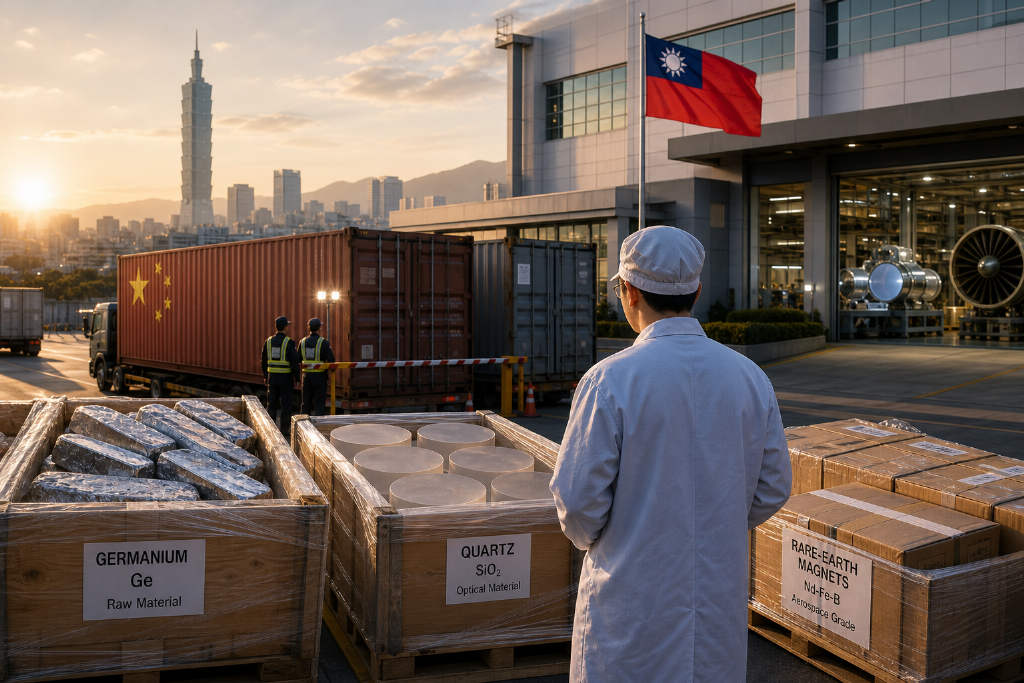
China has recently slowed customs clearance for exports to Taiwan of germanium-based and quartz-based optical materials, as well as some rare-earth magnets used in aerospace, according to a Nikkei Asia report cited by ABMedia. The change has left related industries in Taiwan dealing with shipment delays and lost orders.
Industry sources said the move again shows how Beijing uses supplies of critical materials as a geopolitical lever. It has also added urgency to Taiwan’s push to build more local capacity in rare-earth materials.
Longer customs checks hit germanium and quartz deliveries
The report said inspection times at Chinese customs have lengthened noticeably since last year. Several optical technology manufacturers said they have run into delays or other obstacles when sourcing raw materials from Chinese suppliers.
An unnamed executive at an optical company said, 「This is a common problem across the industry. Many peers are facing similar situations and have been forced to significantly extend delivery cycles.」 The executive requested anonymity out of concern over possible retaliation from Beijing, the report said.
People familiar with the matter said germanium-based and quartz-based materials have repeatedly been held up during the customs process in China. The report described germanium as a key input for thermal imaging, infrared lenses used in defense and industrial applications, and as an important material for fiber optics and photonics. Quartz is widely used in optical components and semiconductor manufacturing and is also difficult to replace.
China is currently the dominant global supplier of both categories, the report said. It added that Beijing has previously used control over such supplies as a bargaining tool during geopolitical disputes.
Chip equipment makers report lost orders
Sources also said some Chinese suppliers had been called in by authorities and asked about customer identities and shipment details. Several chip equipment manufacturers said delivery times had been extended by several months, causing them to lose some orders.
Industry participants said the chip sector requires extremely high quality and precision in quartz, and suppliers outside China remain hard to find.
Rare-earth magnet shortages pressure aerospace motor supply
The aerospace industry is facing a similar problem. Sources said supply of some permanent magnets from China has become a bottleneck, with neodymium magnets seeing the clearest impact.
Neodymium magnets are a key material in motor production, the report said, covering uses from standard industrial motors to precision motors required in advanced robotics.
A senior executive at an aerospace supplier said the company found that critical permanent magnets needed for motor manufacturing had been disrupted by Chinese export controls, while cost-effective alternatives from other regions were not easy to secure.
Export controls expand from rare earths to quartz
The report placed the latest disruption within China’s broader expansion of export controls on critical materials in recent years. Beijing has long used export restrictions on key raw materials and rare-earth metals to pressure countries or regions involved in trade disputes, prompting efforts in Japan, the United States, and elsewhere to cut reliance on Chinese supply.
In December 2024, China updated its list of tightly controlled dual-use export items and added quartz-based materials, citing their military and civilian applications.
At around the same time, China also temporarily suspended exports of germanium and gallium to the United States in response to export controls imposed by the Biden administration on China’s semiconductor sector, the report said.
Taiwan backs local rare-earth development
The report also noted that China has long viewed Taiwan as part of its territory and has not ruled out the use of force in dealing with cross-strait issues. Against that backdrop, the latest controls on optical and aerospace materials are being watched in the context of political pressure across the Taiwan Strait.
Taiwan’s Ministry of Economic Affairs has committed resources to support the Industrial Technology Research Institute, or ITRI, in developing domestic rare-earth technology. The goal is to build a first pilot production line within three years, raising Taiwan’s self-sufficiency in critical materials and reducing dependence on Chinese supply.
The episode has renewed focus on supply resilience and diversification for Taiwan’s technology industry as U.S.-China tech tensions continue to intensify.