
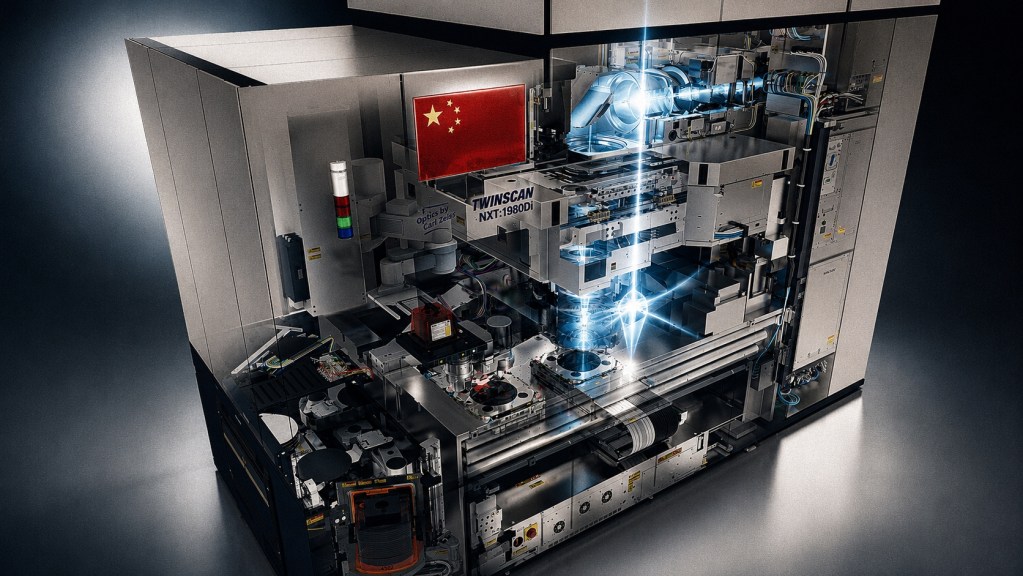
Progress in China’s domestic immersion DUV lithography program sparked a sell-off in semiconductor equipment and chip-related stocks, but Morgan Stanley said the drop does not change the long-term outlook for AI compute demand.
The bank said the weakness was mainly technical, tied to deleveraging after crowded positioning, rather than a deterioration in AI infrastructure fundamentals. Other market commentators made a similar point, arguing that shares such as ASML had fallen more than the underlying news justified and that the bearish narrative looked more like a post hoc explanation for profit-taking.
China DUV update becomes the trigger for a broader sell-off
According to The Information, a Shanghai-based Chinese state-owned enterprise has entered the small-scale production stage for immersion DUV lithography machines. Output is said to be targeted at around five units this year and 20 by 2027, with Semiconductor Manufacturing International Corp. (SMIC), Hua Hong and ChangXin Memory Technologies (CXMT) expected to be among the initial customers.
The report said the machine still depends partly on Japanese components, remains behind ASML on performance and yield, and will need several months of testing and validation before it can move into formal production lines. For comparison, ASML delivered 131 immersion DUV systems last year.
That means the development is not an immediate threat to ASML, but it does point to meaningful progress in China’s effort to localize critical chipmaking equipment during a period of Western export restrictions.
Morgan Stanley says the pressure reflects deleveraging, not weaker demand
Morgan Stanley said recent weakness in AI infrastructure stocks has been driven mainly by technical deleveraging after positions became too crowded, not by a real decline in demand for AI compute. The bank said its preferred AI infrastructure holdings have underperformed global indexes by about 7 percentage points over the past month. Even so, it kept its constructive view and said the pullback created a better entry point.
The bank also rejected another market concern: that companies could rein in AI spending by limiting employee token usage. In Morgan Stanley’s view, the cost of AI remains small relative to the productivity gains it can generate.
X analyst Ren, citing the report, wrote: “Technical factors and leverage unwinds will not stop the advance of the AI wave and demand. Instead, they create a better buying opportunity. The only problem is that many people no longer have enough cash to seize it.”
More efficient Chinese AI models are seen as supportive, not negative
Morgan Stanley also addressed a common bearish argument that gains in efficiency for Chinese large language models, or LLMs, would shrink global compute demand. The bank took the opposite view. It said lower-cost, more efficient AI models can reduce barriers to use and expand adoption, which in turn could increase compute consumption on the inference side.
As the center of gravity in AI compute shifts from training to inference, Morgan Stanley said the change is also reshaping the details of AI infrastructure demand, with memory among the areas most directly affected.
Analysts say the market already wanted to sell
Citrini analyst Jukan said the current bearish talking points around a peak in the semiconductor cycle, excessive capital expenditure hurting profits, and China’s push for technological self-sufficiency are not new. His reading is that the market had already been inclined to take profits, then went looking for a narrative to explain the move after the fact, creating a self-reinforcing loop.
In that context, China’s DUV progress was simply the latest piece of material cited by the market, while the decline in names such as ASML amounted to an overreaction, in his view.
Morgan Stanley’s preferred positioning still includes infrastructure and energy
On portfolio positioning, Morgan Stanley said it favors AI infrastructure bottleneck beneficiaries, semiconductor manufacturing-related companies, Chinese AI solution providers, energy security assets, and hyperscalers including Meta, Alphabet, Microsoft and Amazon.
The bank also acknowledged real constraints on AI infrastructure expansion, including power supply, labor shortages and political resistance. It estimated that the United States could face a data-center power shortfall of as much as 38 GW before 2028, but described those obstacles as “speed bumps” rather than a ceiling.