
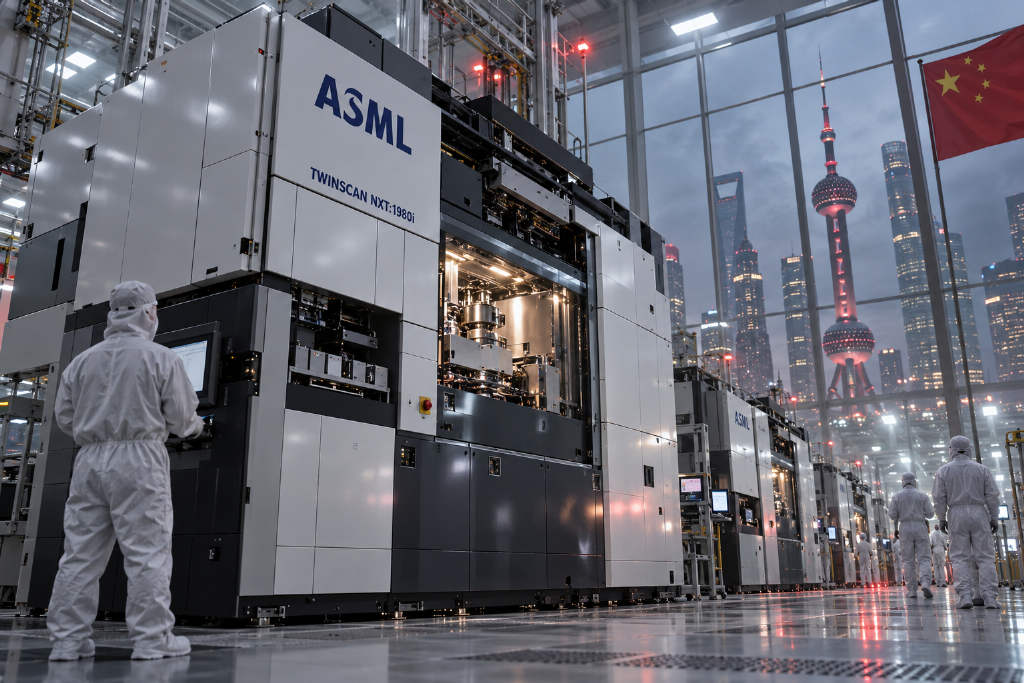
Former U.S. officials said Chinese semiconductor plants have stockpiled hundreds of immersion lithography machines worth billions of dollars in recent years and urged Washington and its allies to stop further exports, according to the South China Morning Post.
A report released in late September by the Centre for Technology & Statecraft, which was founded in August 2026, estimated that Chinese wafer fabs had obtained about 343 immersion deep ultraviolet lithography systems by early 2026. The report was co-authored by Nicholas Brown, a former U.S. export control official, and Saif Khan, a former technology policy adviser at the White House and the U.S. Commerce Department.
The report estimated that roughly 270 of those systems were ASML Twinscan NXT:1980i tools. The authors said the machines, while behind extreme ultraviolet lithography systems, could be modified to manufacture 7 nm-class logic chips and advanced memory required for artificial intelligence processors, including chips tied to Huawei's Ascend series.
The report also said Chinese fabs spent more than $13 billion in 2024 to purchase about 90 NXT:1980i units, then bought another 89 in 2025.
ASML has disclosed that, by shipment destination, China accounted for 41% of its net system sales in 2024 and 33% in 2025. That share fell to 19% in the first quarter of 2026 and then to 14% in the second quarter.
On the regulatory side, the Netherlands has required export licenses since September 2023 for the NXT:2000i and more advanced immersion DUV equipment, and those models have effectively been barred from shipment to China since then. One year later, the licensing requirement was expanded to the NXT:1980i, though that model could still be approved for shipment on a case-by-case basis.