
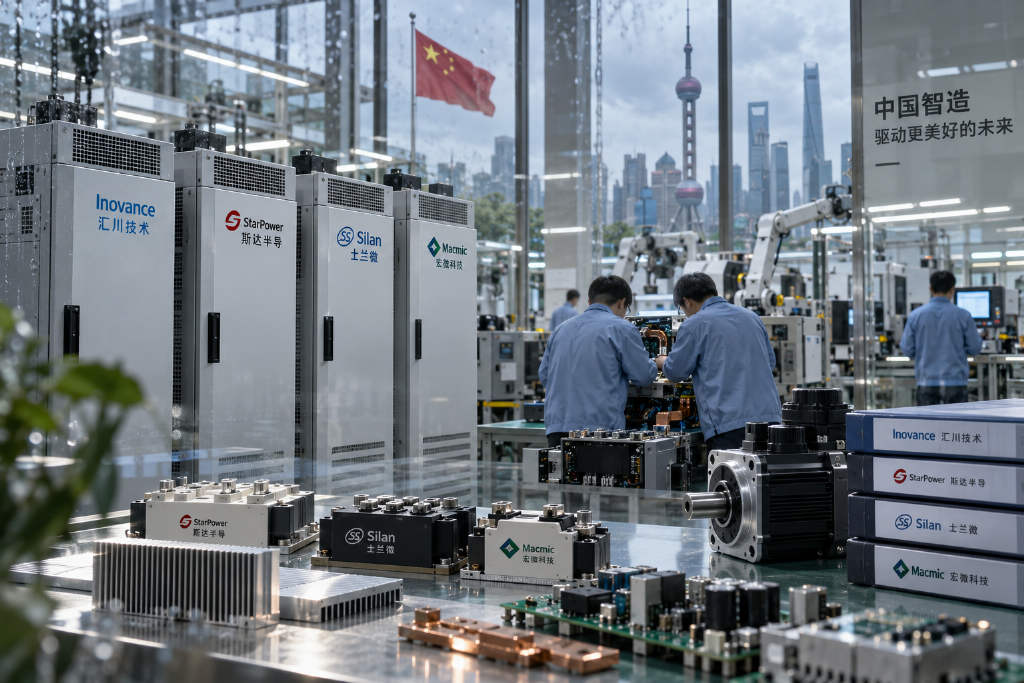
Servo systems and inverters are taking on a larger role in China’s industrial automation localization drive. They sit between upstream semiconductor performance gains and downstream factory upgrades, serving as the execution layer for precision control and flexible speed regulation while also acting as a key link in efforts to reduce reliance on imported industrial control components.
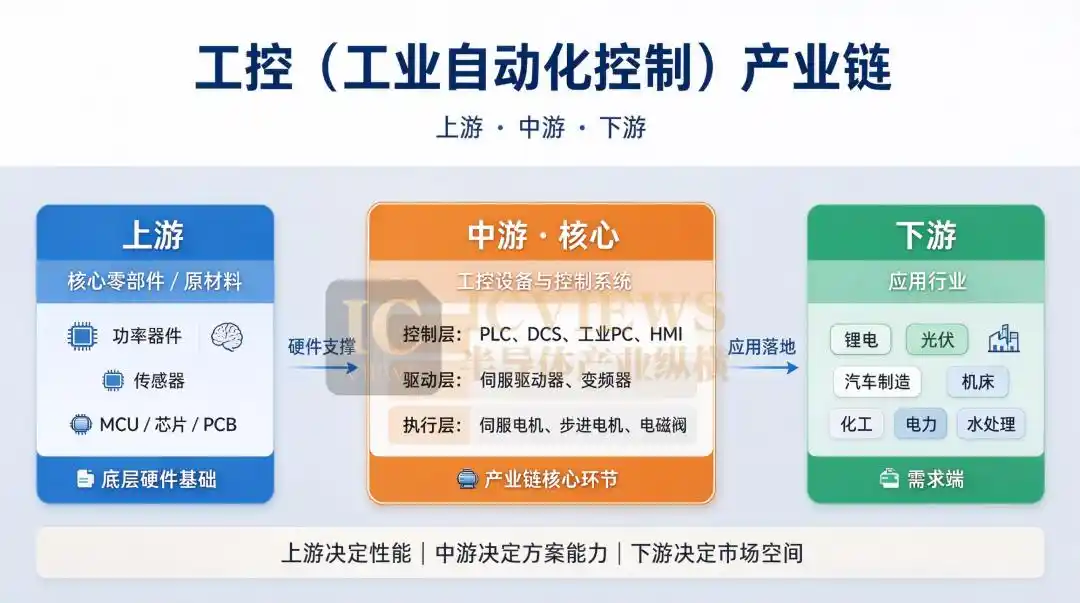
According to the article, China’s core power devices were heavily dependent on imports for years, raising manufacturing costs for finished equipment and leaving supply security and delivery stability exposed. That setup is now changing as domestic power device makers work more closely with servo and inverter manufacturers, from early-stage demand definition and core technology development to long-cycle validation in complex industrial environments. The piece says the old pattern of fragmented development is giving way to a coordinated model built around domestic equipment and domestic components.
Servo systems and inverters are expanding at the same time
In industrial automation, servo systems are described as one of the core motion-control components. They operate through closed-loop feedback, allowing a controlled object to track a target command in position, speed or torque with limited deviation. Their job is to amplify, convert and finely regulate input power so that the drive system can deliver adjustable and precise torque, speed and position control.
A servo system is made up of three main parts: the servo drive, the servo motor and the encoder. The drive acts as the control center, receiving external commands and adjusting motor current to manage closed-loop control across position, speed and torque. The motor handles the physical output, with permanent magnet synchronous motors now widely used for higher power density and better efficiency. The encoder feeds the motor’s actual operating position back to the drive in real time, with incremental and absolute encoders remaining the two mainstream categories.
The article says the servo market has recovered in recent years as smart manufacturing upgrades and emerging industries have added demand. At the same time, rising localization rates and progress by domestic suppliers have started to reshape value distribution across the supply chain. Citing GeWu ZhiSheng’s 2026 China General Servo Product Market White Paper, the report says China’s general-purpose servo market rebounded to RMB 22.96 billion in 2025, and domestic brands took more than 60% of the market for the first time, up from less than 50% five years earlier.
It adds that Japanese brands had long controlled roughly half of China’s servo market through an early lead, but that position has weakened. Their share, the article says, has fallen from above 50% before 2020 to about 26% now.
Localization has also advanced in low-voltage inverters, a key part of the industrial automation drive layer. In simple terms, a low-voltage inverter is an AC motor drive device rated below 690V. It controls motor speed by adjusting the frequency and voltage of the power supply. The article notes that a decade ago, China’s inverter market was still dominated by foreign brands such as ABB and Siemens, whose technical lead created high barriers for local companies.
Quoting GeWu ZhiSheng’s 2026 China Low-Voltage Inverter Market White Paper, the report says China’s low-voltage inverter market reached about RMB 29.27 billion in 2025, keeping it among the larger segments in industrial control. Domestic brands accounted for 46% of the market in 2025, a jump that the article describes as a break from long-standing foreign dominance.
The piece argues that the simultaneous rise of servo systems and inverters is directly expanding demand for upstream power devices. It frames that shift not as scattered growth from a single product line, but as a broader industrial response moving from downstream equipment makers back into the semiconductor layer as localization deepens.
Local suppliers are moving from parts vendors to strategic partners
As ties between upstream and downstream companies deepen, the role of domestic power device makers is changing as well. The article says they were once treated mainly as suppliers that built to specification, with price as the main competitive factor. Now some leading companies are taking part in product definition and research work much earlier in the process, moving closer to the role of strategic partner.
Inovance is presented as one example. The article says the company holds about 22% of China’s servo market, ranking first domestically on the back of a broad product lineup, stable performance and local service capabilities. That puts it ahead of Japanese names such as Panasonic and Yaskawa Electric. Delta Electronics, headquartered in Taiwan, China, is described as part of the second tier with about 9% market share, offering a servo lineup that ranges from high-end multi-axis W3 products to entry-level E3 and E3C models. Xinje Electric follows with about 18% of the domestic segment, supported by its “PLC+” approach.
The cooperation between StarPower and Inovance is cited as a representative case. In January 2026, StarPower again received Inovance’s “Strategic Supplier” recognition. The article says reports indicate that StarPower has been deeply involved in Inovance’s product development, providing semiconductor devices and system-level solutions, especially custom IGBT and SiC module solutions that improved energy efficiency and system reliability and supported Inovance’s position in industrial control and new energy applications.
That kind of joint-definition model means power device makers are no longer just filling orders. They are taking part in performance optimization at the chip level.
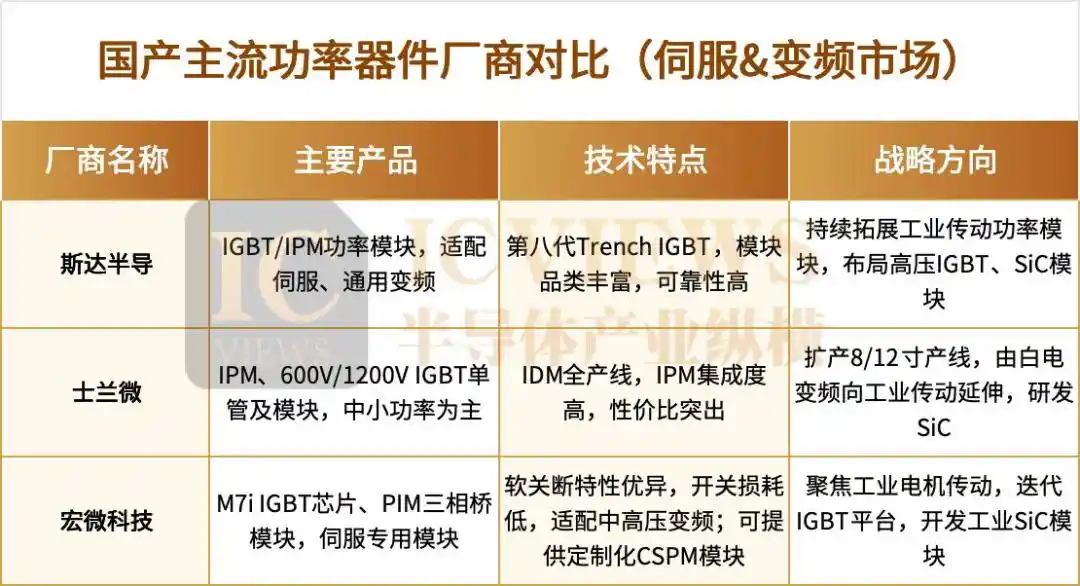
The article also points to product breadth as a technical foundation for capturing these opportunities. Silan Micro is said to be advancing along three lines at once: silicon-based IGBT and MOSFET products, third-generation semiconductors including SiC and GaN, and 12-inch high-end analog products. Its industrial-grade MCU has already been used in industrial inverter scenarios and now sits alongside IGBT and SiC power modules and gate driver ICs in an integrated “MCU + power module + driver IC” portfolio. The report says this chip-level coordination improves system efficiency and reliability while lowering customer development costs.
Macmic Science & Technology is also mentioned as a company with long-standing exposure to core industrial control applications such as inverters and servo drives. According to the article, it has built a platform-based “chip + module” product system and expanded into new energy generation, electric vehicles and data centers, creating a business mix that combines steadier cash-flow operations with higher-growth segments.
The article’s broader point is that domestic power device makers are shifting from selling standalone components to helping define system solutions. In that view, the pairing of domestic equipment and domestic components is becoming an operational model rather than a slogan.
Three hurdles remain for the next stage
The article says the industry’s progress does not remove its structural weaknesses.
The first issue is the remaining technology gap in high-end industrial control power devices. Domestic suppliers, it says, have largely achieved substitution in mid- and low-end industrial control components, with product performance and delivery capacity already meeting mainstream application needs. But in high-end categories required for advanced servo systems and high-voltage, high-power inverters, including high-end IGBT modules, high-precision SiC devices and high-end IPM modules, local products still trail international leaders. Foreign suppliers continue to hold advantages in long-term operating stability, full-life-cycle durability, high-frequency dynamic performance and consistency in mass production. Core devices in high-end industrial control equipment in China still rely heavily on imports.
The article adds that domestic third-generation semiconductor products still have room to improve in mass-production stability and wafer yield, making it difficult for them to meet the strict demands of extreme operating conditions at scale. Limited penetration in the high-end market remains a major weakness for local power device makers.
The second issue is cost. The article says wide-bandgap devices such as SiC and GaN offer clear advantages in high-voltage tolerance, lower loss and high-frequency response, but substrate preparation is difficult and the full production process is complex. As a result, mass-production costs remain well above those of mature silicon-based power devices, and the overall cost-performance balance is still hard to justify for broad use in mid- and low-end general industrial control equipment.
For now, the article says, SiC devices have only landed in small batches in a limited number of high-end servo and high-end inverter projects. Because finished-equipment makers remain under rigid cost pressure, most mainstream products from mid- and low-end industrial control manufacturers still rely on mature silicon-based devices. The pace of large-scale adoption for newer power devices has therefore fallen short of earlier expectations.
The third issue is price competition. As localization rates rise in industrial control equipment, the number of domestic servo and inverter manufacturers has increased quickly, intensifying competition. The article says price pressure has spread from lower-end red-ocean markets into mid- and high-end applications. That pressure is being passed upstream, pulling domestic power device suppliers into low-price competition and narrowing profit margins.
With margins under strain, the article argues, companies have less room to fund the high research spending needed for advanced devices. Some have fallen into a pattern of prioritizing scale over research, which slows broader technology upgrades and limits the industry’s ability to move toward higher-quality and higher-end development.
Opportunity and constraint are moving together
The article concludes that industrial control semiconductors are entering a phase where opportunity and pressure coexist. Faster localization in servo systems and inverters is presented not simply as a market-share contest, but as part of a wider move from equipment-level progress toward greater autonomy across the industrial automation chain. It says domestic power device makers have already shifted from standard suppliers to strategic partners and have achieved broad substitution in the mid- and low-end industrial control device market.
At the same time, the remaining technology gap at the high end, the elevated cost of wide-bandgap devices and the squeeze on research budgets caused by price competition continue to stand in the way of the next stage. The article was originally published by the WeChat public account ICViews and written by Cai Lu.