
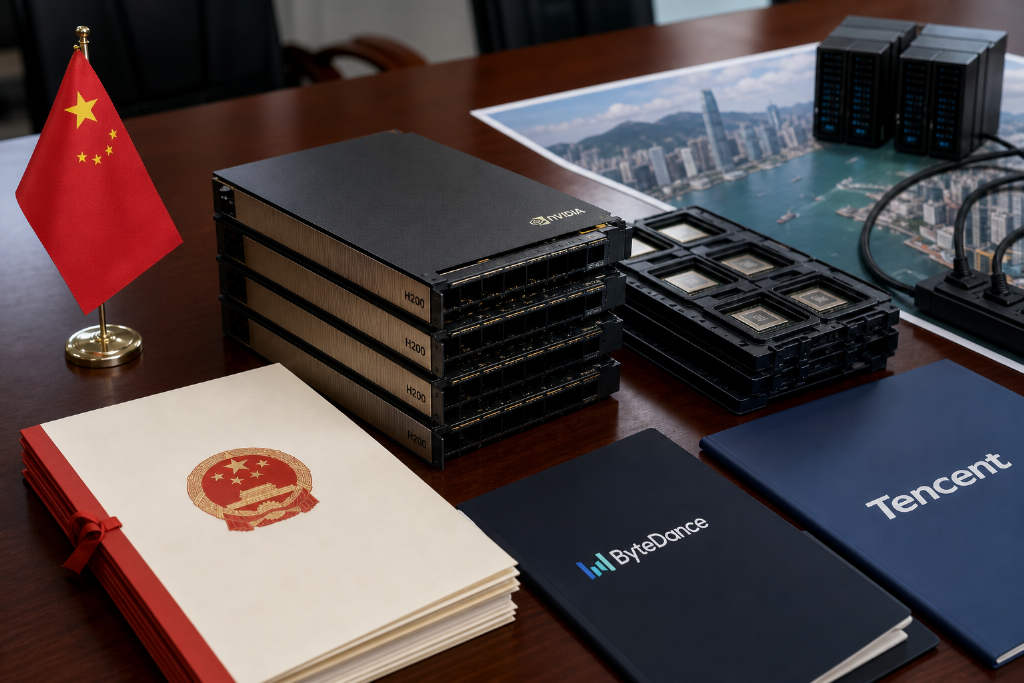
China has started permitting limited imports of Nvidia H200 AI chips, with approvals routed through a case-by-case review process led by the National Development and Reform Commission, according to a Financial Times report cited by ABMedia. The shift gives Chinese companies some access to advanced AI hardware under existing U.S. export controls, though a major deployment bottleneck remains unresolved in Hong Kong.
ByteDance and Tencent each received about 10,000 H200 chips
Two people familiar with the matter said ByteDance and Tencent each received about 10,000 Nvidia H200 AI processors in recent weeks. Several other Chinese technology groups are also expected to win import approval for shipments of a similar scale.
The report described the move as a rare proactive easing by Beijing on AI chip controls. It said the thinking behind the decision was to make sure China’s leading AI companies can keep training frontier models and narrow the technology gap with U.S. peers.
The opening is not a blanket authorization. Imports still require individual applications and approval under the process led by the National Development and Reform Commission. Lenovo and other Nvidia partners told Chinese customers last week that they could resume ordering AI server products containing H200 chips. Those partners assemble Nvidia chips together with CPUs and networking equipment and sell them as complete AI server systems.
Limited easing runs into Hong Kong capacity and power constraints
People familiar with the matter said the opening is extremely limited and internally contradictory. U.S. export licenses in practice allow each Chinese company to buy as many as 100,000 H200 chips, but Beijing is also requiring companies to deploy most of those chips outside mainland China. The report said that approach is meant to support domestic chipmakers such as Huawei and prevent Nvidia from becoming too deeply embedded in the Chinese market.
Hong Kong, because it sits outside China’s customs border, can legally receive the chips. Chinese regulators have also told companies they can send H200 chips there for use. Yet the immediate problem is infrastructure. Hong Kong’s data center capacity is already tight, and power supply constraints make short-term expansion very difficult.
One person familiar with the situation said: 「This is a dilemma. Every company needs chips, but none can find a way to use them in Hong Kong. Everyone hopes the controls will be gradually loosened.」
Nvidia currently has about 500,000 H200 chips in inventory mainly intended for Chinese customers, the report said. Those units had previously been unable to ship because of Beijing’s restrictions.
China still needs Nvidia for training as model competition intensifies
The strategic backdrop to the policy shift is the fast-rising AI race between China and the United States. A person familiar with regulatory decision-making said Chinese authorities want top domestic AI developers to keep training frontier systems capable of competing with leading U.S. models such as Anthropic Mythos 5.
Last month, Chinese AI lab Moonshot released its K3 model, which the report said came close to the most advanced U.S. performance level. Alibaba, DeepSeek and Zhipu then rolled out models described as reaching a similar level of intelligence, pointing to a rapidly narrowing gap between the top AI labs in the two countries.
Chinese companies are moving more quickly toward domestic chips for AI inference. Training is a different story. For the heavier compute work involved in building knowledge bases and identifying patterns, most companies still depend on Nvidia hardware.
Beijing is balancing support for Huawei with near-term AI compute needs
H200 is not Nvidia’s most advanced product. The report said the chip trails Nvidia’s current flagship by at least two generations, and Chinese customers cannot buy newer models under export-control rules. Beijing’s decision to allow H200 rather than higher-end chips points to an attempt to carve out room for the domestic industry within a tight policy framework.
The report also said China still lacks the most advanced chipmaking equipment and is unlikely to become fully self-sufficient in the foreseeable future, especially in the high-end compute needed for AI training. That leaves Beijing in a difficult position: it can keep backing local suppliers such as Huawei, but it is unlikely to end its dependence on Nvidia in the short term.
For now, the limited opening around H200 reflects a practical compromise between China’s long-term effort to reduce reliance on U.S. semiconductor supply chains and the immediate need to sustain its AI training capacity.