
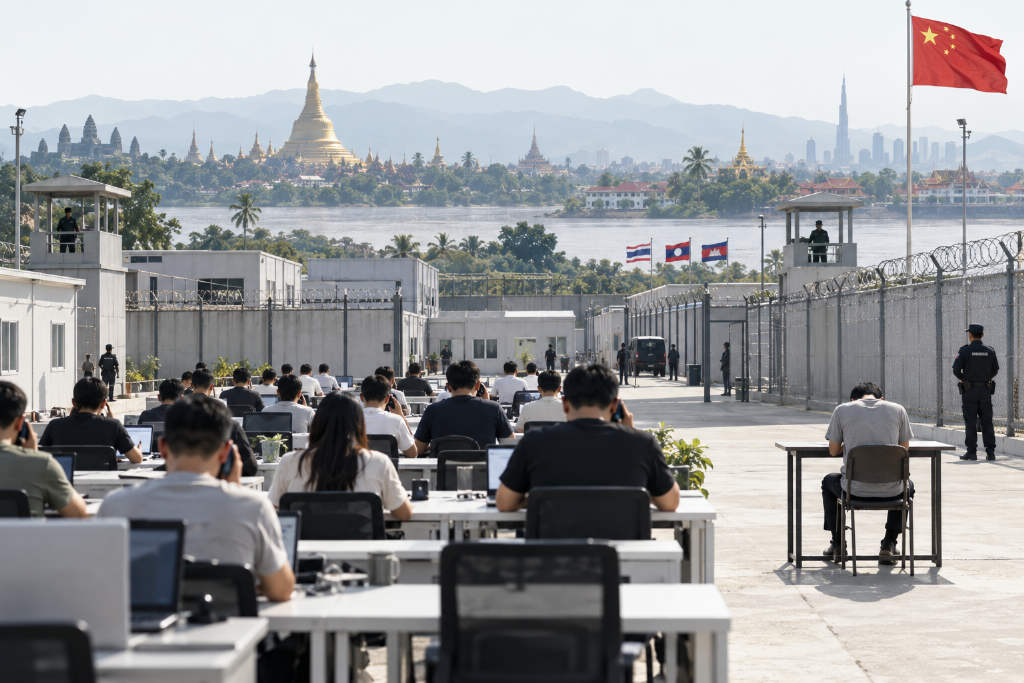
China has released a three-part documentary running about two hours that focuses on pig-butchering scams along the country’s southern border, in a bid to expose more people to the scale and brutality of the trade.
According to Protos, the documentary presents pig-butchering as a major problem for China. The report says scam call centers linked to these operations increasingly depend on kidnapped Chinese victims to keep business running. Most of the centers are located in Myanmar, though similar sites have also appeared in Cambodia, Laos, Thailand, and the UAE as profits have surged.
How the scam system operates
Protos says the process tends to follow a familiar pattern. A scammer lures a target into a region where the person can be kidnapped. The victim is then taken to a remote site, often built out as a commercial park designed to hold prisoners.
Once inside, victims are forced to scam other people through fake romantic approaches, celebrity impersonation, or other fraudulent setups. Their families are then presented with ransom demands that they often cannot afford to pay.
The report says these compounds are not makeshift facilities. Some are described as city-sized areas with full local economies, including restaurants, doctors, dentists, firefighters, and ATMs.
Figures cited in the documentary
According to the documentary, nearly 100,000 law enforcement officials are currently working to disrupt the syndicates behind these scams. It also says more than 50,000 Chinese nationals have been extradited back to China to face charges, while tens of thousands remain imprisoned by the fraud groups.
Protos adds that many of the compounds are protected by armed forces hired by the syndicates. The report describes literal militias made up of thousands of heavily armed personnel, used both to stop victims from escaping and to resist attempts at government intervention.
Families named as major syndicates
The documentary identifies the Bai, Wei, Liu, and Ming families as major syndicates that China has recently managed to disrupt. Protos says all four groups were composed of Chinese nationals who established pig-butchering centers in northern Myanmar after being pushed out of China in the late 2010s.
The report says the groups benefited from a porous border between Yunnan Province and Myanmar, while the ongoing civil war in Myanmar made law enforcement difficult in Kachin and Shan states.
According to Protos, some syndicate leaders remained in China while employees and victims operated the business from Myanmar. It says almost all of those leaders have been arrested and sentenced either to prison terms or death.
No clear end in sight
Even though China has highlighted successful operations against major pig-butchering syndicates in Myanmar, Protos says the business is so profitable in a region shaped by civil war that it is unlikely to disappear soon.
The report says Chinese nationals continue to be lured into Myanmar, Laos, Cambodia, and the UAE, then kidnapped and forced into servitude under scam operators. Protos links that pipeline in part to difficulty finding decent employment in China.
In Protos’ account, pig-butchering will continue until Myanmar ends its civil war, millions across Southeast Asia escape poverty, and young people in China can more readily find work.
