

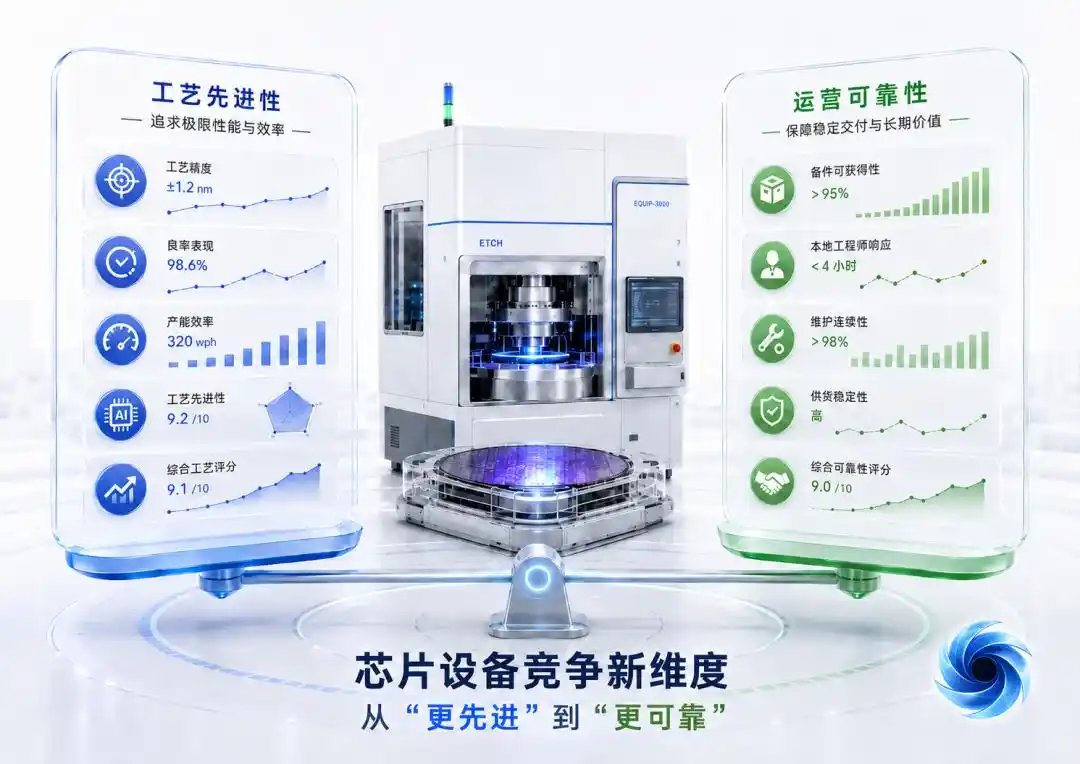
A chip tool can still lead on paper, but if spare parts may become unavailable, software updates may stop and vendor support may grow uncertain, customers have to judge it differently.
That is the line running through a MarsBit article on how U.S. export controls are changing semiconductor equipment purchasing. Citing Reuters, the article says Samsung Electronics and SK Hynix are evaluating etching equipment from Advanced Micro-Fabrication Equipment Inc. China, or AMEC, at fabs in China. It also says such tests do not mean either company is about to replace current suppliers or that Chinese tools have entered their global sourcing systems. Samsung later denied that it was testing or considering AMEC equipment, and there is no evidence that the two sides have reached a large-scale procurement deal.
The article’s main point is elsewhere. It asks why companies that already have mature U.S. and European equipment supply chains would need to test Chinese equipment at all.
Its answer is not simply that Chinese tools have improved. It says customers are increasingly concerned about whether U.S. equipment can remain continuously available under tighter policy controls. Import approvals, replacement parts and software upgrades are all becoming more exposed to licensing decisions. In that sense, export controls are changing not only what China can buy, but also how global chipmakers decide whether a tool is dependable over the long term.
U.S. tools are being assessed through a new risk lens
Semiconductor equipment is not a one-off purchase. Once an etching system enters a wafer fab, it is usually expected to run for years. During that period, fabs need spare parts, software updates, process tuning and on-site technical support. For a plant built around continuous production, buying the tool is only the starting point. The more important question is whether the supplier can keep supporting it for the next 10 years.
That, the article says, has long been one of the hardest strengths of U.S. equipment companies to replace. Applied Materials, Lam Research and KLA built not only strong technical positions, but also worldwide service networks, large process databases and credibility earned through years of work with top-tier customers. For fabs, that meant lower process risk and confidence that engineers and parts would still be available when problems appeared years later.
The article argues that Washington is now weakening part of that advantage itself. It says some Samsung and SK Hynix plants in China had previously held Verified End User status from the United States, allowing them to obtain certain restricted equipment without a separate license for each order. It adds that the U.S. Commerce Department later removed that status. Existing plants may still be able to keep operating for now, but the future flow of equipment imports, spare parts and software updates now faces more approvals and more policy changes.
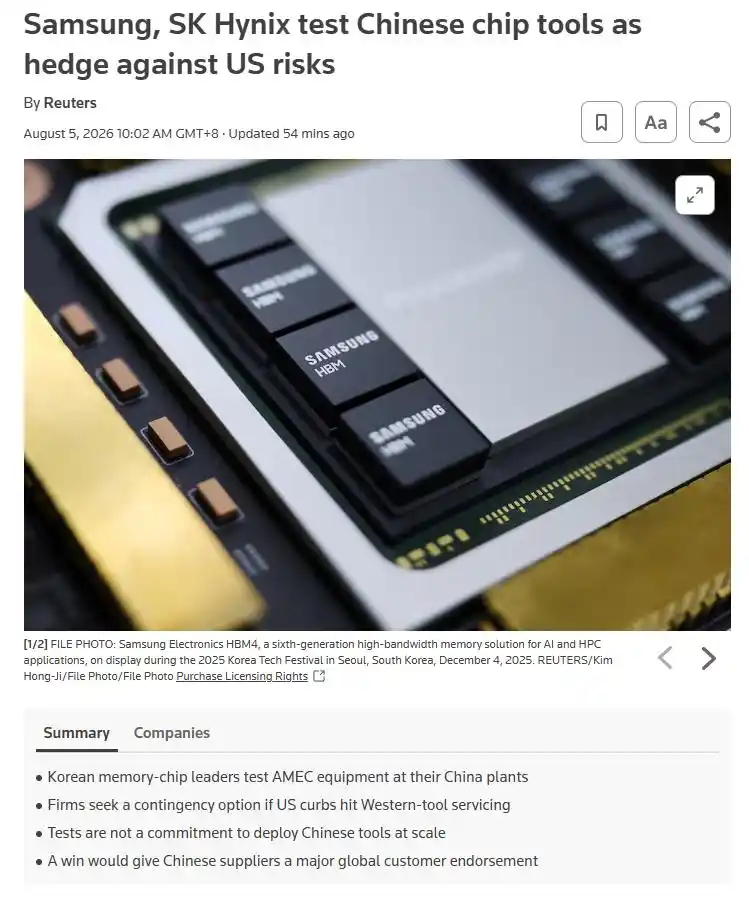
In that environment, suppliers may still want to serve and customers may still want to buy, yet continuity is no longer determined only by the two commercial parties. For fabs that require investments measured in tens of billions of dollars and planning cycles stretching well beyond a decade, uncertainty is itself a risk. The article says companies cannot wait until a tool actually becomes unsupported before they begin looking for alternatives.
Seen that way, testing AMEC’s etching tools is also a way to test the reliability of the existing U.S.-led supply chain. Customers want to know in advance whether Chinese equipment could keep a production line running if support for current tools becomes harder to secure.
From substitute product to backup supplier
The article places this shift against the backdrop of China’s domestic substitution drive. For years, Chinese chip equipment was often framed as a replacement option used when foreign tools could no longer be obtained. In that framing, overseas equipment remained the first choice and local products were a fallback.
What Samsung and SK Hynix may be doing reflects a different logic, the article says. They have not fully lost access to Western tools today. The point of testing Chinese equipment is to guard against the possibility that an existing supply chain could become unworkable in the future.
That is the difference between a substitute and an alternate supplier. A substitute addresses a supply cut that has already happened. An alternate supplier is meant to reduce a risk that has not happened yet, but can no longer be ignored. In practice, that means testing, certification and process verification have to be done while current equipment is still running, not after support has failed.
For Chinese equipment makers, the article says, that kind of access may matter more than a single near-term order. What is scarce in the semiconductor equipment business is not just a purchase contract. It is the chance to enter a top customer’s real production line for validation.
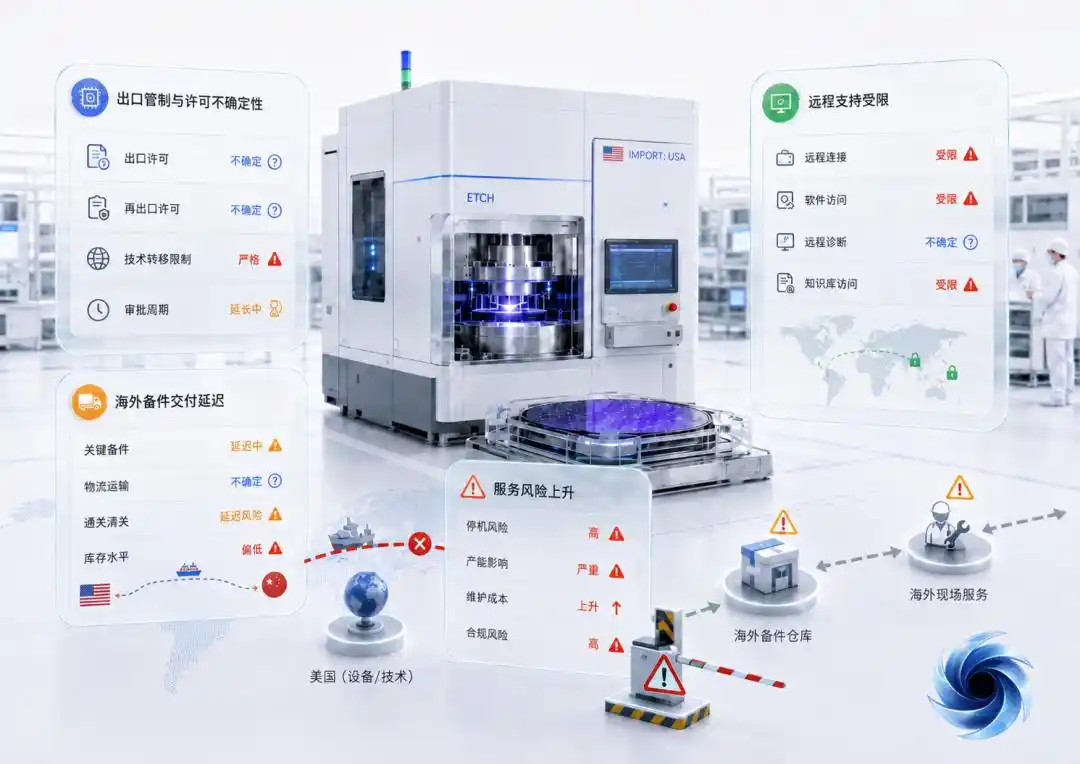
New chip tools do not compete through launch events or specification sheets alone. They need long cycles of process testing, yield tuning and stability checks. Only inside an actual production environment can vendors gather enough data, uncover issues that do not appear in the lab and improve products through customer feedback.
That is why the article says the act of testing itself matters, even if mass procurement never follows. In its telling, the biggest historical hurdle for Chinese equipment was that customers were unwilling to use it. Now policy pressure is giving those customers a reason to test it.
Why Chinese vendors may be able to use this opening
The article also makes clear that external pressure alone cannot put an immature tool into a Samsung or SK Hynix production line. If domestic equipment were still limited to lab prototypes or showcase projects, multinational chipmakers would not risk real production just because policy got tighter. Serious evaluation is only possible because some Chinese tools have already crossed a basic technical threshold in certain process steps.
Etching is presented as one of the faster-moving areas. As 3D NAND stacking rises and advanced logic structures become more complex, etching tools are being asked to remove material with precision in deeper and narrower features. Their importance and frequency of use are both rising. The article says AMEC has gained extensive real-world production exposure over the past few years by serving domestic memory and wafer manufacturing expansion, and that its tools have moved from early introduction to larger-scale use.
It cites AMEC’s 2025 etching equipment sales at about 9.832 billion yuan, up about 35% from a year earlier. More important than the number itself, the article argues, is what it signals: domestic etching tools are no longer only small batches used to prove capability. They are starting to participate in real mass production over longer periods and improve through live production data.
The piece says progress is not limited to etching. NAURA has expanded into etching, thin-film deposition and thermal processing. ACM Research Shanghai has accumulated more customers in cleaning and electroplating tools. Piotech and Hwatsing Technology are also cited as participants in thin-film deposition and chemical mechanical polishing, respectively.
That does not mean China can already supply a full advanced production line. The article is explicit on that point. It says only that in some segments, domestic equipment has moved from the question of whether it can be built to whether it can stay in mass production over the long run. If Samsung and SK Hynix are indeed willing to run tests, the article says, that reflects both pressure from U.S. export controls and groundwork laid by Chinese vendors over several years. Without the first factor, multinational companies might not have much incentive to alter sourcing plans. Without the second, Chinese tools would not be ready when the opening appeared.
The standard of competition is getting another variable
For years, chip equipment buyers mostly compared performance, yield, efficiency, cost and service capability. Under that framework, suppliers from the United States, Japan and the Netherlands held obvious advantages. Chinese tools, even when cheaper or faster to respond locally, struggled to enter the world’s top fabs if process stability and customer validation were still weak.
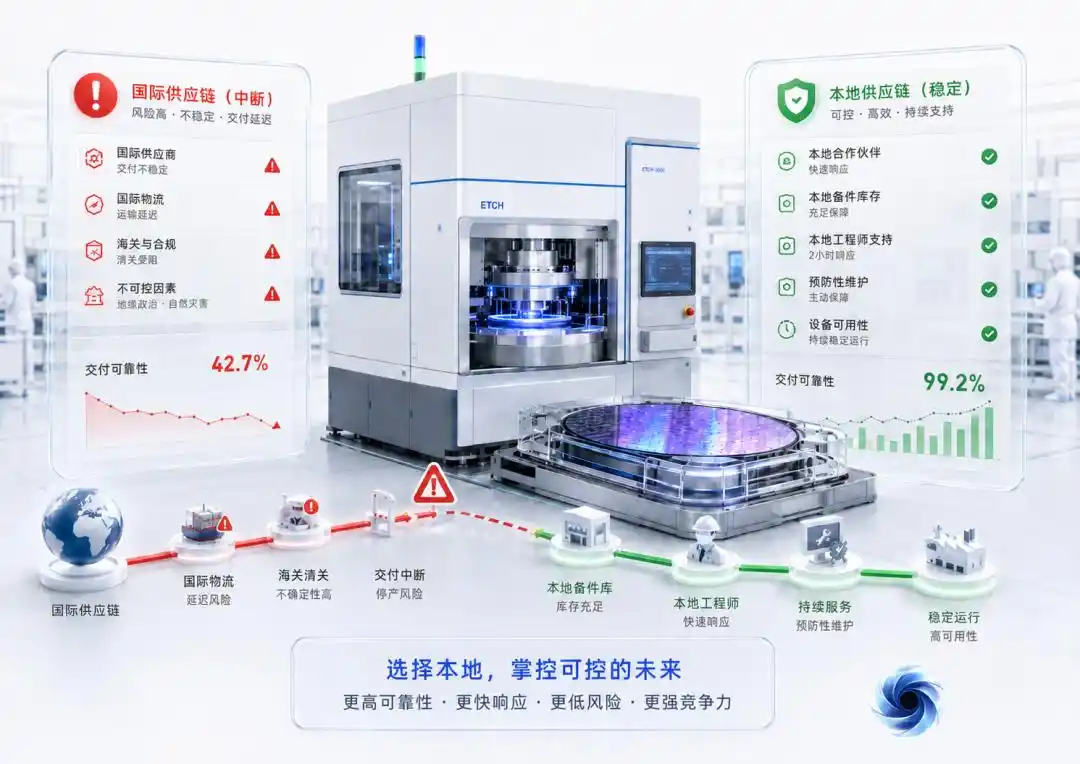
The article argues that export controls are adding another variable to that framework: whether a supplier could suddenly stop servicing customers because of a third country’s policy decisions.
A tool may lead today, but if spare parts could become unavailable tomorrow and software updates could be blocked a few years later, then its technological edge has to be recalculated. For a chipmaker, an advanced tool that cannot be maintained can become just as much of a production risk as a tool that cannot support stable output.
Chinese equipment did not suddenly become more advanced because of U.S. restrictions, the article says. But U.S. equipment has become less certain than before because policy intervention now sits over the supply relationship. The United States still controls many of the most advanced chip tools, yet it may be losing another capability that matters just as much: convincing customers that supply will not be interrupted by politics.
The article does not say global chipmakers are about to abandon U.S. suppliers. Their technology, service depth and customer relationships remain difficult to replace. Still, once customers begin seriously preparing a second supplier, a structure that once looked close to single-source by default has already started to shift.
It extends that logic beyond semiconductors. For decades, globalization prioritized efficiency. Companies concentrated orders with suppliers that offered the best performance, lowest costs and greatest scale. As long as trade conditions stayed relatively stable, reliance on a single supplier could look acceptable because it bought efficiency.
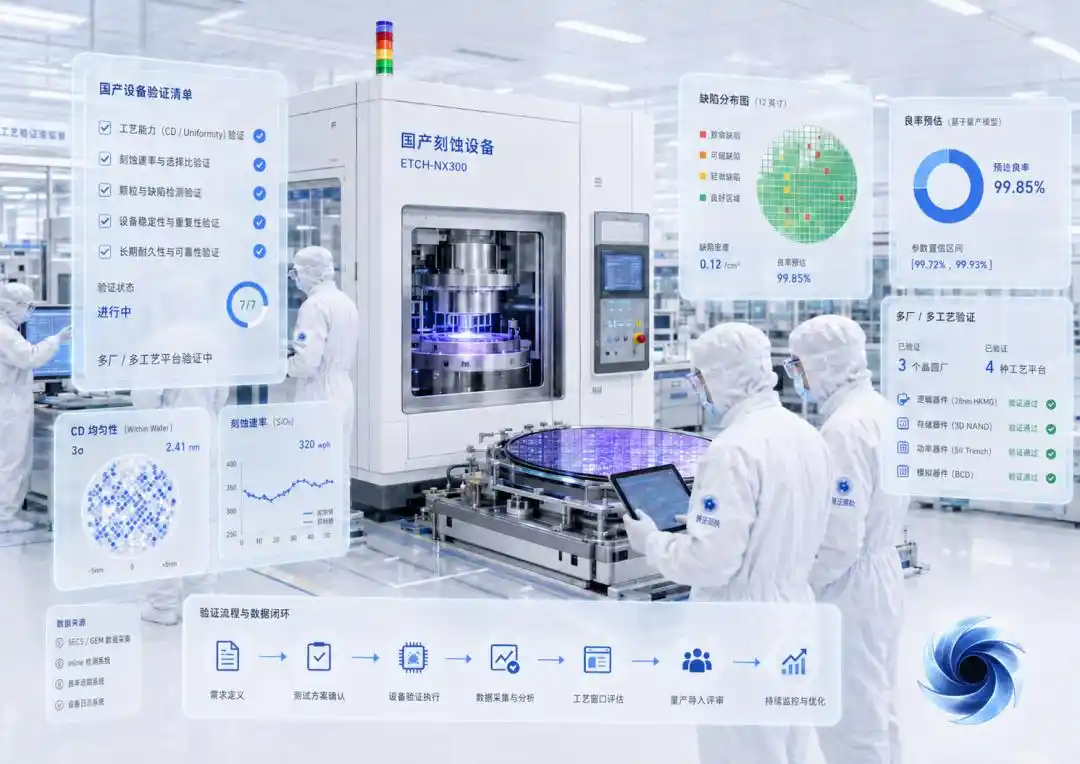
Now, the article says, companies increasingly need second sources across batteries, energy, computing power, chips and critical equipment. A second supplier used to be treated as a compromise with higher cost and lower efficiency. It is gradually becoming part of what keeps an operation running at all. In the article’s phrasing, an era focused on efficiency looked for the optimal answer; an era focused on risk needs substitutability.
Chinese chip equipment sits at that intersection. Domestic vendors are still chasing global leaders on technology, but they have gained a value they did not previously have at the supply-chain level. For fabs in China, local equipment makers can mean closer service, faster response and supply that is less exposed to another country’s export licensing decisions. Technical capability remains the base, but supply certainty is also entering the competition equation.
Closer to the global supply chain is not the same as being global
The article also draws a clear line between entering a multinational customer’s China operations and becoming a mainstream global supplier. The reported AMEC evaluation concerns Samsung and SK Hynix plants in China, not new lines in South Korea or elsewhere. Testing Chinese tools at China-based fabs may show that domestic equipment can enter a multinational production system, but that remains a long way from global procurement adoption.
There is also a lengthy verification cycle between testing and volume orders. Process stability, equipment lifetime, spare-parts support, intellectual property risk and service systems can all affect the final result. Samsung’s denial underscores how sensitive and early-stage such testing would still be, even if it is taking place.
The article adds that China’s semiconductor equipment industry still faces gaps that are hard to avoid. It points to high-end lithography, advanced metrology, some core components and certain critical process tools as areas where Chinese companies still trail leading international vendors by a visible margin. An advanced chip line depends on many categories of equipment working together. Progress in etching, cleaning and deposition does not mean an entire line has broken free from overseas supply chains.
So this is not a story about Chinese equipment having already completed internationalization. It is a story about the industry entering a new phase. Chinese vendors once relied mainly on domestic customers for validation. They are now gaining a chance to enter multinational factories located in China. Whether they can move on to those same companies’ production lines in South Korea, the United States and other markets will still depend on technology, service systems and long-term credibility. U.S. policy may create an opportunity to be noticed, but it cannot finish globalization for them.
The article also says mainland China, Taiwan and South Korea together accounted for nearly 80% of global semiconductor equipment spending in 2025. The most important chip manufacturing capacity, equipment demand and process-validation scenarios remain concentrated in East Asia. The United States may restrict equipment flows into China, but it cannot easily route around East Asia’s central role in global chip manufacturing.
In the past, Chinese fabs used domestic equipment to reduce dependence on overseas suppliers. Now, multinational chipmakers are evaluating Chinese equipment to reduce dependence on U.S. policy. The article says those two needs are starting to meet inside the same factories.
Where the article lands
Its conclusion is direct. Washington wanted to use its equipment advantage to keep China outside the advanced global chip industry. But the tighter the controls become, the more global customers may come to see that the most technologically advanced supplier is not always the lowest-risk supplier.
Chinese equipment has not suddenly overtaken U.S. tools, and the article says major gaps remain in many areas. What is changing is its role. Domestic equipment is moving from being a substitute used when Chinese companies cannot buy foreign products to being a second option that multinational companies feel they need to validate in advance.
That, in the article’s view, may be the most important unintended effect of the latest export-control cycle: the United States has not directly made Chinese tools more advanced, but it has given global customers a reason they feel compelled to test them. Chinese vendors have not received a pass into the global market. They have received a chance to sit for the exam. Whether they stay on the line will still come down to technology, yield and service.
The original article says it is discussing industry and technology development only and does not constitute investment advice. It was published via the WeChat account “科技旋涡” and written by Wang Qinzhou.