
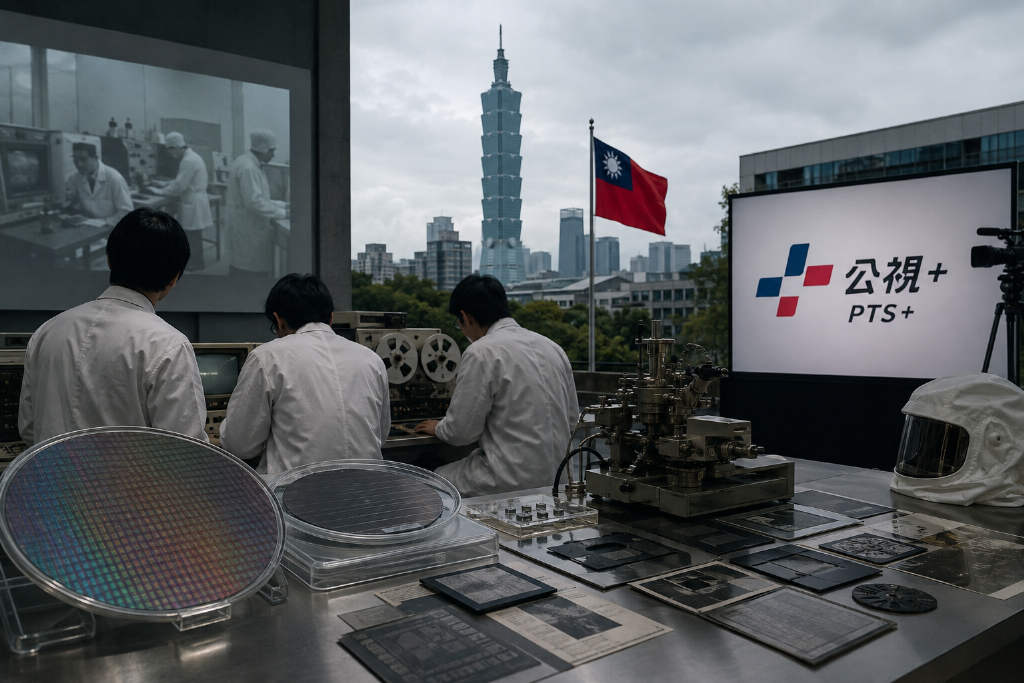
Chip Odyssey: The Century’s Bet is now streaming for free on PTS Plus. Viewers only need to register and sign in to watch the documentary, which was independently produced by director Hsiao Chu-chen over five years and built from interviews with more than 80 participants.
A documentary built around Taiwan’s semiconductor starting point
The report says the film documents how Taiwan’s semiconductor sector grew from what was once seen as an unlikely national wager into the industrial base behind today’s AI computing power.
It centers on 1976, when, under then-Minister of Economic Affairs Sun Yun-suan, the Industrial Technology Research Institute, or ITRI, signed an integrated circuit technology transfer licensing agreement with RCA in the United States. A group of 19 young engineers was then sent to the US for training.
Those engineers were assigned across RCA facilities in New Jersey, Ohio, California and Florida, where they studied chip design, process engineering, testing and equipment operation. The group included Shih Chin-tay, Tsao Hsing-cheng, Tseng Fan-cheng, Tsai Ming-kai, Yang Ting-yuan and Chang Ching-chu. The report describes them as the backbone of Taiwan’s semiconductor industry over the following three decades.
Yield at the pilot plant surpassed RCA’s record
After the pilot plant was completed in 1977, the team returned to Taiwan and began work immediately. According to ITRI records cited in the report, the plant reached a 70% yield by its sixth month of operation, compared with 50% at RCA, the original source of the transferred technology.
The article also notes an industry saying that later circulated widely: RCA executives allegedly looked back on the deal and said the biggest mistake of their lives was transferring semiconductor process technology to Taiwan.
From pilot line to UMC
The documentary uses the idea of “mountain building” to describe Taiwan in the 1970s and 1980s, a period marked in the report by the end of US aid, withdrawal from the United Nations, the break in diplomatic ties with Japan and repeated oil-shock disruptions. Against that backdrop, the government treated semiconductors as a critical path forward.
The report says that after the 19-member team returned and helped establish the pilot plant at ITRI, wafer technology was transferred out again in 1980, leading to the creation of United Microelectronics Corp., or UMC. It describes UMC as Taiwan’s first semiconductor manufacturing company and says TSMC came later.
Five years of production and more than 80 interviews
Hsiao has worked in documentary filmmaking for 30 years and has won the Golden Horse Award for best documentary feature in two consecutive editions. The report says she was not initially drawn to semiconductor history as a topic.
Her decision to make the film came after attending a memorial service for semiconductor pioneer Hu Ding-hua. Hearing industry veterans recall the sense of mission they had when they were young convinced her to document that period.
The film was produced independently, not on commission from the government or from a corporation. Hsiao and the producer also agreed not to let interview subjects preview the documentary before release in order to preserve the work’s independence. The interview list expanded from a small initial group to more than 80 people, including members of the first RCA training cohort, female line workers from that era, senior figures from policy and technology circles and younger engineers now facing their own career choices.
Box office performance after the theatrical release
The documentary includes appearances by Morris Chang, Tseng Fan-cheng, Shih Chin-tay, Yang Ting-yuan, Hu Ding-hua and Liu Ying-da. It opened across Taiwan on June 13, 2025. The report says it passed NT$5 million in its first weekend, crossed NT$10 million on June 26 and exceeded NT$30 million in under three months. It also entered the top five on Taiwan’s all-time documentary box office list, with nearly 300 private screenings booked.
The article places that history next to the current global scramble for AI computing capacity, where foundry output and yield have become key points of competition. It says the foundation for that race was laid by a government-backed bet made in the 1970s, long before anyone could know how it would end.