
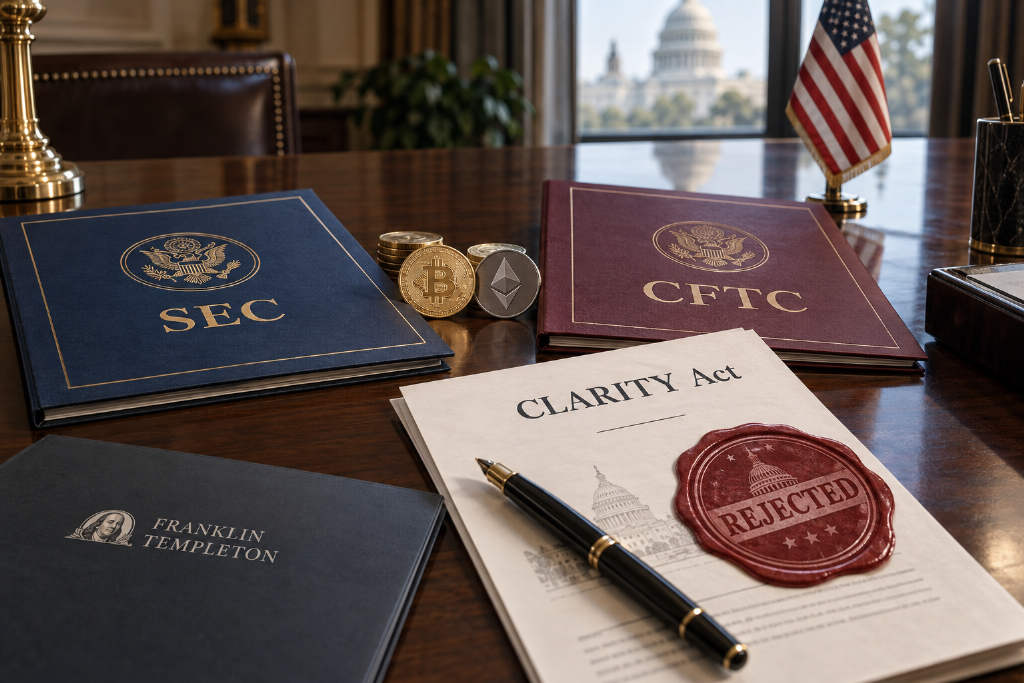
Chris Perkins, head of Franklin Crypto, said the crypto industry still has meaningful regulatory clarity even after the U.S. Senate failed to move forward with the CLARITY Act.
On the Sept. 21 episode of Unchained’s Bits + Bips podcast, which he co-hosts with Austin Campbell and Ram Ahluwalia, Perkins said, 「I think we’re fine either way. We have clarity.」 He added that the clarity already provided is 「very powerful for institutions」 even without the bill becoming law.
CLARITY Act stalled in the Senate
The CLARITY Act stalled in the Senate on Sept. 15. A motion to take up the bill received 49 votes to 50, leaving it 11 votes short of the 60 needed. The result marked a major setback for the crypto industry’s push to put digital-asset rules into federal law.
Perkins argued that the practical effect is smaller than the headlines suggest because the key U.S. regulators overseeing crypto have already acted on their own.
Perkins points to SEC and CFTC action
His argument rests on recent moves by the U.S. Securities and Exchange Commission and the Commodity Futures Trading Commission.
Two days after the Senate vote, the SEC issued a five-year innovation exemption that allows venues to trade tokenized U.S. stocks on public blockchains without registering as national securities exchanges, according to CoinDesk.
The CFTC, operating with a single commissioner under Chairman Michael Selig, has said it will write its own crypto rules if Congress does not act.
Perkins said that resolves what he described on the podcast as the industry’s long-running taxonomy problem. 「We didn’t know what was a security and we didn’t know what was a commodity. Now,」 he said, 「we’ve got great rules for both.」
He also said that where a token with cash flow would previously have been treated as a security and effectively left behind, regulators have now removed that barrier. 「The regulators are providing that clarity,」 he said.
He calls it a regime change
Perkins described the shift as a 「regime change」 and said it is larger than many investors realize.
He said crypto is starting to trade on fundamentals rather than as a frontier risk asset driven by macro and geopolitical stress. As an example, he pointed to bitcoin rising even after the Federal Reserve raised interest rates on Sept. 16 for the first time since 2023.
「There’s a lot of reasons for a frontier risk asset not to be performing right now,」 Perkins said on the show.
He noted that bitcoin closed above its 50-week moving average on the weekly chart for the first time in roughly 45 weeks and was trading above $87,000 during Monday’s episode.
Why he is not troubled by the lack of legislation
Perkins said he was not troubled that regulators, rather than Congress, delivered the framework. He pointed to the courts’ retreat from Chevron deference to agencies.
In what he called the post-Chevron world, 「these regulators, they’re smart.」 Speaking about Selig, Perkins said, 「I know Chairman Selig,」 and described him as 「someone who was a very strong attorney.」
He also said a statute still would have been preferable. 「Enshrinement would’ve been great. Federal preemption would’ve been great,」 he said. Even so, his conclusion was simple: 「We march on.」
The clarity in place can still change or expire
The framework now in place is not permanent. The SEC’s exemption lasts five years and was issued together with a request for public comment. The CFTC’s recent crypto guidance also states that it is not binding on the commission.
The bill itself may not be finished. Within days of the failed vote, seven Senate Democrats reopened negotiations on market-structure legislation.
That leaves an open question beneath Perkins’ optimism: whether regulatory clarity that can be revised or allowed to expire carries the same weight for institutions as a law passed by Congress. His co-hosts pressed him on that point, with Campbell noting that both of the CFTC’s instruments describe themselves as temporary.