
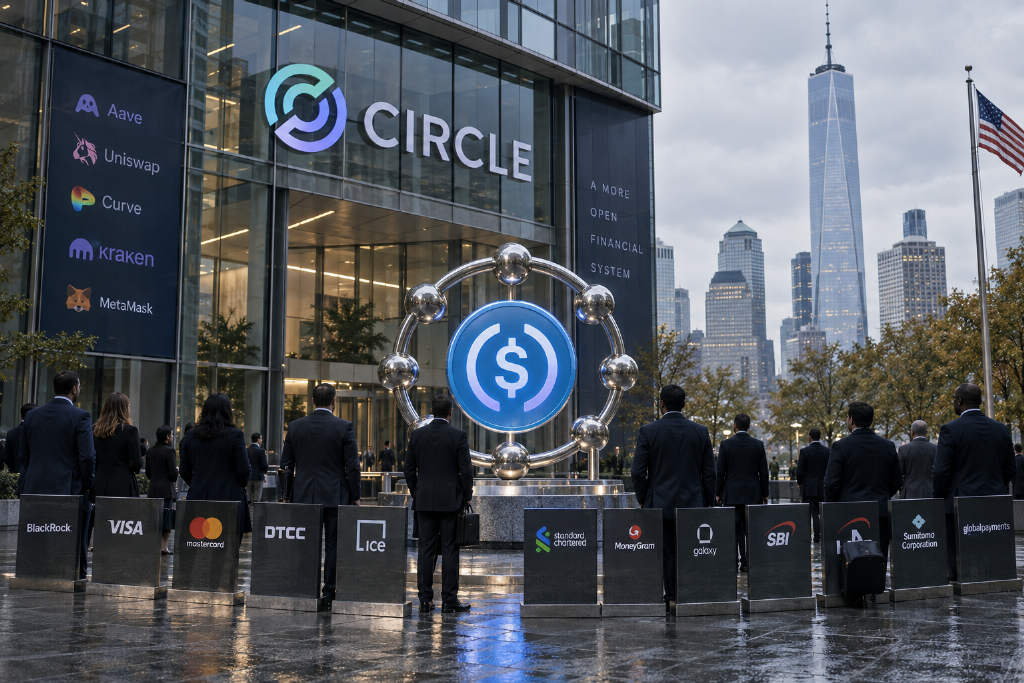
Circle will open the public mainnet for Arc on Sept. 16. According to the PANews report, the chain’s genesis validator list includes BlackRock, DTCC, Intercontinental Exchange, Visa, Mastercard, Standard Chartered, MoneyGram, Galaxy, Sumitomo Corporation, SBI Group and Global Payments.
The lineup is notable for what it does not include: the article says none of the names are crypto-native projects. In that framing, Arc was not designed to answer whether crypto needs another Layer 1. It was built around a different question — if stablecoins become global payment rails, who operates the underlying system that keeps those rails running? Circle’s answer is to build that system itself.
How Circle positions Arc
Arc is a Layer 1 blockchain developed by Circle and described as an economic operating system for the internet. The report highlights three design choices that set it apart from most other L1 networks.
First, USDC serves as the native gas token. Transaction fees are priced in dollars and paid in USDC. The article says this gives traditional financial institutions a cost structure that is predictable and easier to book, without exposure to volatility from a separate native token.
Second, Arc targets sub-second deterministic finality. Its consensus engine, Malachite, comes from Byzantine fault tolerance technology brought in after the Informal Systems team joined Circle, and the system is described as having evolved from Tendermint. In practice, the report says, once a transaction is confirmed it cannot be rolled back. That matters for point-of-sale payments, real-time foreign exchange settlement and brokerage clearing.
Third, Arc combines EVM compatibility with compliance-oriented privacy. The execution layer is built on Reth and is fully compatible with Ethereum’s Solidity tooling and contract libraries. It also offers an optional privacy layer exposed through EVM precompiles, supports pluggable cryptographic back ends, and keeps an audit disclosure channel. The article’s point is straightforward: privacy on Arc is designed to work with compliance requirements, not against them.
Day-one ecosystem spans DeFi, payments and wallets
The report says Arc will not launch as an empty chain. Circle has already disclosed a day-one ecosystem covering DeFi protocols, payment providers, wallets and exchange-related entry points.
DeFi protocols and capital allocators
The list includes Aave, Aerodrome, Morpho, Uniswap, Curve, Euler Finance and Fluid. It also includes market-making and capital deployment firms such as FalconX, Galaxy, GSR, Keyrock, Nonco and XFX. The article presents this as a near-complete set of core components for lending, trading and onchain capital allocation.
Stablecoin payment service providers
Rain, Thunes and Wirex are listed among the early payment participants, covering card settlement, compliant consumer-facing platforms and global cross-border payment networks.
Wallets and exchange gateways
Binance Wallet, Chainlink, Fireblocks, Kraken, Ledger, MetaMask, Uniswap Labs and Upbit are named in the first-day ecosystem. The report characterizes that as broad coverage across major user and institutional access points.
Arc also includes StableFX, an onchain foreign exchange engine built to support real-time conversion between stablecoins denominated in different currencies. Together with deep integration of Circle’s CCTP cross-chain transfer protocol and Paymaster gas sponsorship service, the article says Arc gives developers a ready-made toolkit for building stablecoin financial applications.
ARC token design: 10 billion initial supply, 60% for the ecosystem
Circle’s white paper, published in May 2026, outlines the token framework for ARC. Initial supply is set at 10 billion tokens. Annual issuance is projected at 2% to 3%, with a long-term target described as “inflation neutral.”
ARC is positioned as the coordination mechanism for the Arc network. As the network transitions toward a proof-of-stake consensus model, the token is intended for staking, governance and network incentives.
On allocation, 60% is earmarked for the ecosystem. The article says that bucket covers token sales, developer grants, network growth programs and other participation mechanisms.
The report also cites Cryptonomist as saying the ARC presale has raised $222 million at a $3 billion valuation, led by a16z crypto, with BlackRock and Apollo participating.
There is still no officially confirmed airdrop plan. Even so, the article says Circle CEO Allaire has publicly stated that the company is “actively exploring” a native token. Combined with the tokenomics in the white paper — especially the 60% ecosystem allocation — that has fueled expectations among users.
Testnet metrics are also part of the discussion. The article says the Arc testnet has processed more than 500 million transactions and attracted nearly 3 million wallet addresses, figures that many users are treating as a possible qualification signal.
Arc ecosystem map before mainnet launch
According to ArcLens, a third-party project directory cited in the report, more than 308 projects currently claim to be building on Arc. The article groups the most notable names into several tiers.
Tier one: blue-chip DeFi projects confirmed for early deployment
Uniswap v4: The article says Uniswap announced on Aug. 17 that it will deploy v4 AMM infrastructure when Arc mainnet goes live, adding liquidity pools and programmable hooks. The report ties Uniswap’s arrival directly to early trading depth on Arc.
Aave: The lending protocol has confirmed deployment on Arc, where users will be able to borrow and lend USDC and other supported assets.
Morpho: The modular lending protocol, focused on rate optimization, is described as complementary to Aave.
Aerodrome / Velodrome (Dromos Labs): Aerodrome on Base and Velodrome on Optimism are backed by the same team, Dromos Labs, and have confirmed entry into the Arc ecosystem. The article notes that Aerodrome’s early incentive and veToken model on Base could be replicated on Arc.
Curve: As a long-running venue for stablecoin swaps, Curve is presented as a natural fit for a network where stablecoins are central to fee payment. The article says Arc’s native StableFX engine could end up complementing Curve or competing with it.
Euler Finance and Fluid: Both protocols have tested versions deployed on the Arc testnet and are confirmed to go live alongside mainnet.
edgeX (EDGE): Backed by Circle Ventures, edgeX is a perpetual futures DEX that has secured exclusive launch-partner status for Arc foreign exchange perpetuals. The article says it will begin 24/7 USD/JPY perpetual trading on Sept. 16 and later expand to more than 150 markets covering U.S. equities, commodities and crypto.
Tier two: market makers and liquidity providers
FalconX, Galaxy, GSR, Keyrock, Wintermute, IMC, Auros, B2C2, Cumberland and Zodia Markets are grouped into the second tier. The report says the presence of major market makers should help Arc avoid the thin liquidity and sharp price swings that often accompany new-chain launches.
Tier three: Arc-native projects
These are projects built specifically for Arc and, according to the article, have not received official backing from Circle. That makes them higher risk, but also more directly exposed if Arc’s ecosystem expands.
ViFi Labs: A decentralized foreign exchange protocol focused on emerging market currencies including the Nigerian naira, Brazilian real and Colombian peso. It uses an AMM architecture built for correlated assets and aims to deliver near-zero-slippage swaps. The project is already deployed on the Arc testnet, with Arc serving as its main liquidity and execution venue.
ARCLaunch: Described in the report as an Arc version of Pump.fun, the platform is positioned around one-click token issuance and trading. Planned features include an integrated cross-chain bridge, unified balances, Uniswap integration, creator fees and a referral system.
AstraPump: Another launchpad and DEX focused on one-click token launches and trading. The article says it ranks high on ArcLens’ trending list and is in direct competition with ARCLaunch.
Lunex: A Curve-style StableSwap AMM focused on low-slippage stablecoin trading.
Orixa (ORIXIANS): An Arc-native NFT marketplace that plans to sell the ORIXIANS NFT series after mainnet launch. The report says it has not yet clarified whether a token will be issued.
Tier four: payment infrastructure
Blockradar: The article points to Circle’s official blog on July 13, which introduced the team as a payment infrastructure provider for enterprise users.
Rain, Thunes and Wirex: These names reappear here because of their exposure to card settlement and cross-border payment activity. The article says retail participation is limited, but their traction could serve as an early signal for whether Arc’s “payments chain” narrative is taking shape.
What the article says to watch in the 24 hours before launch
- Prepare USDC. Since Arc operations use USDC for gas, users need enough USDC on Ethereum or another chain supported by CCTP.
- Set up wallets. MetaMask has confirmed support for Arc, and users can add Arc’s Chain ID and RPC endpoint after mainnet launch. Ledger hardware wallets are also confirmed to support the network.
- Watch the bridge. Circle’s CCTP is the official path for moving USDC from other chains into Arc. The article warns that fake “ARC Bridge” phishing sites have already appeared and says users should stick to Circle’s official channels.
- Track ArcLens and official ecosystem pages. ArcLens is presented as the most comprehensive third-party directory for monitoring token prices, market capitalization, trading volume and liquidity data across the ecosystem.
- Use the testnet. ARC airdrops remain unconfirmed, but the report says the 60% ecosystem allocation in the white paper, together with the existing Community Program of badges and points, has made testnet activity a focus for users positioning ahead of launch.
The article ends on a simple note: everything is ready, and the market is waiting for the doors to open.



