Circle’s stock, CRCL, closed at $103.23 on Sept. 3, up 16.46% on the day after touching an intraday high of $103.28. The close was just $0.05 below the session peak. Coinbase rose 10.14% the same day to $192.70.
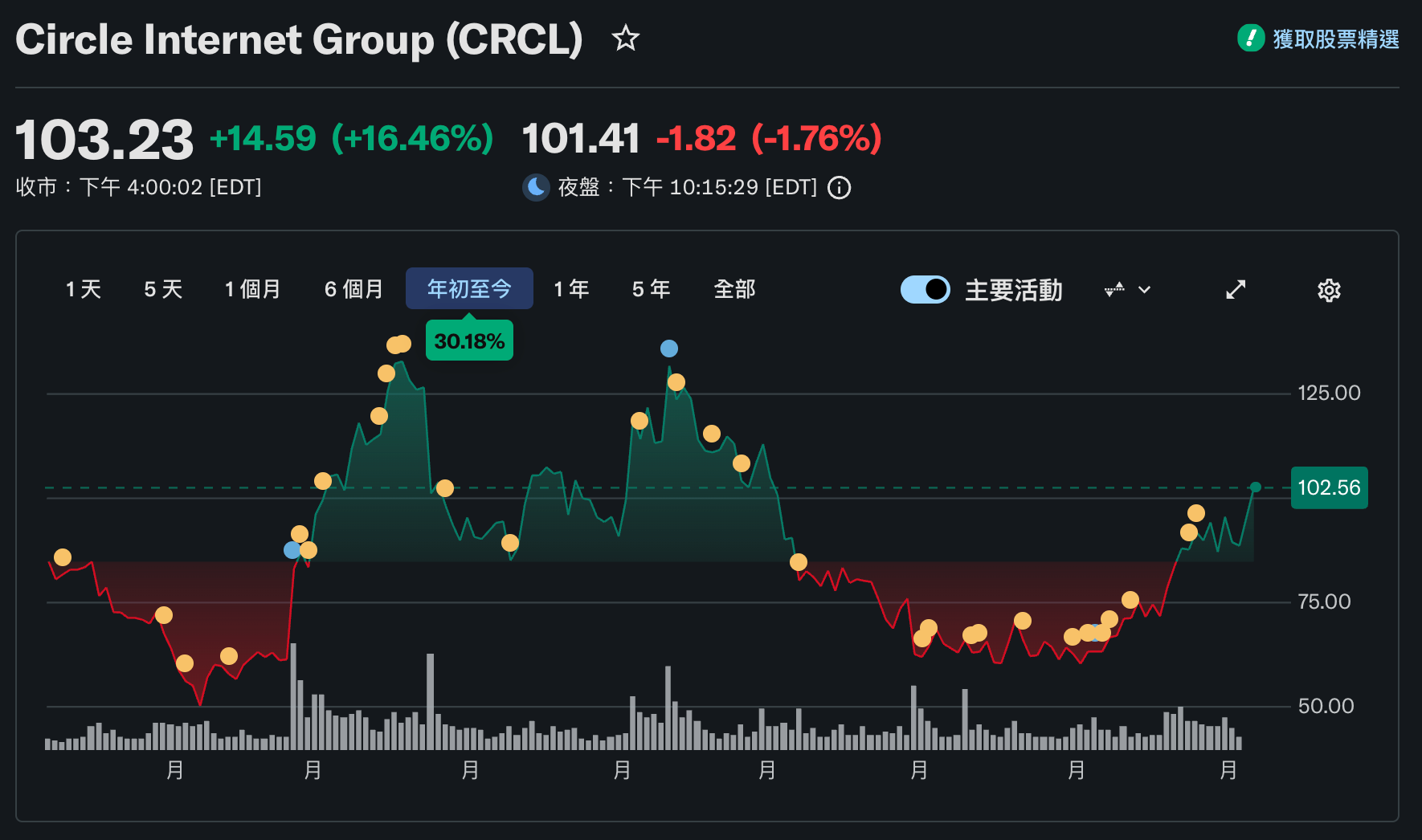
Measured from Aug. 3, when CRCL closed at $60.35, the stock has rebounded by about 71% in one month. Bitcoin gained 5.02% on Sept. 3 to about $81,200 and reached as high as $82,300 intraday, providing the direct push for crypto-linked equities. CRCL outperformed both BTC and Coinbase in daily gains.
The move has also been supported by company-specific developments. Over the past two months, Circle secured a U.S. federal trust charter and a New York state trust license, USDC operations kept expanding, and the Arc public mainnet is set to launch on Sept. 16. Together, those factors have lifted market expectations for the company.
The rebound follows a sharp drop from late June to early August
The latest rally has repaired much of the sell-off seen between late June and early August. At the end of June, CRCL fell 17.5% in a single day after the Open Standard alliance announced OUSD, a stablecoin backed by more than 140 companies.
Around the same period, Morgan Stanley cut its price target at the beginning of August from $106 to $38, citing pressure from tokenized money market funds, competition from OUSD and slower USDC growth.
USDC growth offset part of the pressure from lower rates
Circle issues USDC and earns most of its revenue from interest on the cash and short-term U.S. Treasuries that back the stablecoin. A larger USDC supply usually means a larger reserve base for Circle to invest, while lower Treasury yields reduce income generated by a similar reserve pool.
According to its financial results, USDC circulation stood at $73.3 billion at the end of the second quarter of 2026, up 19% year over year. On-chain transaction volume reached $14.8 trillion in the quarter, up 151% from a year earlier. Circle reported total revenue and reserve income of $701 million, up 7%, with reserve income at $668 million, or about 95% of the total. Net income was $48 million, and adjusted EBITDA came in at $143 million.
Average USDC circulation in the second quarter rose 25% year over year, offsetting part of the effect from a 66-basis-point decline in reserve asset yield. Reserve income still increased 5% from a year earlier. Over the same period, Circle Payments Network reached an annualized transaction volume of $14.7 billion based on the most recent 30 days, up 76% quarter over quarter, while connected financial institutions increased to 175. Payments network, technology services and transaction revenue remain early-stage businesses, and other revenue for the quarter was $34 million.
Costs remain heavy. Circle’s distribution, transaction and other costs totaled $412 million in the second quarter, including $324.6 million in distribution costs paid to Coinbase. If USDC growth comes mainly through exchanges and partners that require revenue sharing, a meaningful portion of incremental reserve income will continue to go to those channels.
Payments and enterprise services are the next revenue test
Circle is trying to add more fee income through payments and enterprise services. BNY has integrated USDC custody, minting and redemption into its digital asset custody platform. Nium has connected Circle Payments Network to local payment rails across more than 190 countries and 100 currencies.
On Aug. 28, Circle also became a principal partner of Chelsea FC. The USDC logo will appear on the front of shirts worn by the men’s, women’s and academy teams. That marketing push extends Circle’s brand exposure beyond crypto-native users to a global sports audience.
Arc adds a second valuation line beyond reserve income
Circle plans to open the Arc public mainnet on Sept. 16. Arc is a Layer 1 built for stablecoin payments, foreign exchange and tokenized assets. It uses USDC to pay gas fees, offers sub-second finality, optional privacy features and compatibility with Ethereum developer tools.
In August, Circle disclosed 11 founding validators, including BlackRock, DTCC, Galaxy, ICE, Mastercard, Visa, Standard Chartered and SBI Group. BlackRock plans to deploy its tokenized money market fund BUIDL on Arc. DTCC plans to support tokenization and stablecoin settlement on Arc for assets under its custody starting in the second half of 2027. Circle said more than 100 institutions and ecosystem builders are already participating in the Arc private mainnet.
Arc extends Circle’s revenue opportunity from USDC reserve interest into network fees, developer tools and institutional services, but those lines still need to be proven after launch. Other revenue accounted for only about 5% of total revenue in the second quarter. Trading volume after Sept. 16, the amount of USDC retained on the network and the pace of institutional adoption will determine whether Arc can gradually change Circle’s current revenue mix.
Licenses, patent acquisition and exchange integrations all feed the long-term case
Arc is not the only piece of the story. On July 10, the Office of the Comptroller of the Currency gave final approval for Circle to establish Circle National Trust, a national trust bank that can provide federally regulated digital asset custody services and may also create room for future management of USDC reserves. On July 31, the New York State Department of Financial Services approved a limited-purpose trust charter for Circle New York Trust.
On Aug. 6, Circle integrated native USDC and its Cross-Chain Transfer Protocol, or CCTP, with X Layer, the network affiliated with OKX, adding another usage scenario for USDC inside exchange ecosystems.
Earlier, on July 27, Circle acquired IBM’s blockchain patent portfolio as part of its long-term push in payments, tokenized assets and cross-chain infrastructure. The company did not disclose the purchase price, but said after the deal closed it became the U.S. company holding the largest number of blockchain patents. The national trust bank gives Circle a federal custody qualification, the IBM patents cover on-chain technology, and Arc brings USDC into a proprietary settlement network. Whether those investments can materially increase revenue still depends on later customer usage.
Valuation remains a point of dispute on Wall Street
With CRCL back above $100, Circle’s market capitalization is about $26.2 billion. Even so, that remains below its 52-week high of $159.47.
Wall Street views on the stock remain far apart. Bernstein maintained an Outperform rating and a $140 price target on Aug. 31, arguing that stablecoin payments, RWA and AI agent payments could keep expanding demand for USDC. Goldman Sachs, Wolfe Research and Morgan Stanley have recently set targets of $81, $65 and $37, respectively.
Firms with lower targets are mainly focused on three pressures:
- rate cuts would directly reduce returns on reserve assets;
- distribution partners such as Coinbase retain strong bargaining power over revenue sharing;
- new stablecoins such as Open USD may compete for balances held by exchanges and payment institutions.
Circle’s second-quarter revenue rose 7%, far below the 151% increase in USDC on-chain transaction volume. That gap suggests that higher on-chain activity has not been translating into company revenue at the same pace.
Two upcoming dates now stand out. The U.S. Senate is expected to hold a key procedural vote on a crypto market structure bill on Sept. 15, and Arc’s public mainnet is scheduled to go live the next day. Those events are likely to keep shaping the market’s view of Circle’s regulatory premium and growth outlook.