
Circle has opened its Cross-Chain Transfer Protocol, or CCTP, to all token issuers. On Nov. 2, Circle co-founder and CEO Jeremy Allaire said in a post on X that CCTP was now available to all token issuers, calling it a "major unlock" for asset issuers. Circle had already published a developer guide on Oct. 30 explaining how ERC-20 issuers can integrate with CCTP.
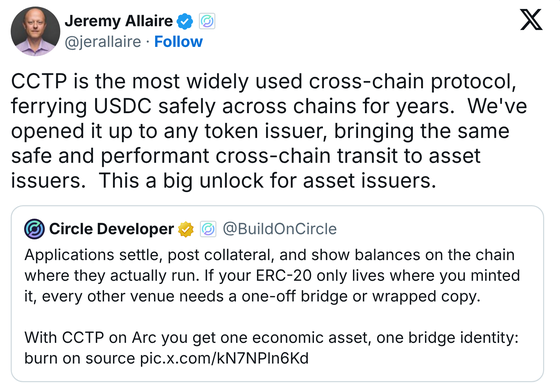
CCTP launched in April 2023 and had previously been used mainly for USDC. According to DefiLlama data cited in the report, CCTP recorded $182.05 billion in cumulative cross-chain volume from the start of tracking in January 2024 through Nov. 2, 2026. As of Nov. 3, its 30-day volume stood at $17.61 billion, ranking first among bridges tracked by DefiLlama. Total bridge volume over the same period was $48.76 billion, with LayerZero second at $12.48 billion.
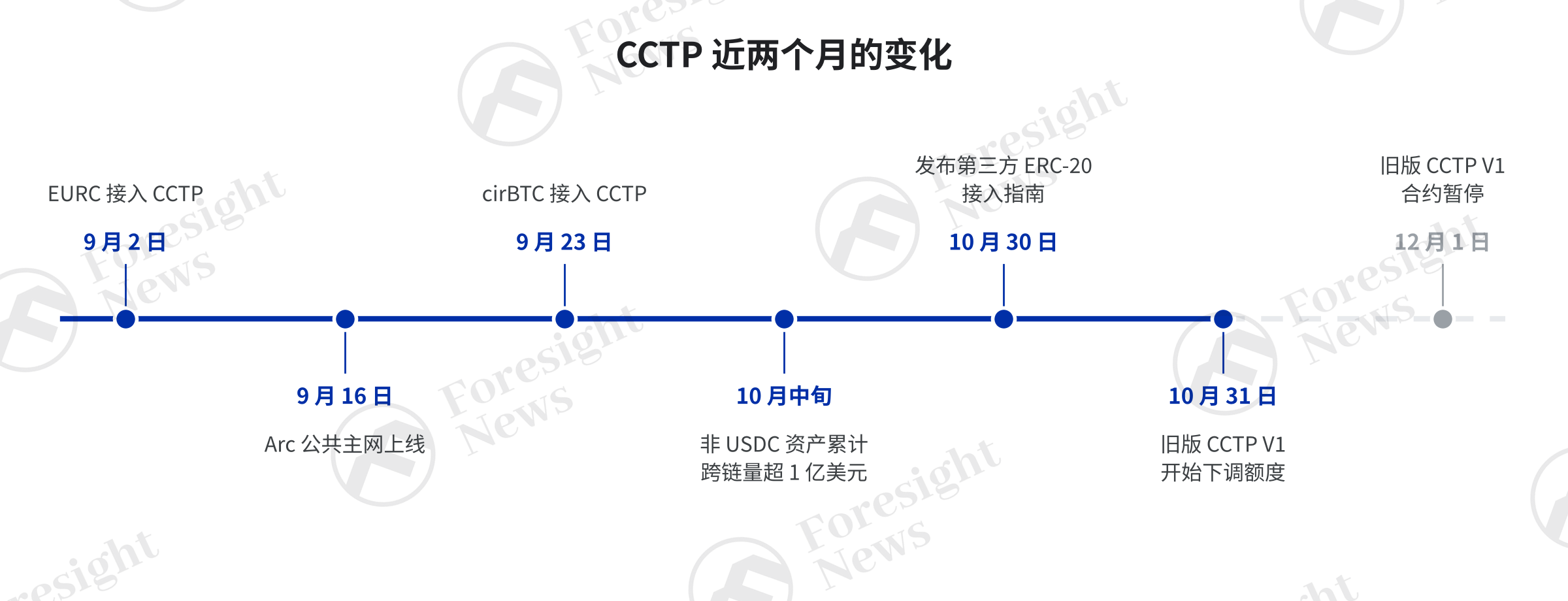
Before the third-party integration guide was released, non-USDC assets on CCTP were mostly Circle-linked assets including cirBTC, EURC and WETH. Circle said on X that, as of mid-October, cumulative cross-chain volume for those assets had only just exceeded $100 million.
From a USDC-only rail to a public route in two months
CCTP’s expansion has been concentrated over the past two months.
- On Sept. 2, Circle’s euro stablecoin EURC was added to CCTP.
- On Sept. 16, Arc, Circle’s self-built blockchain, launched its public mainnet.
- On Sept. 23, the Bitcoin-backed token cirBTC joined the protocol.
- On Oct. 30, Circle published the third-party integration guide.
Over the same stretch, the older CCTP V1 used by USDC began to wind down. Starting Oct. 31, limits on CCTP V1 were reduced in stages, and the contracts are set to pause on Dec. 1. Developers need to migrate to V2 before then.
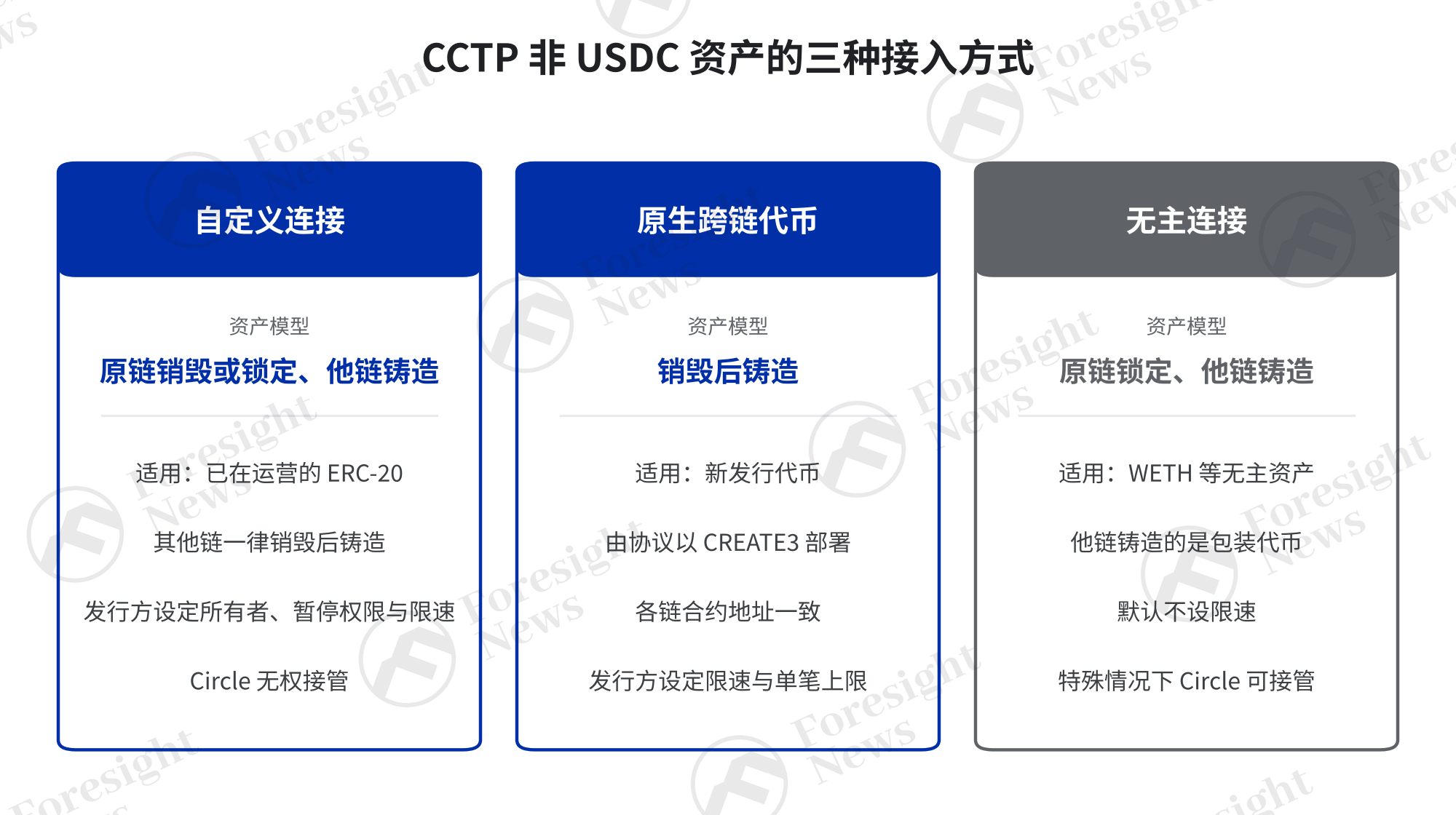
The underlying verification model has not changed. After tokens are burned or locked on the source chain, Iris, the signing service run by Circle, issues an attestation. The destination chain then mints or unlocks the same amount of tokens against that proof. For third-party tokens, Circle uses a separate entry contract. Rate limits, per-transfer caps and pause authority are handled by each token’s own management contract. Cross-chain fees are quoted by Iris on a per-transaction basis and paid in the source chain’s native gas token.
Existing ERC-20 tokens do not need to migrate chains to connect. They can be set up through a "custom connection" model. Under that setup, issuers on the original chain can choose burn-and-mint, which requires granting minting authority to the CCTP management contract, or lock-and-unlock. On all other chains, the model is burn-and-mint. Ownership, pause authority and rate limits are set by the issuer, and Circle says in its documentation that it has no authority to take over.
New tokens can be deployed directly as native cross-chain tokens through the protocol. Assets such as WETH, where the issuer is not involved, use a "permissionless connection" model: tokens are locked on the original chain and wrapped tokens are minted elsewhere. No rate limit is set by default, and Circle can take control in special cases such as security incidents.
The main difference is not the asset model, but who verifies transfers
By transfer design, mainstream bridges can be broadly split into two groups.
One group consists of token standards and messaging protocols that burn or lock tokens on the source chain and mint on the destination chain at the contract level. CCTP, LayerZero’s OFT, Wormhole’s NTT and Chainlink’s CCT built on the Cross-Chain Interoperability Protocol, or CCIP, all fall into this category. The other group includes intent and liquidity bridges such as Across and Relay, where market makers front liquidity on the destination chain and issuer participation is not required. By opening CCTP to third parties, Circle is moving directly into competition with the first category.
At the asset-model level, the token standards are fairly similar. New tokens generally use burn-and-mint. If the original chain contract is left unchanged, the setup is lock on the source chain and mint elsewhere. When issuers configure the system themselves, they also retain control over rate limits and pause authority.
The key difference is who confirms that tokens were burned or locked on the source chain.
- OFT lets issuers choose their own Decentralized Verifier Network, or DVN, combinations. Issuers including USDT0, Ondo and PayPal also run their own DVNs.
- Wormhole relies on signatures from at least 13 of its 19 Guardian nodes.
- Chainlink uses a default committee-based verification network made up of 16 node operators, with the option to add more validators.
- CCTP relies on signatures from Iris, which is operated by Circle.
Validator design has direct security implications. On April 18, 2026, KelpDAO’s rsETH bridge built on OFT was attacked, with losses of about $292 million. LayerZero later said KelpDAO had configured only one DVN, LayerZero Labs, at the time. The attacker compromised the RPC nodes used by that DVN and forged cross-chain messages. KelpDAO later switched to Chainlink CCIP.
A September 2026 assessment by risk evaluator LlamaRisk on the Aave governance forum said CCTP uses a 2/2 signing threshold and that all signers are controlled by Circle. It also said Arc’s CrossChainTokenService is an upgradeable contract with no multisig or timelock, and each token’s management contract depends on it to resolve code implementation during calls. In other words, issuers can set parameters for custom connections, but upgrade authority over the underlying contracts still sits with Circle.
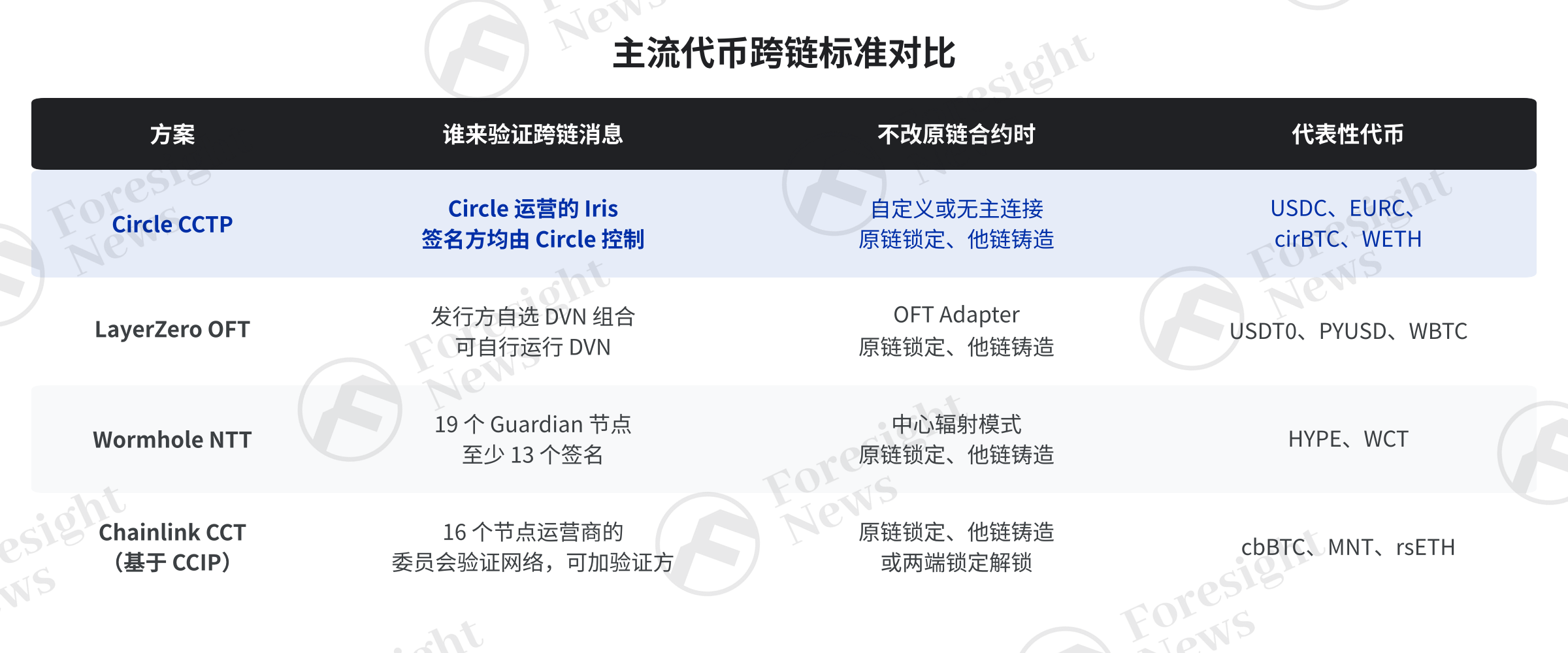
With OFT, issuers can decide how many validators to use and which ones to trust. With CCTP, issuers neither need to configure validators nor are allowed to do so. Everything depends on Iris. For USDC holders, that does not introduce a new trust assumption. For other issuers, though, integrating CCTP means handing cross-chain verification to a single company: Circle.
Large issuers may have little reason to switch now
CCTP leads in bridge volume, but almost all of that volume comes from USDC itself. Outside USDC, many large issuers have already adopted other standards.
LayerZero said in June 2026 that more than 830 tokens had adopted the OFT standard, including Tether’s USDT0, Ethena’s USDe, PayPal’s PYUSD and Ondo’s USDY. In October 2026, the Canadian dollar stablecoin CADC also said it would use OFT.
USDT’s cross-chain route also uses OFT. USDT0 was launched by Everdawn Labs on OFT and is backed 1:1 by USDT. Tether also made a strategic investment in LayerZero Labs in February 2026.
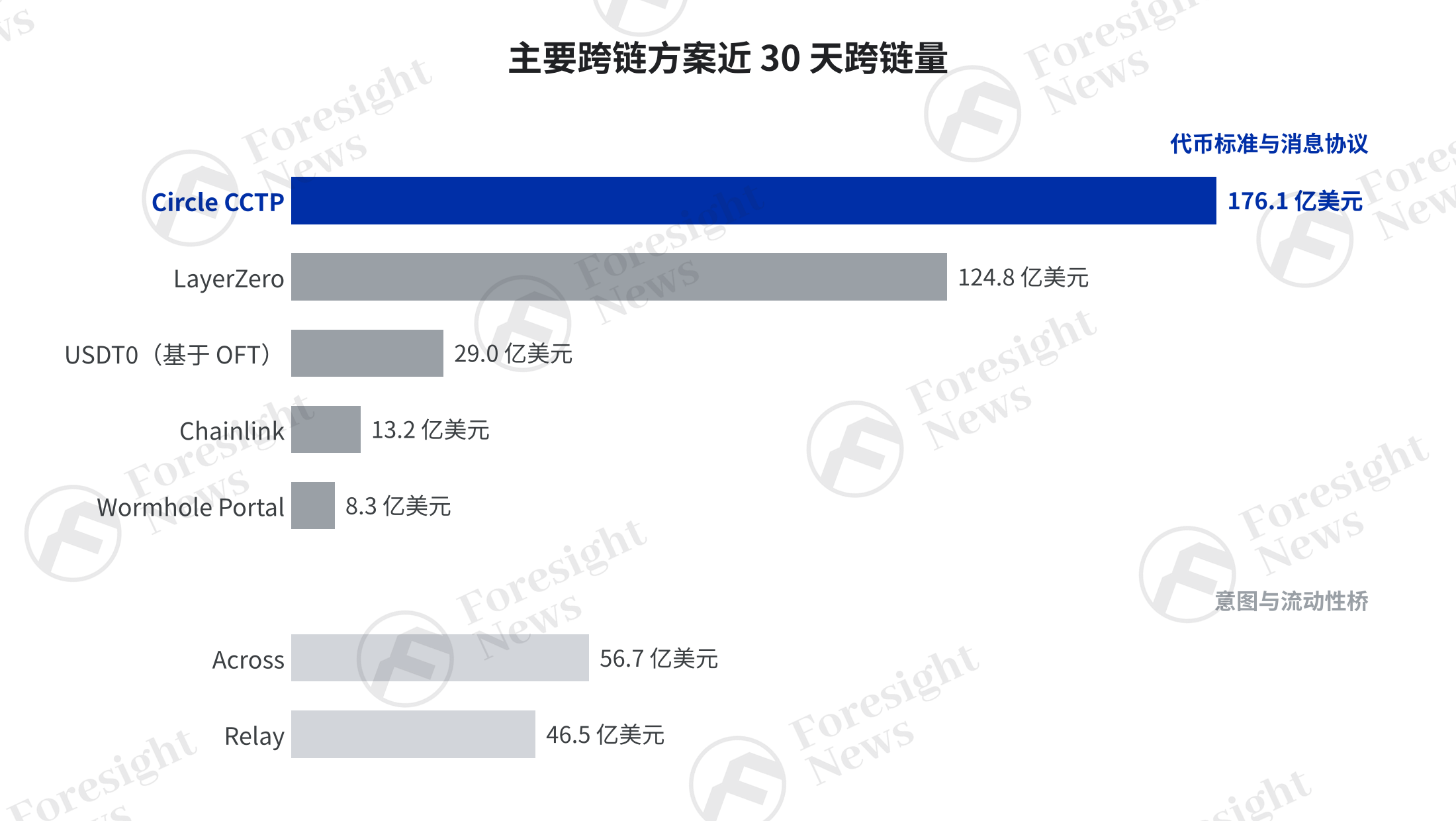
Earlier disclosures showed cumulative trading volume for USDT0 had surpassed $100 billion by June 2026. DefiLlama shows its 30-day cross-chain volume at $2.9 billion. For tokens that already use OFT, moving to CCTP would require reconfiguring contracts and mint permissions across chains.
Issuers are not locked into one bridge forever. KelpDAO switched from LayerZero OFT to Chainlink CCIP after the rsETH attack. As for intent bridges such as Across and Relay, their 30-day volumes were $5.67 billion and $4.65 billion, respectively, but they can only move tokens that already exist on the destination chain. They do not determine which token standard an issuer chooses.
Coverage is another constraint. Circle said in an August announcement that CCTP V2 for USDC supports 27 chains. But according to Circle’s contract address documentation, non-USDC tokens are currently deployed only on Ethereum, Avalanche, OP Mainnet, Arbitrum, Base, Polygon PoS and Arc, all of them EVM chains. By comparison, information disclosed by LayerZero in June 2026 said OFT tokens had already reached more than 170 chains.
That leaves Circle with the largest cross-chain traffic lane in the market, but also with a concentrated verification model and limited non-USDC coverage. Many major issuers have already been operating on OFT for some time. Based on the facts laid out in the report, the case for switching to CCTP does not yet look compelling for them.