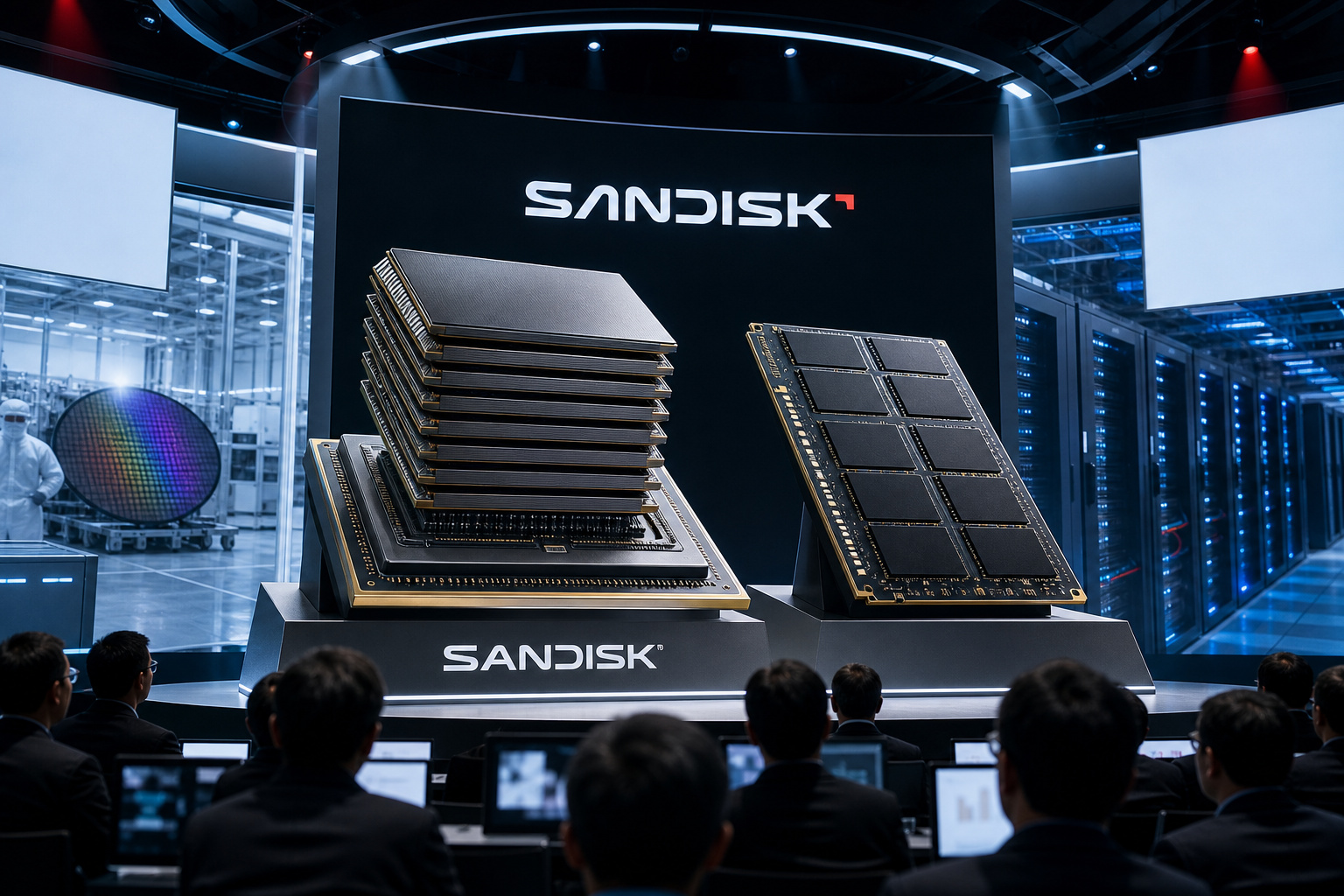
Citrini analyst Zephyr challenged SanDisk’s HBF-versus-HBM comparison shown at its investor day, arguing that the setup may have understated HBM’s real capabilities. In his post, he said SanDisk assigned the same total bandwidth of 12.8 TB/s to both HBF and HBM, which works out to 1.6 TB/s per stack, and used the Qwen3-480B-A35B model running in bfloat16 for the demonstration. Zephyr said current inference workloads more commonly use FP4 or FP8, putting the model’s memory requirement at roughly 240 GB to 480 GB depending on quantization. He also said SanDisk fixed HBM capacity at 192 GB per GPU, while a 16-layer HBM4E setup with eight stacks can reach 512 GB and deliver about 32 TB/s of bandwidth, around three times the level used in the company’s demo. Based on that, Zephyr argued that SanDisk’s result showing HBF needing only one to four GPUs while HBM needed eight does not adequately reflect the performance of higher-spec HBM configurations.
BlockBeats reported on Aug. 14 that Citrini analyst Zephyr questioned SanDisk’s HBF and HBM performance comparison presented during the company’s investor day, saying the demo parameters may have been set in a way that "deliberately understated HBM performance."
Zephyr said SanDisk assigned both HBF and HBM the same total bandwidth of 12.8 TB/s in the comparison, equal to 1.6 TB/s per stack, and used the Qwen3-480B-A35B model in bfloat16.
He added that current model inference is more commonly run in FP4 or FP8, which would put the model’s memory requirement at about 240 GB to 480 GB depending on quantization.
Zephyr also said SanDisk fixed HBM capacity at 192 GB per GPU in the presentation, even though a 16-layer HBM4E configuration with eight stacks can reach 512 GB of capacity and offer about 32 TB/s of bandwidth, roughly three times the bandwidth used in SanDisk’s demo.
In his view, those parameter choices mean SanDisk’s result showing that HBF would need only one to four GPUs while HBM would require eight GPUs does not fully represent actual performance under higher-spec HBM configurations.
This article was originally published by Bit.Fan. For more cryptocurrency news and market insights, visit www.bit.fan. Disclaimer:
The market information, project data, and third-party content displayed on this platform are for industry information sharing only and do not constitute any form of investment advice or return commitment.
Cryptocurrency trading carries high risks. Users should fully assess their risk tolerance and make independent decisions. All profits, losses, and legal responsibilities are borne by the users themselves.