
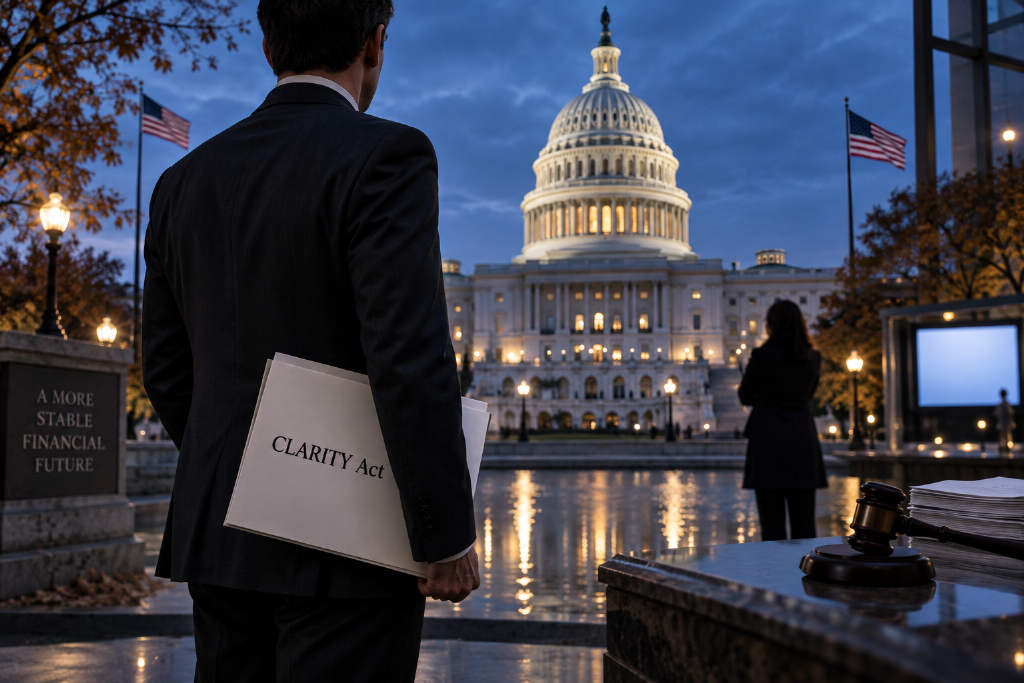
The US Senate returns on Monday after more than a month of in-state work, with the CLARITY Act back on the agenda. The bill, sought by many in the crypto industry as a way to set clearer regulatory rules, faces a narrow path to becoming law. If it does not advance now, it could be pushed into the next Congress, where the political balance may look very different.
A Senate vote this week could decide the bill’s immediate future
Senate Majority Leader John Thune has scheduled a cloture vote on the CLARITY Act for Tuesday. Republicans will need support from at least some Democrats to reach the 60-vote threshold required to break a filibuster and move the bill ahead.
If the bill fails to secure the supermajority needed to continue consideration, it is effectively unlikely to become law before the next Congress is sworn in in 2027. Control of Congress after that point will depend on the outcome of the November midterm elections.
Senator Cynthia Lummis, one of the bill’s strongest supporters, said on Sept. 6 that if lawmakers cannot reach agreement and send the measure to the president for signature, the next real chance for passage may not come until 2030. Lummis is not running for reelection to the Senate in 2026.
Midterm results may reshape the path forward
This year’s midterms will decide all 435 seats in the House of Representatives and 33 seats in the Senate. Event contracts on prediction market Kalshi show traders favoring Democrats to retake the House majority, while control of the Senate remains close to even.
After the 2024 election, Republicans won the Senate, the House and the presidency, giving the party unified control in Washington and allowing it to move legislation seen as favorable to the crypto sector. The GENIUS Act was one example. If that alignment flips, Republicans would have to advance future crypto bills on terms acceptable to Democrats starting next year.
Crypto PAC money is becoming a bigger factor in 2026 races
Former Ohio Democratic Senator Sherrod Brown, who once chaired the Senate Banking Committee, lost in the 2024 election after crypto industry political action committees, including Fairshake, spent millions of dollars on ads backing his opponent. Brown is now running again for the Senate seat vacated by Vice President JD Vance.
Fairshake, backed by crypto companies including Coinbase and Ripple, has become a major vehicle for the industry’s effort to help elect lawmakers seen as friendly to crypto. Many candidates supported by its ad spending won their 2026 primaries, though the PAC has not won every race.
In March, Illinois Lieutenant Governor Juliana Stratton won her US Senate primary despite a heavy round of attack ads from the industry. Incumbent lawmakers who voted for the GENIUS Act and the CLARITY Act have received support from crypto PACs, while challengers critical of the sector have been targeted in negative campaigns.
Jason Ploof, a Democratic candidate in Massachusetts’ 4th District running against incumbent Representative Jake Auchincloss in a primary, said: 「Auchincloss voted for the CLARITY Act, which is why the crypto industry is spending heavily to reelect him.」 A PAC tied to Fairshake ran campaign ads for Auchincloss.
Ploof added: 「The massive influx of outside crypto money means a small number of oligarchs have too much influence over our lawmakers and federal policy. That is exactly why we need to get big money out of politics.」
The White House and regulators are unlikely to change before 2029
Even if Democrats win one chamber in November or take back both the House and Senate, the White House will remain under Republican control until January 2029, leaving the president with veto power over legislation.
If the president vetoes a crypto bill led by Democrats, both chambers would need a two-thirds majority to override that veto.
As long as Donald Trump remains in office, leadership at the two main US financial regulators, the Securities and Exchange Commission and the Commodity Futures Trading Commission, will also stay in place. Trump appointed Paul Atkins as SEC chair and Brian Quintenz as CFTC chair. Both have said publicly that if Congress does not move the CLARITY Act this year, the agencies will issue digital asset rules on their own.