
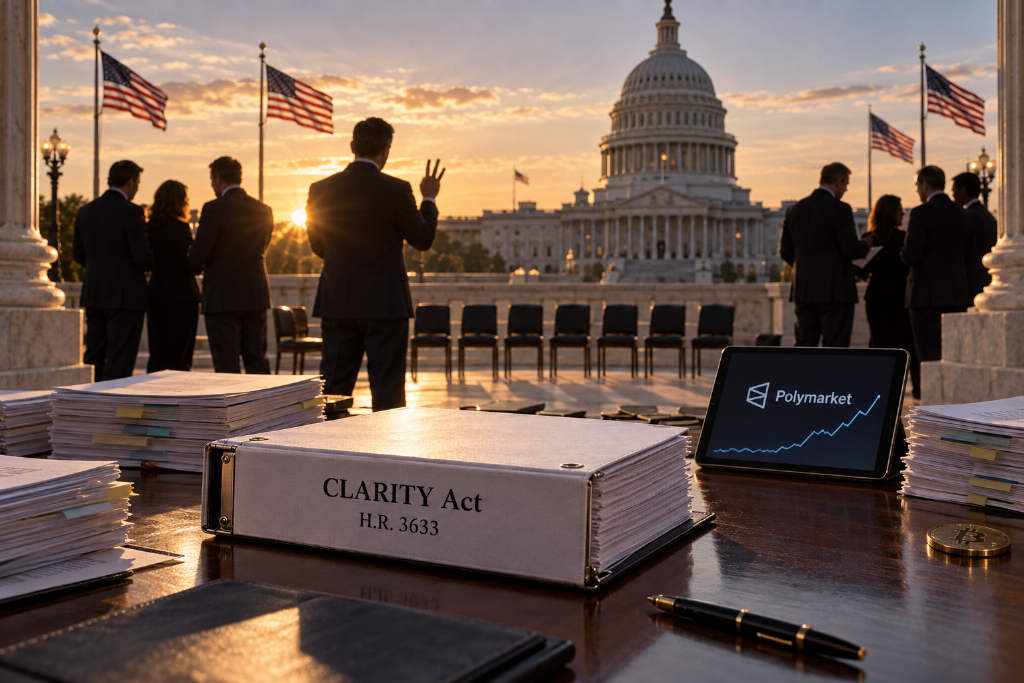
Senate Republicans released what they described as the final draft of the Digital Asset Market Clarity Act, or CLARITY Act (H.R. 3633), just before a key procedural vote set for Tuesday, Sept. 15. They said the new version incorporates 126 "substantive changes" sought by Democrats. If Tuesday's procedural motion passes, the updated text will be offered as a substitute amendment.
The cloture vote still needs 60 votes. Republicans hold 53 Senate seats, so even with full support from their own side, they would still need at least seven Democratic or independent senators to back the motion. After the revised text was published, Polymarket pricing for the bill's chances of passing this year rose from about 22% to 32%.
Republicans publish final draft before the procedural showdown
Senators Cynthia Lummis, John Boozman and Tim Scott released the bill text late Sunday and said the draft takes in 126 substantive Democratic revisions.
Republicans said the new version adopts most of the Tillis-Gallego ethics proposal, including language that would let state attorneys general enforce conflict-of-interest rules covering public officials. Some Democrats had made the inclusion of those provisions a condition for supporting the bill.
According to The Associated Press, President Donald Trump has largely agreed to the ethics provisions proposed in the CLARITY Act. Trump and his family have faced political scrutiny over their crypto businesses, including World Liberty Financial, the USD1 stablecoin and the TRUMP meme coin. His financial disclosure filings show that he received more than $1.4 billion in crypto-related income in 2025. At the same time, his administration is writing rules for the crypto industry, drawing conflict-of-interest questions.
In a statement, Lummis said: 「President Trump voluntarily accepted unprecedented ethics restrictions, placing all federal elected officials, judges, and their spouses under the strictest ethics constraints in American history. Democrats have gotten what they wanted, and now they should take yes for an answer.」
Ethics rules would cover officials and spouses, but not other family members
The bill text says the ethics restrictions would apply to public officials or government employees, the president-elect, the vice president-elect, members-elect of Congress and their spouses.
The draft does not extend those limits to other family members, including officials' children.
Draft adds a stablecoin rewards "circuit breaker"
The revised draft would also give the U.S. Treasury secretary authority to impose a "circuit breaker" on stablecoin reward mechanisms if payment stablecoins trigger large-scale withdrawals, with the aim of limiting deposit outflows from community banks. That authority would remain in effect for 18 months after the law takes effect.
This point sits inside an unresolved dispute between the banking industry and the crypto sector. Banks have pushed for tighter limits on stablecoin yield-related practices. Under the current bill text, platforms would be restricted from paying interest on users' idle stablecoin holdings, but they could still offer rewards tied to actual stablecoin use. The circuit breaker appears aimed at giving banks an emergency stop if the kind of large deposit flight community banks fear begins to materialize.
Rob Nichols, president and chief executive officer of the American Bankers Association, said earlier Sunday: 「During the August recess, bankers and bank customers spoke directly to senators and made clear that local deposits are the foundation of community credit across America. We are encouraged to see that more senators recognize the need to close the loophole on stablecoin interest in the bill and further strengthen the CLARITY Act.」
Other changes touch software developers, related-party trading and state consumer law
The new text includes several other provisions as well:
- it revises the Blockchain Regulatory Certainty Act by narrowing the set of software developers who would need to register as money transmitters and by adding a civil liability safe harbor;
- it places limits on related-party transactions and conflicts of interest within the Agriculture Committee's jurisdiction;
- and it clarifies when and how state consumer protection laws would apply.
Even if cloture passes, the calendar is still tight
Patrick Witt, executive director of the White House Digital Asset Advisors Council, wrote on X: 「After more than a year of negotiations, it is time to pass this bipartisan bill.」
Still, clearing the Sept. 15 procedural vote would only allow the Senate to formally begin considering the bill. Lawmakers would still need to process amendments, hold a final vote, and then the House would need to deal with the substitute text sent back by the Senate.
The remaining legislative window is narrow. The Senate's tentative 2026 schedule shows lawmakers entering an in-state work period on Oct. 5, while midterm election day is set for Nov. 3. House leadership has also canceled the weeks of Sept. 21 and Sept. 28, shrinking the time available before campaign season tightens its grip on the calendar.
Lummis said last week that if the CLARITY Act does not pass in this Congress, its path could be delayed until 2030, costing years of jobs, investment and tax revenue.
After the latest bill text was released, Polymarket moved the probability of CLARITY passing this year from about 22% to 32%.
