
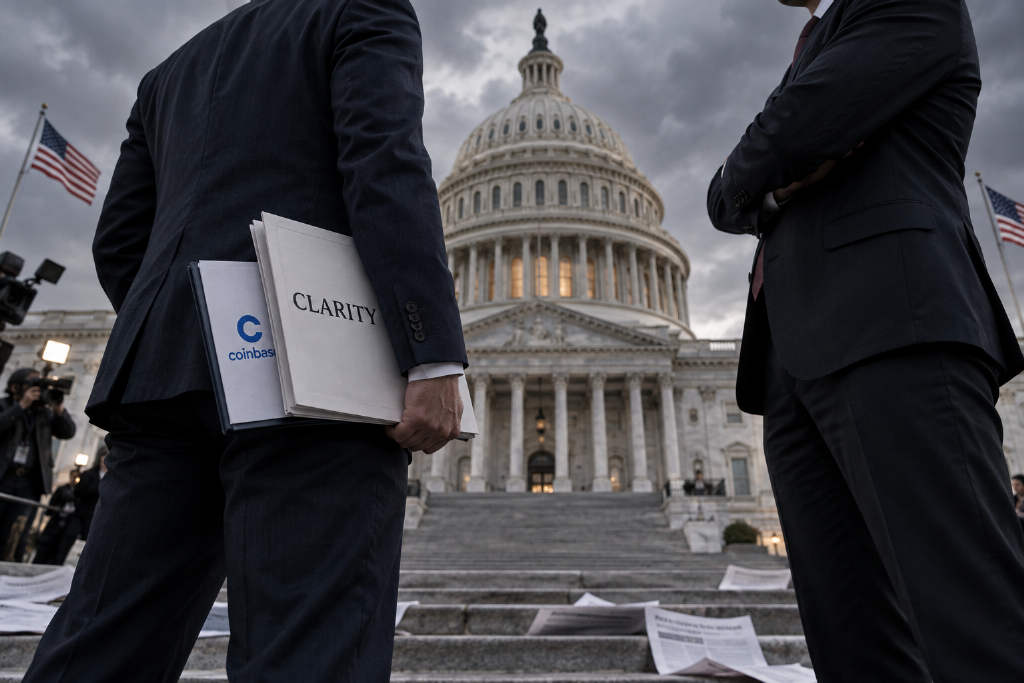
The CLARITY Act, one of the most closely watched crypto bills in Washington, failed to advance this week after falling short of the votes needed in a procedural Senate test, according to a Wall Street Journal report that lays out months of internal industry conflict, banking opposition and political fallout around President Donald Trump’s crypto holdings.
The report presents the defeat as the result of several overlapping fights: a battle over stablecoin-related rewards, repeated friction between Republicans and Democrats, and the unusually direct role played by Coinbase Chief Executive Brian Armstrong during negotiations.
Armstrong’s voicemail and the January break
In January 2026, Maryland Democratic Senator Angela Alsobrooks was preparing to end her holiday when she found a voicemail on her phone from Armstrong, the Journal reported. The message lasted about three minutes. Alsobrooks was a key lawmaker in negotiations over the bill, which was intended to support broader adoption of digital assets.
The two had already been in contact for months. But as talks between Alsobrooks and other lawmakers became more tense, some people involved in the negotiations felt Armstrong’s tone in conversations with senators was not appropriate.
According to people familiar with the matter cited by the Journal, Armstrong told Alsobrooks in the voicemail, 「You give banks an inch, and they’ll take a mile.」 The dispute centered on changes she supported that could have limited Coinbase’s ability to keep offering interest-like rewards to digital token holders. Banks had been pushing to block those arrangements, arguing they could pull deposits away from the traditional banking system.
Less than two weeks later, as an early version of the bill was nearing progress, Armstrong abruptly withdrew his support. Ahead of a key Senate vote on Jan. 15, he posted: 「We’d rather have no bill than a bad bill.」 The move shocked much of the industry.
Finger-pointing after the bill stalled
The CLARITY Act, as the legislation is known, failed this week to win enough support in a procedural vote, bringing months of negotiations to a halt. For an industry that had only recently begun to convert new lobbying power in Washington into legislative gains, and one that also had Trump’s backing, the setback was striking.
Blame spread quickly. Some crypto executives and lawmakers pointed to Democratic resistance. The Journal also said Trump’s disclosure in June of large crypto-related income intensified concerns about ethics issues tied to his family businesses.
As 2026 moved on, lawmakers were also dealing with other priorities, including the Iran war, inflation, and backlash tied to data centers and runaway AI agents. Others argued that the crypto industry missed its best opening by failing to lock in a deal earlier in the year, before those issues gathered momentum.
Armstrong’s influence in Washington
Armstrong, the CEO of Coinbase, the largest crypto exchange in the US, sat at the center of the debate. In the lobbying battle around the bill, he effectively became the industry’s lead advocate and used the sector’s leverage over the legislation to the fullest, the report said.
People involved in the talks told the Journal that, aside from Trump, few individuals carried as much influence as Armstrong. Between the 2024 election and the September vote, he traveled to Washington 13 times. For months, his lobbying team held calls with industry participants several times a week to discuss strategy around the bill. The Journal described that level of involvement as highly unusual for a single company and its chief executive.
People familiar with the matter said the 43-year-old billionaire could nearly veto provisions he disliked, and did so. That made an already difficult negotiation process harder.
Some in the industry backed his hard line. Ripple CEO Brad Garlinghouse took the opposite view, saying the tougher faction inside crypto cost the sector its chance to move the bill. 「We had a lot of momentum in January, but then one camp within the industry, in some ways, cut off our own path forward,」 he said.
Coinbase said Armstrong’s decision to pull support in January was in the best interests of the crypto industry and that the company had identified multiple problems in the bill. In a statement, Coinbase Chief Policy Officer Faryar Shirzad said: 「In order to hold the coalition together and keep the legislation moving forward, we accepted compromise after compromise.」
From the GENIUS Act to the CLARITY Act
Armstrong co-founded Coinbase in 2012. In 2024, he became an important Republican political fundraiser and donor, helping the crypto industry build a political support base that could not be ignored, the Journal said.
After Trump took office, Armstrong quickly secured a place for himself in crypto lobbying efforts. His first major test was the GENIUS Act, a bill aimed at regulating stablecoins, digital assets pegged to real-world currencies such as the US dollar.
The Journal said Armstrong stood out on Capitol Hill while pushing that bill, appearing with a shaved head and a navy suit. The measure eventually won support from a number of Democrats and was signed into law by Trump in the summer of 2025.
That was a major win for the crypto industry and highlighted Armstrong’s new standing as a key lobbyist. The CLARITY Act came next. The report described it as a companion to the GENIUS Act, but broader in scope, covering multiple parts of the crypto sector.
After facing regulatory pressure and lawsuits during the Biden administration, crypto companies wanted a durable legal framework written into law. That would let them launch new products without worrying that regulators might turn aggressive again after a political shift. The new law would also help bring crypto deeper into the mainstream financial system.
The fight over stablecoin rewards
For banks, the bill also offered a chance to limit yield-style rewards in the crypto ecosystem. Banks argued that such arrangements resembled interest paid on deposits and posed a competitive threat to traditional banking.
Stablecoin issuers were already barred from paying yield directly to stablecoin holders, but banks also wanted to stop partnership structures they viewed as workarounds.
Coinbase became the most prominent example. The company has a lucrative revenue-sharing agreement with Circle, the issuer of USDC, with the split tied to USDC balances on Coinbase’s platform. Coinbase had also recently promoted a 3.75% annual reward on USDC.
Banking representatives argued that arrangements like these could trigger a large outflow of customer deposits and threaten banks’ ability to lend and keep the economy functioning.
As CLARITY negotiations intensified, Armstrong began forcefully opposing any restrictions that might stop Coinbase from continuing its rewards program. People involved in the talks said that when negotiations became difficult, Armstrong could turn combative and unwilling to bend, to the point that even some of the bill’s strongest Senate supporters felt disrespected.
The Journal said Armstrong did not shy away from bypassing congressional staff or speaking sharply to senators, including some who were ultimately trying to help him get the bill through.
The fight over stablecoin yield became public in January. According to people involved in the talks, the drafting of an early version was chaotic, leaving Armstrong and other industry figures unhappy with the direction of the bill.
Shirzad said in a statement that Armstrong had good relationships with senators in both parties and remained respectful in those conversations. 「This was a negotiation with very high stakes, and disagreements were inevitable, but disagreements should not be confused with disrespect,」 he said.
A spokesperson for Alsobrooks said she would not comment on private conversations but had maintained positive and productive communication with Armstrong and with other leaders in digital assets and banking. 「Senator Alsobrooks’ goal remains to regulate this multibillion-dollar emerging technology,」 the spokesperson said.
A 15-page compromise list and a June turning point
Not long after a Senate committee vote was put on hold, Armstrong went on television and accused banks of using customer deposits for lending without customer consent. The Journal said the remarks amounted to an attack on long-standing banking practice.
That angered Wall Street executives. Later in January, at the World Economic Forum in Davos, JPMorgan Chase CEO Jamie Dimon pointed a finger in Armstrong’s face and called him 「full of shit,」 according to prior Wall Street Journal reporting cited in the article.
The tension fed five months of negotiations over stablecoin rewards. Some people in crypto began to feel they were giving ground on more central issues.
In May, Alsobrooks and North Carolina Republican Senator Thom Tillis announced a compromise. It would not directly ban stablecoin rewards, but it would force Coinbase to modify its rewards program. Armstrong approved the proposal, and Coinbase described it as a major concession. Banks, however, said it was far from enough.
Senate negotiators then moved on to a series of unresolved issues. To pass the bill, winning support from at least a few Democrats was critical.
In late June, Republicans pushed to reengage Democrats and sent Democratic members of the Senate Agriculture Committee a 15-page list of possible compromises. According to people familiar with the matter, Democrats signaled by the next day that they were willing to accept many of the proposals.
Armstrong then objected. The Journal said Republicans, after learning that he did not support some of the proposals, were forced to shelve several of them. Democrats were left confused by the reversal.
Trump’s crypto income turned ethics into a central issue
Not long after that, the political environment around the bill became more difficult. Trump disclosed that he had earned $1.4 billion in 2025 from family meme coin and crypto businesses. The Journal described that as an unprecedented sum for a US president.
Democrats seized on the disclosure and repeatedly used it as a line of attack ahead of the midterm elections. They also pushed harder to add ethics provisions to the CLARITY Act that would bar public officials from holding crypto, and they wanted those rules to apply to Trump and his family. Under that approach, the president and his sons would have been forced to sell large crypto holdings.
A 600-plus-page bill and a failed final push
By late summer 2026, the CLARITY Act had grown to more than 600 pages. People familiar with the matter said both Republicans and Democrats were increasingly frustrated with the process and with the number of people involved in the talks.
Banks used that period to keep weakening the bill. Community bank executives traveled to Washington to speak with their members of Congress and explain their concerns. In their view, the legislation posed an existential threat.
At the same time, Senate staff in both parties grew more frustrated with crypto lobbying groups, especially Armstrong and his team, who kept pressing for concessions they believed would benefit Coinbase and the broader industry.
At one point, the talks became especially heated. Earlier this year, staff for Senator Cynthia Lummis of Wyoming, one of the bill’s main backers and one of crypto’s strongest allies in Congress, began refusing to meet with one member of Armstrong’s lobbying team, the report said.
A spokesperson for Lummis said she would not comment on private meetings but had maintained a 「good relationship」 with Coinbase and appreciated the company’s continued efforts to push the CLARITY Act across the finish line.
When the Senate left for its August recess, the bill still had not come to a vote. Trump then invited several crypto executives, including Armstrong, to the White House for a meeting that was also livestreamed. The Journal said Trump cracked a few jokes and then took the executives on a tour of the Oval Office.
Last weekend, Senate Republicans released a version of the bill that included new concessions tied to Trump, including a provision requiring the president to place his crypto holdings into a blind trust, an arrangement in which an independent trustee manages assets without the owner taking part in investment decisions.
Democrats still were not satisfied. A White House official said the Trump administration had agreed to include 「the most comprehensive and far-reaching ethics provisions in history.」
On Tuesday, the bill failed to secure the 60 votes needed in a key procedural vote at the final stage, preventing it from moving ahead. Coinbase shares closed down more than 10%.
Two days later, the Securities and Exchange Commission cleared a path for tokenized stocks to trade in the US, helping restore some momentum for the industry. Coinbase shares rose 12% on Friday.
Early Saturday, Armstrong said the final version was better than earlier drafts, while acknowledging that the bill had failed to advance. He wrote on X: 「I’m proud to have been part of this, and if I had to do it again, I still would, because it helped us arrive at a better bill. This is one step on a long road, and there are many more steps ahead.」