
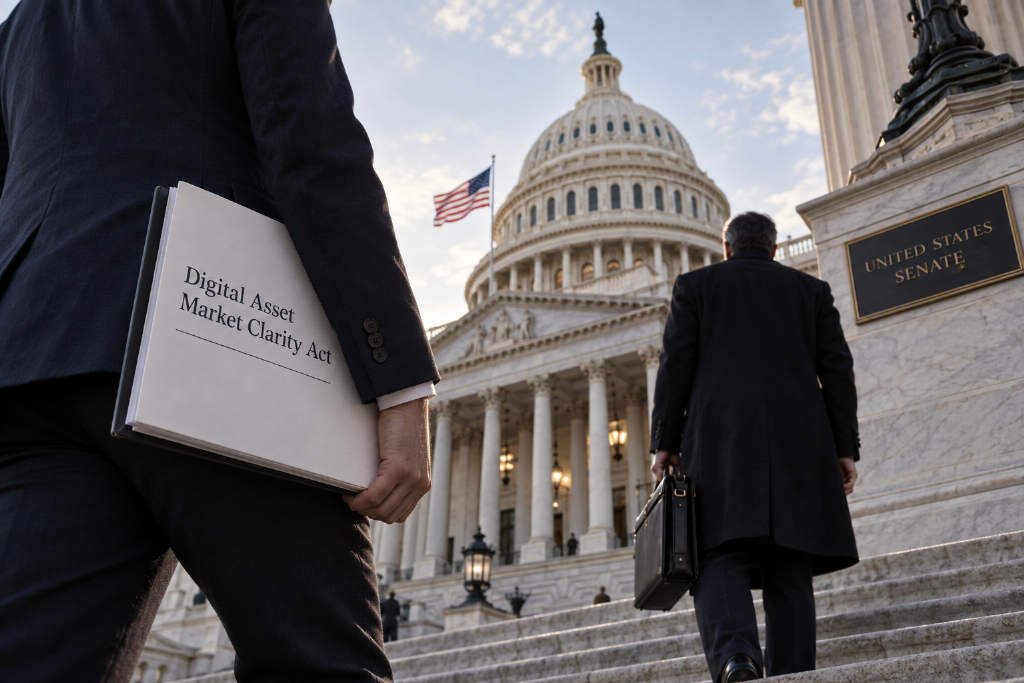
The U.S. Senate will vote on cloture for the Digital Asset Market Clarity Act on the afternoon of Sept. 15 Eastern Time, a procedural step used to end debate and force a vote. It needs 60 votes to pass. In the final weekend before that vote, the bill changed again.
According to CNBC, Republican lead negotiators released a revised version late Sunday and described it as the last draft they could offer to meet Democratic demands. Trump agreed to ethics limits in the new text, including one provision Democrats had pressed for: allowing state attorneys general to enforce ethics rules against federal officials. Democrats reviewed the language and still rejected it, then sent a counterproposal late Monday.
State attorneys general gain authority to enforce ethics rules against federal officials
The revised draft includes most of a crypto ethics agreement brokered by Senator Thom Tillis of North Carolina and Senator Ruben Gallego of Arizona. CNBC reported that Trump had agreed to it.
The clearest change is that state attorneys general would be allowed to enforce ethics requirements against federal officials. Democrats had previously argued that leaving enforcement solely to the Department of Justice would make the provision ineffective. Ethics language had already been a major reason the bill stalled in July, as Democrats pushed amendments to bar the president, vice president, and their family members from profiting from the crypto industry.
In an emailed statement, the White House press office said, "The president's position has always been clear: Congress must pass the Clarity Act so that we can stay ahead of foreign competitors and lead the world in innovation." The statement also said the administration had agreed to "the most comprehensive, broadest ethics provisions in history." CNBC said the White House did not answer its questions about the specific concessions made on ethics language.
Democrats say the language still does not reach the president
According to CoinDesk, several Democratic senators raised concerns about the updated ethics provisions even before formally sending a counterproposal. Their complaints centered on two points. First, even under the revised wording, state attorneys general still would not be able to sue or directly take enforcement action against the U.S. president. Second, the Office of Government Ethics could issue notices allowing senior government officials to keep their crypto business ties. In other words, enforcement authority would go to state attorneys general, but not against the president personally.
CoinDesk, citing a person familiar with the matter, reported that Democratic senators sent their counterproposal to Republican negotiators late Monday. The outlet said it could not immediately confirm the contents of that proposal and noted that Politico first reported the development. Industry sources said Democratic negotiators met Monday afternoon to discuss what issues should be included in the counterproposal, with ethics provisions among them.
Republicans said they had already gone as far as they could. Senator Cynthia Lummis said earlier in the day that Democrats kept demanding more concessions even though the bill was ready for a vote. White House crypto adviser Patrick Witt said at a Washington event that Republicans had "done everything we can" to address Democratic objections and that there was almost nothing left to change: "If there are any changes left, we're talking about punctuation now." He added that he is not a senator and that the final outcome on the Senate floor would be up to senators.
Stablecoin yield language shifts to a Treasury trigger tied to deposit outflows
The revision also addresses a demand from the banking industry. Banks argued that if the bill did not stop stablecoins from offering interest-like rewards, deposits could move into higher-yield crypto accounts, making the legislation unacceptable in its earlier form.
The new compromise does not impose a blanket ban. Instead, it would authorize the Treasury secretary to restrict those rewards if community banks experience large-scale deposit outflows.
When the Senate Republican version was released on Sept. 11, Lummis said it included 114 Democratic demands. After the new draft was published, she raised that figure to more than 120 and said, "This text is a true bipartisan version, incorporating more than 120 Democratic requests."
In the same statement, she added: "A no vote on Tuesday is a vote against real ethics reform for politicians' personal investments, a vote to hand America's leadership in digital assets to foreign competitors, and a vote to leave Americans unprotected in digital asset markets. Democrats got what they asked for, and now they should accept the answer."
Republicans frame Tuesday's vote as procedural, not final passage
Backers of the bill have repeatedly stressed that this is not a final vote on passage. Senator Bernie Moreno of Ohio wrote on X: "This is not a vote on final passage of the bill. This is a vote on whether the United States Senate should consider digital asset regulatory legislation and whether debate should end." He also said senators with concerns could still offer amendments after the Senate agrees to proceed.
CNBC cited a Democratic staffer familiar with the talks, who spoke anonymously because the discussions were not public, saying Senate Majority Leader John Thune had pitched the vote as a "free vote." The idea, according to that staffer, was that the vote would simply allow the bill to move ahead, while the substance could still be revised and voted on again before final passage. The staffer also said the White House had signaled that if cloture passes, it may still make additional concessions on ethics provisions and other issues.
Senator Chris Van Hollen of Maryland posted a video on X on Sunday opposing the bill. "I can assure you, I have not heard from my constituents that their top priority is passing the Clarity Act," he said. He described the measure as one that "pretends on the surface to create good regulation and consumer protection for cryptocurrency, but it still has some big problems that have not been fixed," adding, "We cannot let it pass."
The vote math gives those objections weight. When the bill cleared the Senate Banking Committee in May, only two Democrats supported it. To overcome extended debate, the measure needs 60 votes, meaning at least seven Democrats or independents would have to back it if all senators are present.
On the day before the vote, SEC Chair Paul Atkins publicly urged Congress to pass the bill while also saying the SEC's crypto agenda would not stop regardless of whether the measure succeeds. At the same time, eight banking trade groups and 18 state attorneys general separately sent letters to the Senate opposing it.