
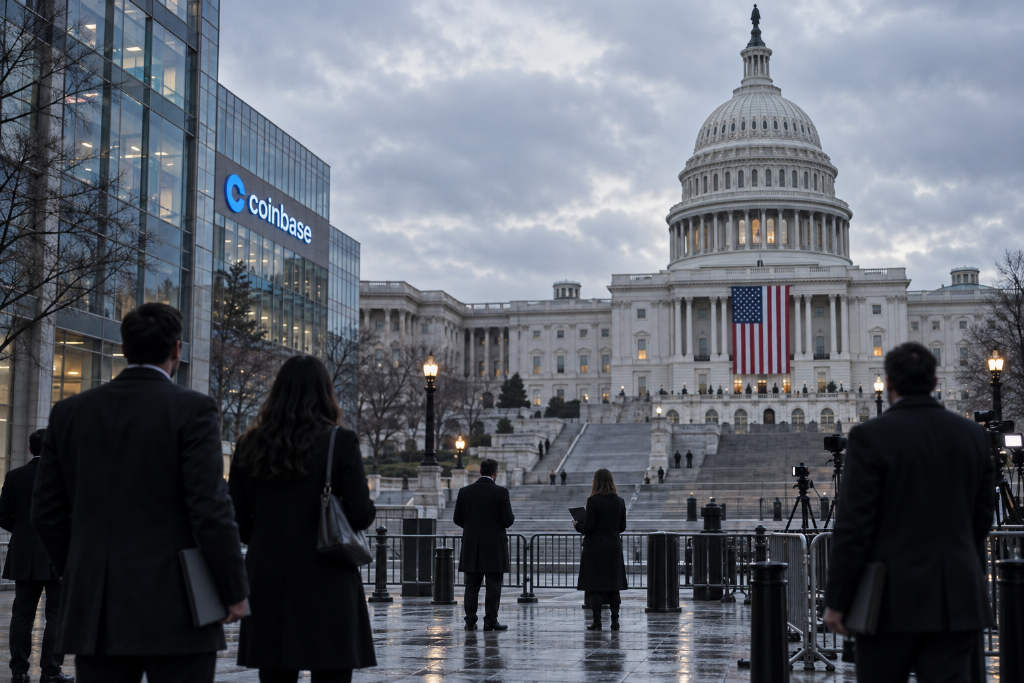
A major U.S. crypto market structure bill lost momentum last week after the CLARITY bill failed to reach the 60-vote threshold in the Senate on Tuesday, blocking it from moving to floor debate. With the legislative calendar tightening ahead of the Nov. 3 midterm elections, the bill’s chances of passing this year have dropped sharply.
Saxo says Coinbase has the most at stake
In a Wednesday research note, Saxo Bank strategist Ruben Dalfovo said Coinbase is the company most exposed to the setback because its trading business is tied directly to U.S. market structure rules. Those rules would determine registration thresholds, which assets can trade, and who qualifies to participate on platforms.
Dalfovo drew a contrast with other crypto-linked firms. Circle’s risk profile, he said, is tied more closely to USDC adoption and reserve interest income, while Strategy depends mainly on its bitcoin holdings and access to financing.
Markets moved quickly after the vote. Shares of Coinbase, Circle and Strategy fell 5% to 10% and weakened again the following day. Dalfovo’s view was that exchanges are not the only businesses affected, but their operations are tied most closely to market structure rules, leaving Coinbase exposed to several more months of uncertainty if regulation remains delayed.
Standard Chartered turns bullish on Arbitrum
Standard Chartered’s head of digital assets research, Geoff Kendrick, said Arbitrum could outperform both Bitcoin and Ethereum by 2030.
Part of his thesis rests on Arbitrum’s ability to collect 10% of net protocol revenue from companies building on the network. Kendrick said Robinhood Chain, which launched in July, has materially changed Arbitrum’s economic model. He expects September revenue to reach $5 million, more than five times its earlier level.
Kendrick projected ARB could climb from about $0.14 to $10. Based on the figures cited in the report, that implies roughly a 70x increase. ARB has already risen 86% over the past month.
Standard Chartered’s case is built on a broader tokenization forecast. The bank sees tokenized assets at $390 billion now and as much as $4 trillion by 2028. In that framework, Arbitrum’s Layer-2 infrastructure and revenue-sharing model stand to benefit, though the pace of adoption remains uncertain.
Bitmine estimates $334 million in annual staking income
Bitmine said it expects to generate $334 million a year in staking income from its $15.8 billion crypto treasury. The company added another 27,180 ETH last week, bringing total holdings to 5.95 million ETH, valued at $15.4 billion in the report and equal to about 4.9% of Ethereum’s circulating supply.
More than 5.06 million ETH have already been staked. At current rates, the company said that would translate into annualized staking income of $334 million.
For comparison, the Grayscale Ethereum Staking ETF stakes 84.6% of its ETH. The report noted that unlike bitcoin treasury companies, which rely mainly on price appreciation, Bitmine’s ETH position can produce recurring income.
Bitmine shares have gained nearly 38% over the past month, though they remain negative for the year. Strategy, meanwhile, did not buy bitcoin for a second straight week and instead spent $139.3 million to repurchase preferred stock.
Phemex co-founder calls AI a net negative for crypto
Federico Variola, co-founder of Phemex, said on Cointelegraph’s Chain Reaction program that AI is a “net negative” for the crypto industry. He argued that AI is pulling liquidity away from the sector while also making it easier for attackers to search for protocol vulnerabilities.
Variola pointed to a July incident in which attackers used what he described as suspected AI-assisted methods to find a vulnerability in Coldcard hardware wallets, stealing about $116 million in bitcoin from more than 5,200 addresses.
Coinkite co-founder Rodolfo Novak said AI-assisted code review is now moving faster than senior experts. CertiK’s Natalie Newson offered a different view, saying AI is also “one of the strongest defenses.”
Business signals shift as regulation slows
Even with the CLARITY bill stalled, the week’s developments pointed to a broader shift in how crypto businesses are being judged. Bitmine is leaning on staking income to build recurring cash flow. Standard Chartered is using tokenized asset forecasts to reprice Layer-2 networks. Exchanges, by contrast, remain tied more directly to unresolved market structure rules.
Taken together, the signal from this week was not only about who holds more crypto assets, but which business models can turn those holdings into ongoing revenue.