

Anthropic has publicly detailed the full workflow behind large-scale code migration with Claude Code, and the highest-profile example in the release centers on Bun creator Jarred Sumner. According to the report, Sumner moved Bun’s core from Zig to Rust in less than two weeks, producing about 1 million lines of code in the process.
The migration used 5.9 billion input tokens and 690 million output tokens. At API pricing, the cost came to about $165,000. The report contrasts that figure with roughly four years and $3 million in prior development spending.
The article was published by MarsBit and attributed to the WeChat account New Intelligence, with authorship credited to “ASI启示录.” It says Sumner originally chose Zig for a straightforward reason: he wanted a language with extreme simplicity and performance comparable to C. In his words, “before LLMs, one person in a small apartment in Auckland wrote Bun in a year.”

Bun’s shift from Zig to Rust
Bun is described as a JavaScript runtime faster than Node.js. As its ecosystem expanded, the report says Bun CLI monthly downloads passed 10 million and that Bun became a heavy underlying dependency for Claude Code itself. At the same time, earlier technical debt had become harder to ignore.
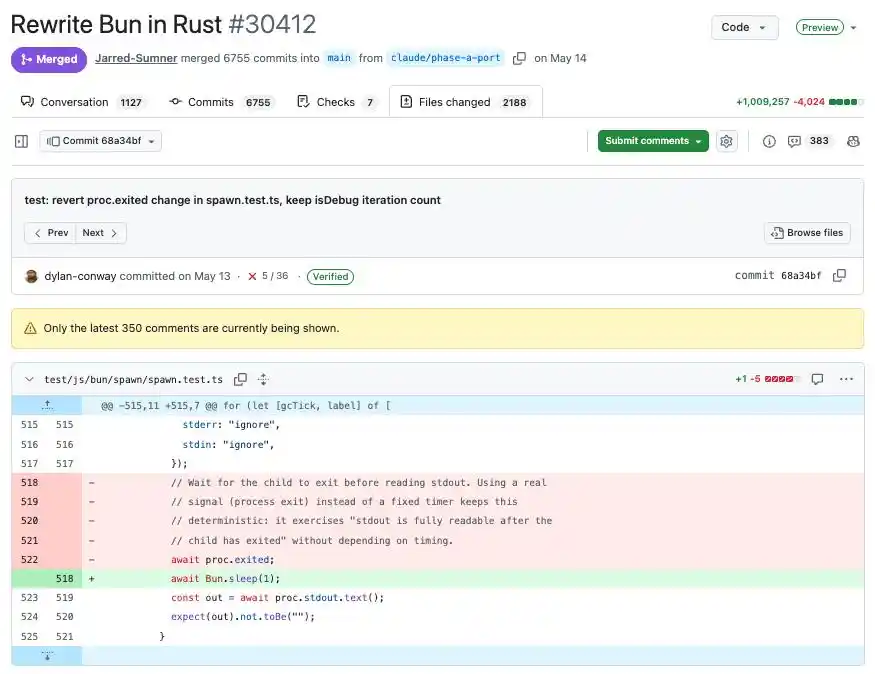
That set up the migration: Sumner used Claude Code to move the entire Bun project from Zig to Rust, which the piece describes as more memory-safe. Before the merge, Bun’s full existing test suite passed 100% in CI. After the merge, 19 regressions surfaced. The report says those have now all been fixed. The Rust version quietly went live in June together with Claude Code.
Another migration case: Python to TypeScript
Anthropic also highlighted a second example from Mike Krieger, co-head of Anthropic Labs and Instagram co-founder. Over a single weekend, he migrated a Python codebase into 165,000 lines of TypeScript, with the main body of work consuming about 27 million tokens.

That process, according to the report, involved hundreds of agents, eight gates, and three rounds of adversarial review. It ended with a consistency check that compared the output of every command against the original Python version. Any behavioral difference was treated as a bug and fixed.
Krieger also had Claude design an end-to-end testing setup on its own, then ran it across four consecutive all-nighters to catch edge cases that had not been anticipated.
Why the migration was necessary
The report says Krieger’s team needed to package internal tools into a single binary for users. With the Python toolchain, compilation took eight minutes per platform, and a full build matrix added up to half an hour for each release.
After the migration, the same compile step took two seconds, binary startup became six times faster, and one entire deployment pipeline was retired.
Anthropic’s six-step framework
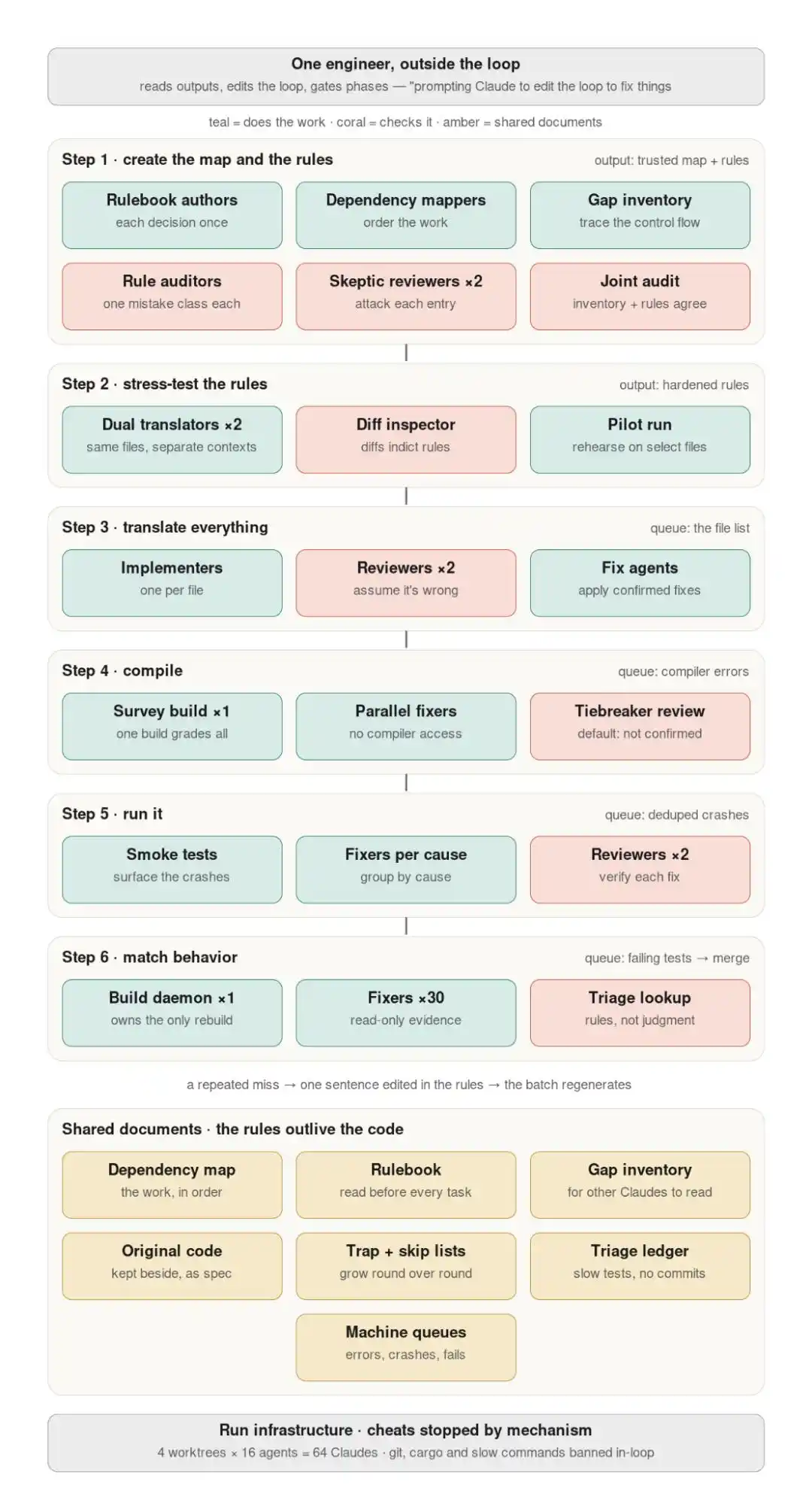
Anthropic summarized the approach in one line: don’t fix the code, fix the loop that produces the code.
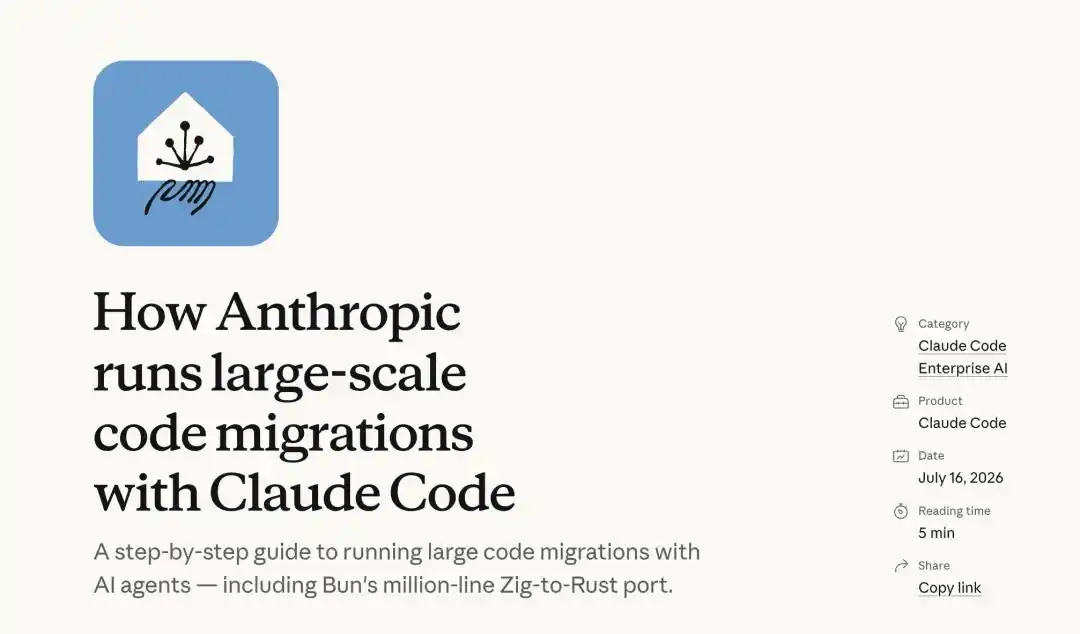
The report lays out the logic behind that view. Large migrations map well to AI because the work is naturally parallel, the old code already serves as the specification, the test suite can act as a ready-made judge, and failed builds or tests expose the next task without requiring human arbitration.
- Set up the judge.
- Write the rulebook.
- Map dependencies.
- List the gaps.
- Run a small pilot to pressure-test the rules before scaling to thousands of files.
- Translate at full scale, then cycle through implementation, review, and repair before compiling, running, and checking behavior file by file.
Throughout the process, the rules were not maintained by manual patchwork. As described in the article, each time a reviewer found an error, that lesson was added to the rulebook, and the affected files were generated again.
Anthropic’s closing suggestion was simple: take a codebase you have been putting off for a long time and ask Claude what its migration plan would look like.
The piece says that line would have sounded like a joke four years ago. Today, it is presented as an engineering workflow that can actually be executed. In that framing, migrations that once felt out of reach for developers now look like a backlog waiting to be cleared.