

Anthropic’s release of Claude Fable 5.2 and Claude Mythos 5.2 has put Claude’s code-based video production back in the spotlight. The models were presented for their programming, scientific research and robot-operation capabilities, but Fable 5.2 has also been used to build 3D scenes, animate objects, plan camera movement and render complete clips from a natural-language instruction.
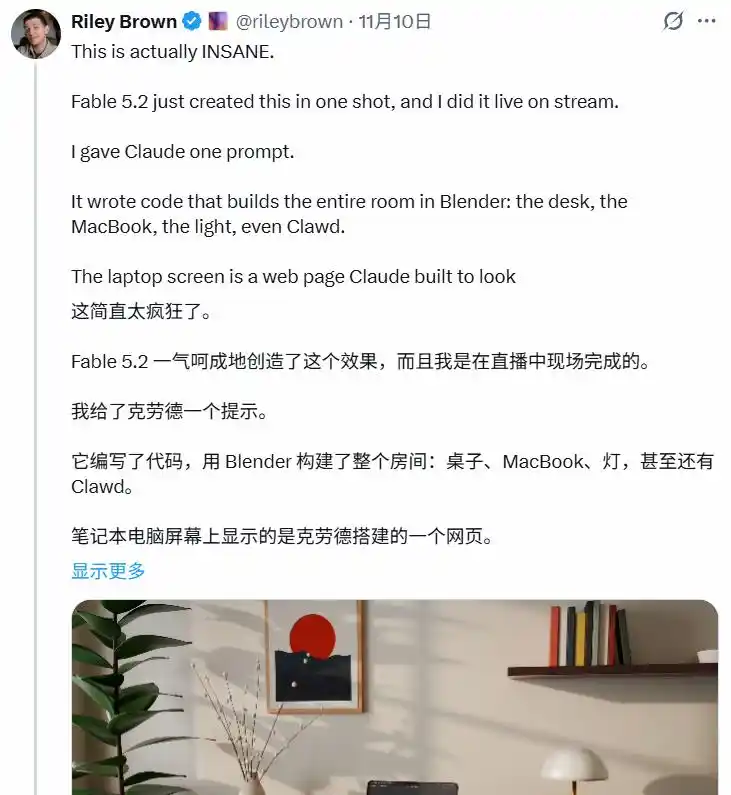
Developer Riley Brown posted a 3D short titled “The Edge” on X after the model’s release. The film centers on a work desk. A MacBook lights up, Claude’s lobster mascot Clawd moves through the scene, and the keyboard, screen content and ambient light work together as the sequence develops. The camera cuts between views while the sky outside shifts from dusk to night and then to sunrise. The short contains 13 shots and runs for about 59 seconds.
Brown said he gave Fable 5.2 only one prompt during a livestream. The model then wrote Blender code to create the desk, laptop, lamps and character models. It also arranged the camera movements and added animation to objects in the scene.

After the modeling and animation work was complete, Fable used 10 GPUs on RunPod to render the film in 4K. The process took 52 minutes. Brown disclosed a cloud-rendering cost of $5.75. The model also handled color grading and title creation, while ElevenLabs was used to generate the music and sound effects.
Developer Peter Yang used Fable 5.2 for a separate 20-second autumn travel advertisement for Kyoto’s Fushimi Inari Taisha. The entire video was built through code and includes music.
Opus video experiments gained attention in September
Fable 5.2 was not the first Claude model to attract attention for code-generated video. On September 14, developer Kevin Ngo showed an animation drawn frame by frame with JavaScript by Claude Opus 5.
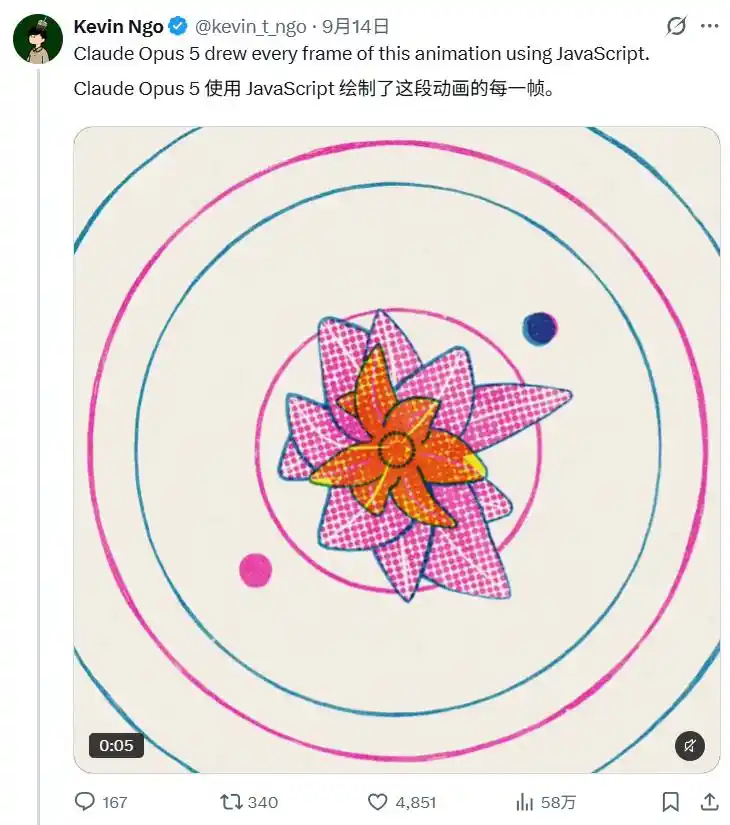
Other developers later used Claude Code to reproduce a Risograph print style. The project generated about 3,500 lines of Canvas 2D code, placed 26 illustrated scenes in a single HTML file and synthesized music with WebAudio.
Anthropic released Opus 5.5 on September 22, adding momentum to the wave of experiments. On the day of the release, Reddit user AzorAhai1TK shared a roughly one-minute surreal horror short. The request to Claude was deliberately open-ended: make a video about an ordinary workday, give it an unsettling atmosphere, create both the visuals and audio through programming, and choose the tools independently.
According to the creator, Opus 5.5 completed the production in 45 minutes in Extra-High reasoning mode, including the final render. The toolchain included NumPy, SciPy, Cairo, Piper TTS and FFmpeg.
More complex projects appeared over the following days. On September 24, a Reddit user showed a battle video in the style of a retro SNES game. Opus 5.5 coordinated multiple agents, assigning separate tasks for the characters, setting, music and battle animation. The creator said no ready-made assets were supplied, but confirmed in the comments that the production went through two or three rounds of revisions.
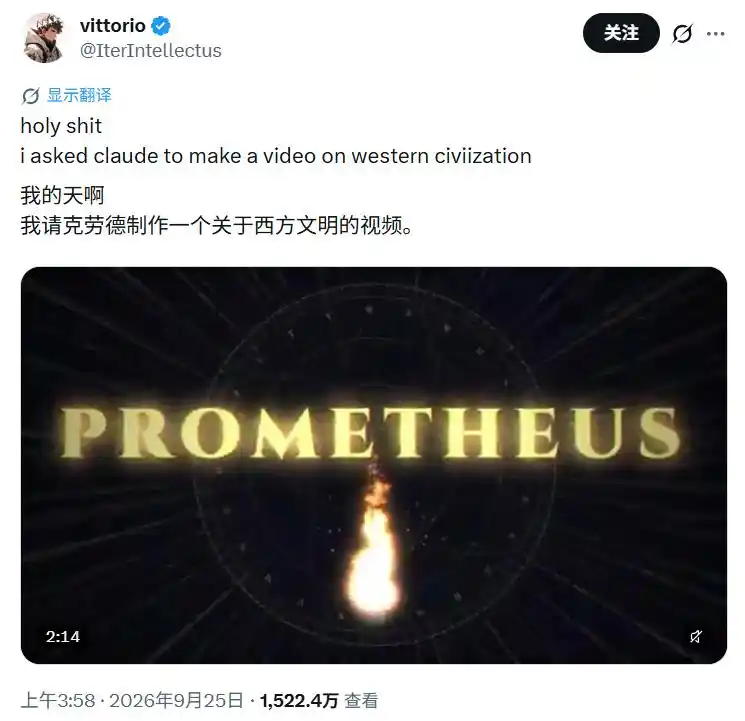
Around the same time, X user @IterIntellectus posted a 2-minute-16-second animation about the history of Western civilization. Black-and-gold lines and motion graphics connected ancient Greece, Rome, the Renaissance and the Industrial Revolution. The video received 5.8 million views roughly 24 hours after publication and later passed 15 million total views. The creator said the work was made with a single prompt.
The scale of the activity is also reflected in a third-party index. Claude Video currently lists 1,276 videos made by creators using Opus 5.5, covering 1,007 creators. Public prompts are attached to 457 of those videos. The site records about 78.9 million cumulative views on X.

How Claude creates videos with code
Claude can write HTML, CSS, JavaScript, SVG or Canvas animations from a natural-language request. It can also use Three.js to build a 3D scene or call Blender for modeling and rendering.
For a 15-second product commercial, for example, Claude can first plan the shots and timeline. It can then write code that controls text, graphics, cameras and transitions. The program calculates each frame according to time, after which the video can be exported as an MP4 through browser recording, a rendering engine or FFmpeg.
For more complex 3D environments, Claude can write a Blender Python script that automatically creates models, sets materials, places lights and cameras, and calls GPUs for rendering. The workflow relies mainly on programming, spatial reasoning, task planning and tool use.

The images are calculated and rendered by a program, which is technically different from the generation methods used by video models such as Veo and Runway. Code-generated video offers precise control over the position of text, numbers and graphics. Scenes and animation timelines can also be revised repeatedly. Interface elements in product demonstrations, technical diagrams and animated charts can all be generated with structured code.
Remotion previously released a Claude Code plugin that lets developers create and edit video projects with natural-language instructions. On October 8, Anthropic also launched the Claude Motion beta. The tool supports turning text, charts and graphics into animation and exporting the result as an MP4. It is available to Team and Enterprise users.
For now, Claude’s most mature code-video applications are motion graphics, information visualization, product presentation, technical education and stylized 3D animation. Specialized generative video models still have their own advantages for highly realistic people, complex natural movement and continuous cinematic shots.
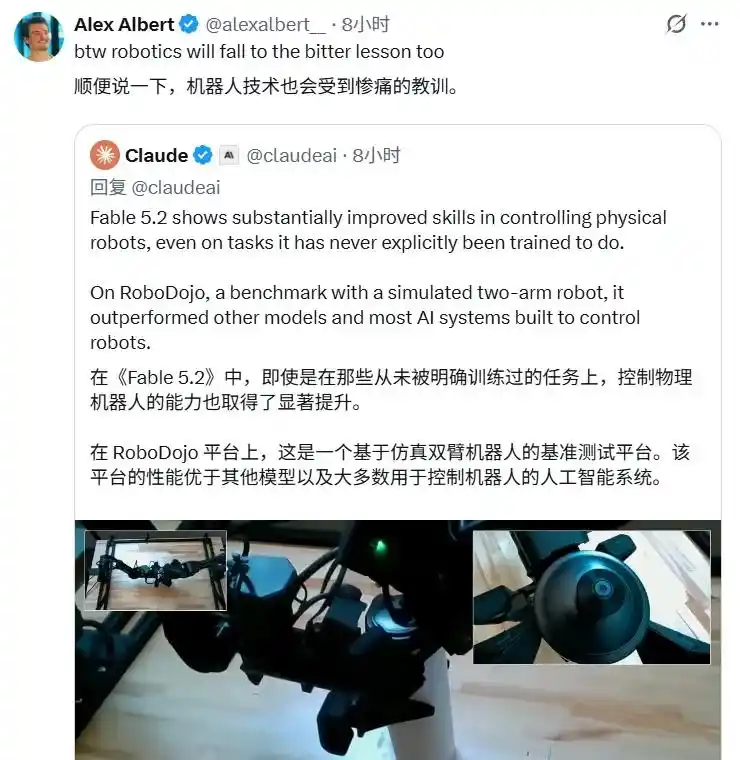
Fable 5.2’s robot-operation capabilities have also prompted discussion among several Anthropic researchers. In social-media posts, they said the “bitter lesson” in robotics may have arrived.
From the Opus 5.5 experiments in September to the latest Fable 5.2 projects, Claude’s code-generated videos have covered 3D shorts, travel advertising, retro game scenes and animated history.



