
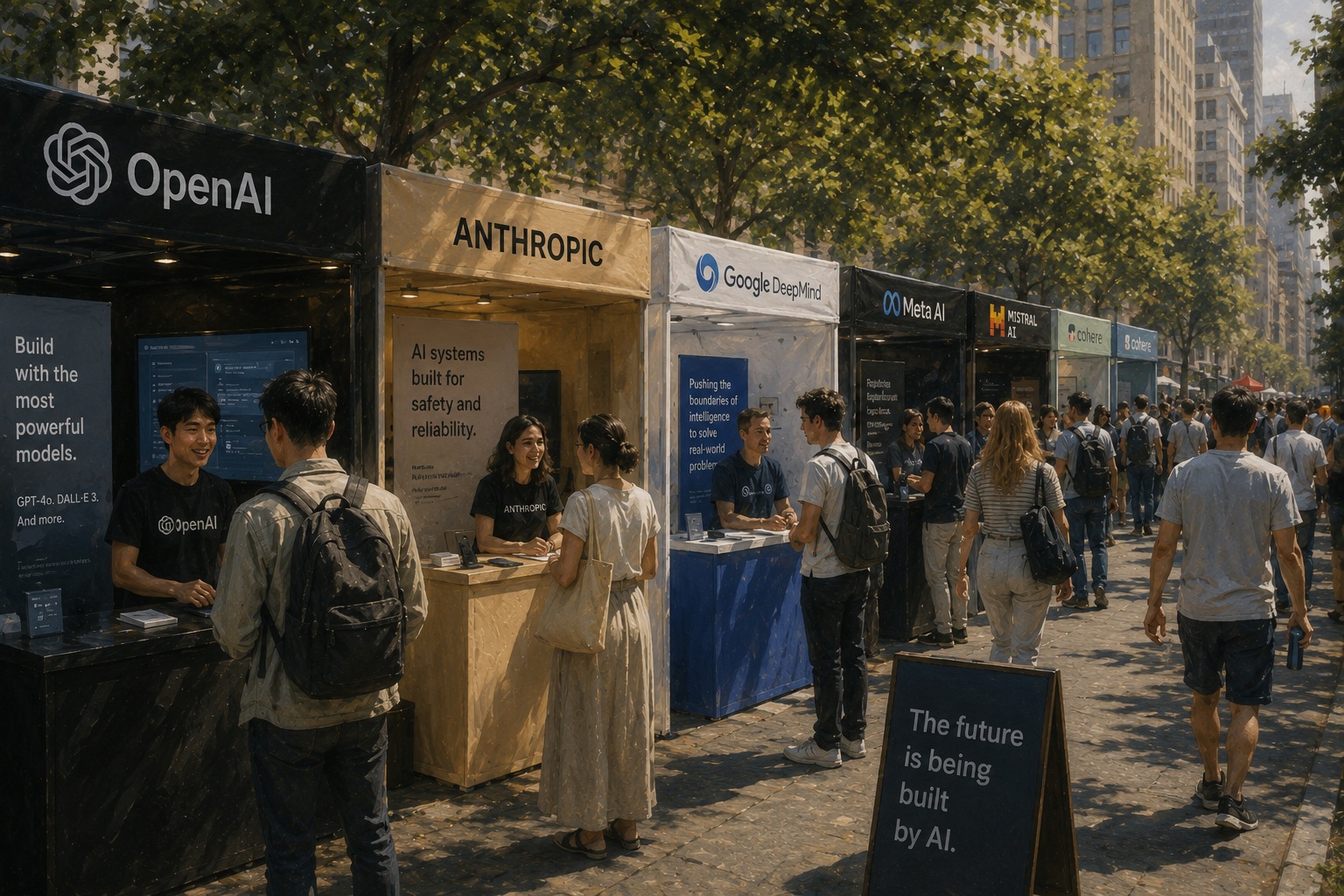
Lin Shanglun, a lawyer, noted in a recent analysis that Anthropic has loudly announced the launch of 12 legal-specific AI tools, while OpenAI once explicitly banned the use of GPT for professional advice. He argues this is more than a tech battle; it's a commercial mythmaking campaign.
OpenAI's Self-Limitation vs Anthropic's Market Grab
As the industry leader, OpenAI adopted an extremely conservative strategy in its early days, even explicitly prohibiting GPT from being used for high-risk domains like law, finance, and healthcare in its usage policy. Effectively, it hung a "closed for business" sign on the massive professional services market. In contrast, ambitious Anthropic seized the vacuum left by OpenAI. It aggressively marketed its model as ideal for legal and financial applications, claiming hundreds of built-in domain-specific agents. This wasn't just a tech showcase but a textbook B2B marketing campaign, successfully implanting the image of "I understand professionals better than GPT" and attracting several high-valued SaaS platforms to purchase massive amounts of tokens.
Top Platforms' Real Choice: Minor Performance Gaps, Priority on Stability and Business
The key question: Does Anthropic's model truly outperform OpenAI or Google's Gemini on underlying legal logic? The answer may be no. Observing SaaS platforms serving top-tier clients, they now offer OpenAI, Anthropic, and Google models side by side, letting clients choose. If any single model had overwhelming superiority, platforms wouldn't need to do this. Behind this lies deeper business logic:
Solving system congestion and rate limits: Global AI usage surges, causing frequent resource exhaustion errors (Error 429) during peak hours, especially in the heavy-usage US market. Offering multiple models is essentially load balancing and failover, ensuring service continuity. When one model is congested, users can instantly switch to another.
Risk shifting and responsibility diffusion: If a platform is locked into one model, all customer complaints go to the platform when that model underperforms or goes down. With multiple choices, the platform can respond, "This is model A's issue; please try model B," neatly shifting risk back to the underlying model provider.
Feeding clients' tech vanity: Many enterprise customers are influenced by marketing hype, questioning "Why doesn't your platform have the popular Claude?" To eliminate such doubts and speed up procurement, integrating all trending models is the fastest route.
Lin concludes that for enterprise-scale applications, current top-tier models from major players show no qualitative gap; performance differences are minimal. Anthropic's success is less about technical superiority and more about a well-executed commercial mythmaking campaign that exploited a rival's conservative strategy through precise marketing.