
A rumor that Anthropic's Claude may have solved the Navier-Stokes existence and smoothness problem spread rapidly on social media over the past day, pulling a Millennium Prize problem into a wave of AI speculation.
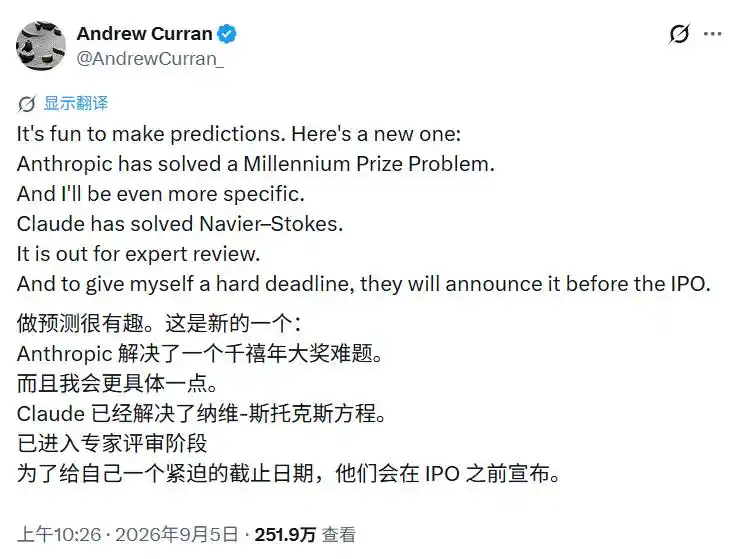
The immediate trigger was a post from blogger Andrew Curran, who said he was "predicting" that Anthropic had solved the problem, that the result was under expert review, and that it might be released before an Anthropic IPO. The post went on to draw more than 2.5 million views and was reposted widely.
So far, though, no corresponding paper, proof text, or expert review materials have appeared in public. The Clay Mathematics Institute also continues to list the Navier-Stokes existence and smoothness problem as an unsolved Millennium Prize problem.
Why the rumor took off
The speculation did not emerge out of nowhere. A key backdrop was a set of posts published on Sept. 3 by mathematician Terence Tao, who used Navier-Stokes as an example while discussing how AI could reshape mathematical research once it becomes capable of solving major open problems.
The Navier-Stokes equations describe how fluids such as water and air move. The unresolved mathematical question concerns the three-dimensional incompressible case: starting from smooth initial conditions, does a solution remain smooth for all time, or can a singularity form in finite time? The Clay Mathematics Institute lists the problem among the Millennium Prize Problems, with a $1 million prize attached.
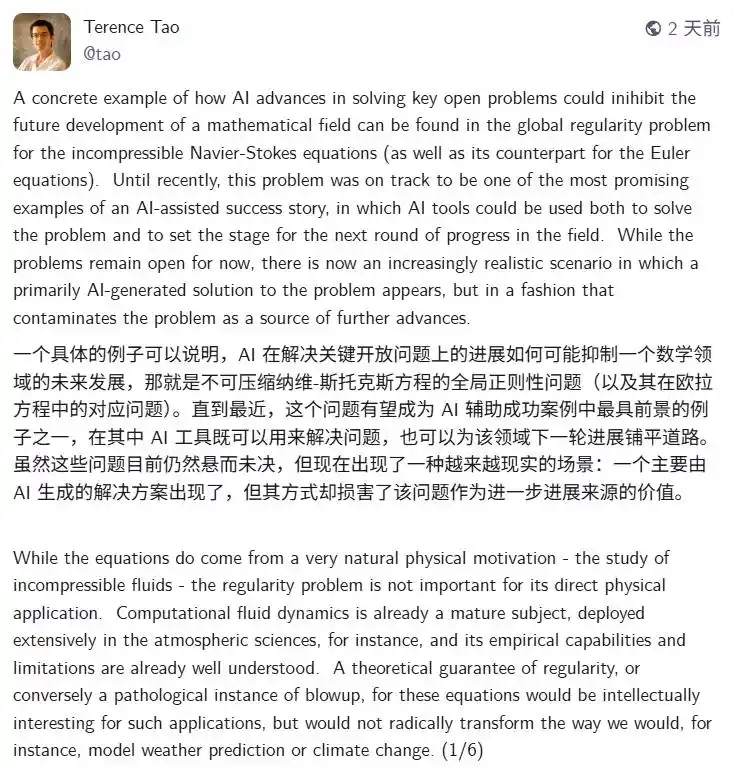
In those posts, Tao described a possible future workflow in which an autonomous AI system with large amounts of compute repeatedly tries different mathematical constructions, studies why they fail, adjusts its approach, verifies intermediate results, and eventually produces an extremely complicated candidate proof. That proof could then be machine-checked using a formal system such as Lean.
His focus was not a claim that the problem had already been solved. He was asking what happens to the mathematical knowledge created along the way. In traditional research, a hard problem often generates a long trail of byproducts over many years: new lemmas, new tools, new directions, and new questions worth studying. Tao's concern was that if an AI system completes the whole search inside a closed process, humans may end up receiving only a finished verified result while much of the valuable intermediate path fails to enter the mathematical community.
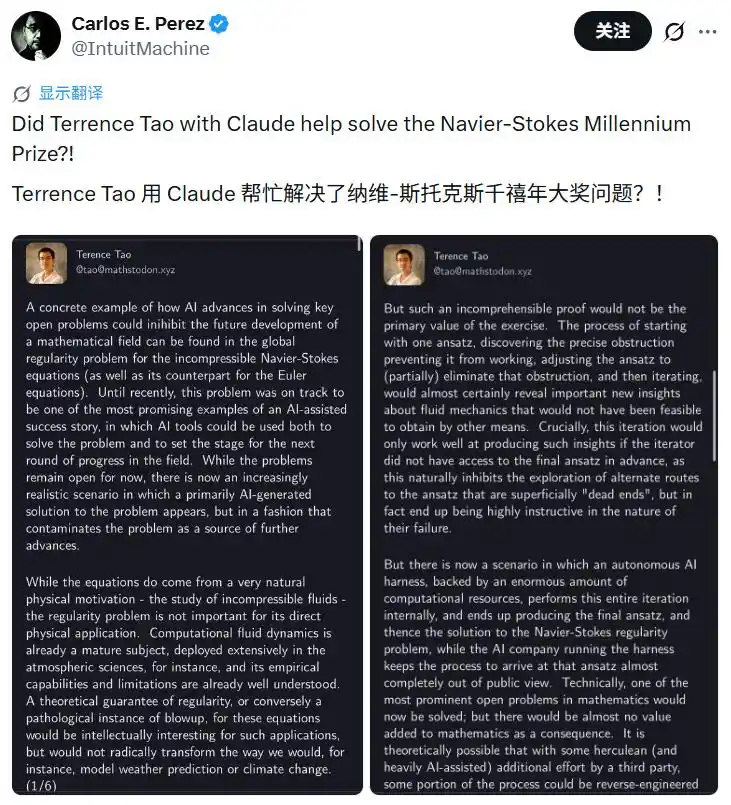
Because Tao's hypothetical scenario was highly specific, including AI search over candidate structures, numerical tests, a massive Lean proof file, and the eventual resolution of the Navier-Stokes regularity problem, some people began to ask whether he was hinting at nonpublic information.
That is how social posts claiming Tao might be signaling that Claude had already solved Navier-Stokes started to circulate. Curran's post then pushed the idea much further by stating the prediction in direct terms: "Claude has solved Navier-Stokes." From there, the rumor spread quickly.
Tao's clarification
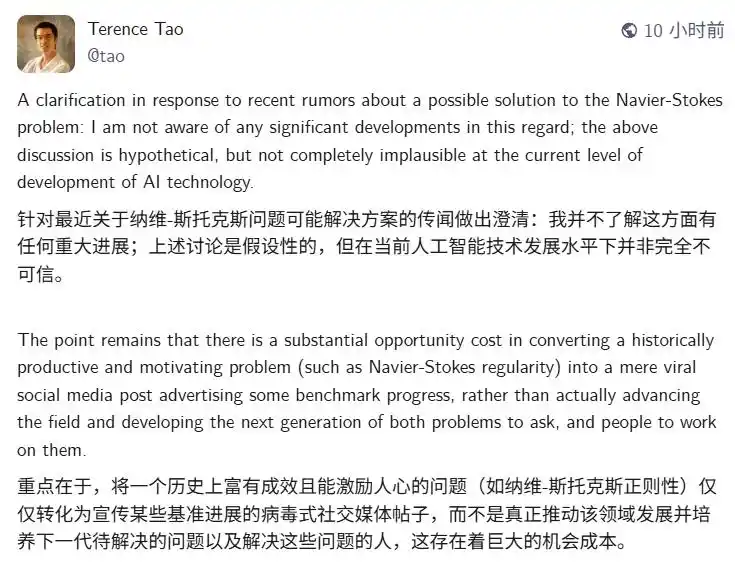
As the speculation grew, Tao issued a clarification. He said he was not aware of any major new progress on the Navier-Stokes problem and that his earlier discussion was only a hypothetical AI research scenario.
He also said that, given the current pace of AI development, such a scenario now carries a degree of real-world plausibility.
Tao then shifted the discussion to what he called an opportunity-cost issue. Open problems such as Navier-Stokes have spent decades generating new methods, new questions, and new researchers. If AI can reach the final answer quickly, mathematics will still need a way to preserve the process, methods, and failed routes from machine-led exploration so they can be turned into knowledge that people can understand and build on.
That question is becoming less abstract and more practical inside AI-driven mathematics research.
AI is moving into research-grade mathematics
The rumor drew so much attention partly because AI systems have crossed several mathematical thresholds in recent months that would have seemed hard to imagine not long ago.
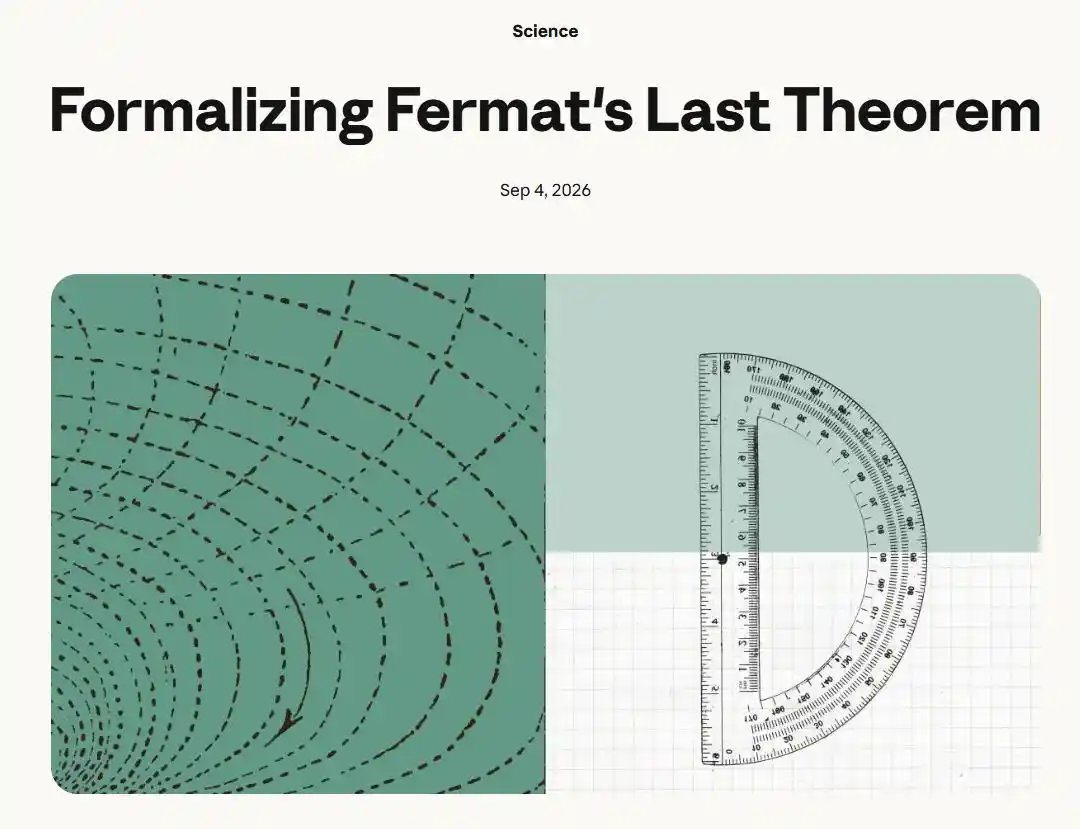
One day earlier, Anthropic published Claude's formalization work on Fermat's Last Theorem. Fermat's Last Theorem was proved in the 1990s by Andrew Wiles and others, but mathematicians have long wanted the full proof translated into a formal language such as Lean so a computer could check each step.
Anthropic said Claude completed the end-to-end Lean formalization in largely autonomous fashion over 11 days. The final code base reached about 13 million lines. During the process, the model generated about 30,300 machine-checkable theorems, of which about 29,500 were included in the final proof. Kevin Buzzard, a mathematician involved in the long-running effort to formalize Fermat's Last Theorem, also gave the result a positive assessment.
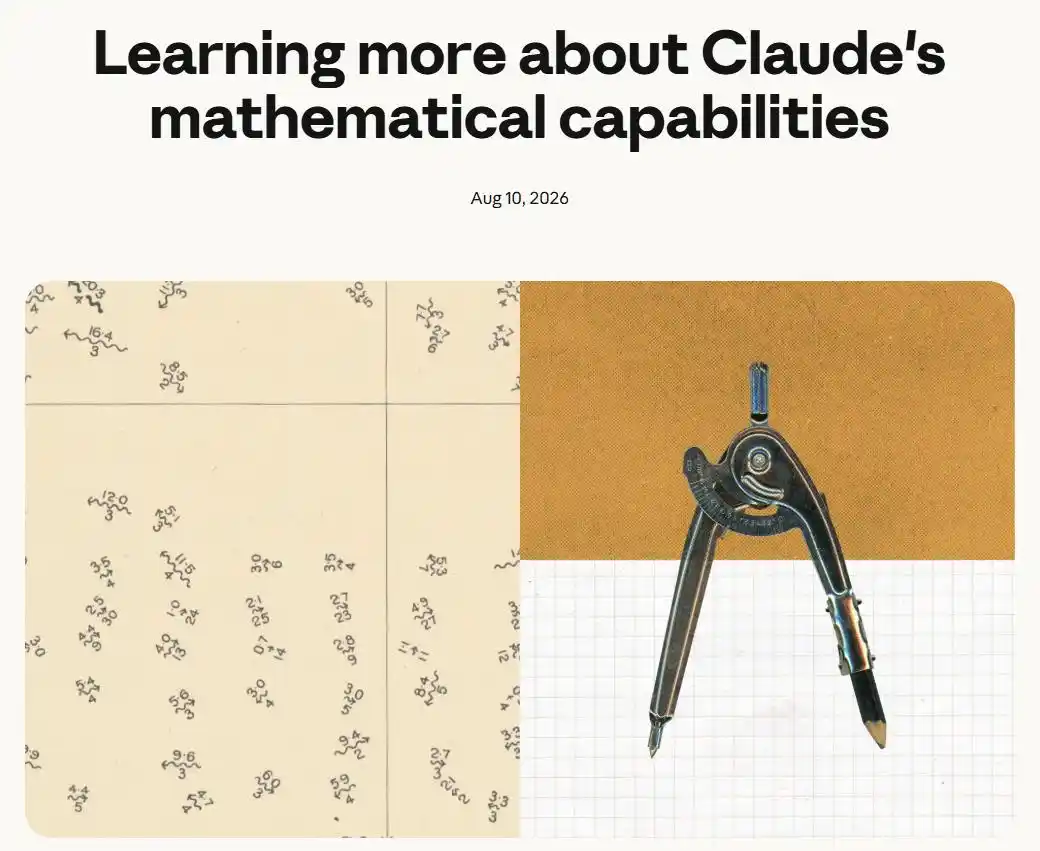
A month earlier, on Aug. 10, Anthropic said an unreleased Claude research model had made progress on a problem related to the Riemann Hypothesis. According to the company, it improved the lower bound on the proportion of zeta-function zeros known to satisfy the Riemann Hypothesis from 41.6% to 67.2%. The Riemann Hypothesis, closely tied to the distribution of prime numbers, is itself another Millennium Prize problem.
In May, OpenAI also published a result in discrete geometry. A general-purpose reasoning model constructed a new unit-distance point set and disproved a long-standing conjecture related to the Erdős unit distance problem in the plane. External mathematicians later checked the proof. The company said the result resolved an important conjecture inside that area, while the broader unit distance problem still leaves room for more work.
By August, OpenAI had released a package of 10 results in mathematics and theoretical computer science, including solutions to or substantial progress on several long-standing open problems.
A few years ago, the most visible mathematical achievements from large models were still concentrated around olympiad-style problems. Now the target has shifted toward open problems, paper-level results, and large-scale formal proofs.
What becomes scarce in mathematical research
As AI systems produce mathematical derivations more quickly, verification is becoming more important. Language models can generate large volumes of reasoning at speed, but they can also introduce subtle errors. Proof assistants such as Lean break a proof into steps a machine can inspect one by one. The faster AI generates proofs, the more central formal verification becomes as infrastructure.
Tao has repeatedly argued that one future bottleneck in mathematics may shift toward checking, organizing, and understanding, rather than just producing derivations.
A second change concerns the division of labor for mathematicians. If routine derivations, literature search, computational experiments, and even parts of proofs can be delegated to AI, human researchers may spend more of their time on choosing problems, framing the right conjectures, designing research programs, and distilling machine-generated results into theories people can actually interpret.
Tao has described that future as a form of "big mathematics": complex problems are broken into many modules, with humans, AI systems, and formal proof tools working together before machine verification recombines the final result.
As answers become cheaper, the question changes. What is still genuinely scarce in mathematics? In the past, an important open problem could sustain a research direction for decades, and the detours taken along the way could themselves generate new theory. If AI compresses that process sharply, final answers may arrive faster, but the field will also need new ways to preserve research paths, assign credit, and train the next generation of researchers.

That was the shift Tao was pointing to when he chose Navier-Stokes as his example.
Still only a rumor
On the information currently available, the claim that Claude has already cracked the Navier-Stokes Millennium Prize problem remains a social-media rumor. No public paper, proof text, or review file has surfaced, and the Clay Mathematics Institute's public listing has not changed.
Even so, the confusion says something about the moment. A few years ago, "AI solves a Millennium Prize problem" would have sounded much closer to science fiction. By 2026, people are treating it as a scenario worth discussing seriously, including what mathematics would need to do next if it actually happened.
Reference links mentioned in the source
- Andrew Curran post: https://x.com/AndrewCurran_/status/2096062392442724805
- Terence Tao posts: https://mathstodon.xyz/@tao
- Anthropic on formalizing Fermat's Last Theorem: https://www.anthropic.com/research/formalizing-fermats-last-theorem
- Anthropic on progress related to the Riemann Hypothesis: https://www.anthropic.com/research/riemann-zeta
- OpenAI on a discrete geometry result: https://openai.com/zh-Hans-CN/index/model-disproves-discrete-geometry-conjecture/
- OpenAI on ten advances in mathematics: https://openai.com/zh-Hans-CN/index/ten-advances-in-mathematics/
- Tao on AI in math and theoretical physics: https://academy.openai.com/public/blogs/terence-tao-ai-is-ready-for-primetime-in-math-and-theoretical-physics-2026-03-06
- IEEE Spectrum article: https://spectrum.ieee.org/ai-in-mathematics