

Just two days after Claude Opus 5 shipped, AI investor and former HyperWrite CEO Matt Shumer posted a video showing a fully playable first-person shooter that he said the model had built entirely on its own.

Shumer wrote that Claude Opus 5 had “one-shotted” the game and that the build used no external assets. That claim drew attention on its own. What pushed the story further was the prompt behind it, which Shumer later published in full on GitHub.
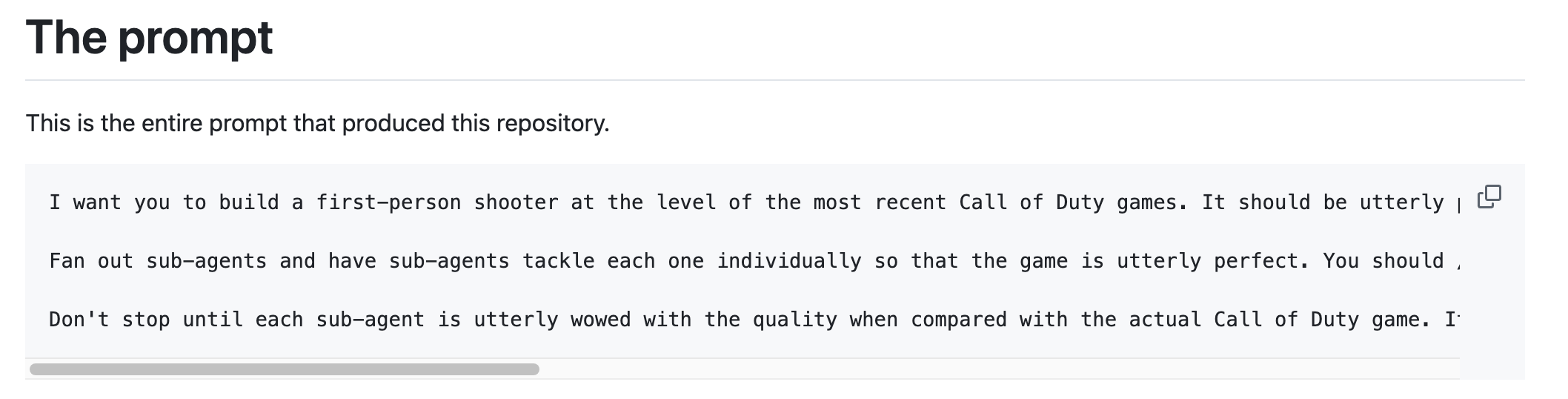
It was not a long, highly structured instruction set. It was three short paragraphs.
The prompt told Opus 5 to build a shooter on the level of recent Call of Duty titles, to split the work across subagents, and to keep iterating each piece with a separate, harsh critic until the result held up in a blind side-by-side comparison against real Call of Duty footage. The target, in the prompt’s own words, was something “utterly perfect.”
A short prompt challenged standard prompt-engineering advice
The article frames that as a reversal of the guidance that dominated the vibe-coding wave. The common advice was to define success in concrete, inspectable terms instead of leaning on broad adjectives. Rather than asking for “AAA,” users were told to spell out the systems, mechanics, and visual goals a model should satisfy.
Shumer’s version went close to the other direction. He asked the system’s own subagents to be “utterly wowed,” while leaving the practical definition of quality to a critic that Opus 5 generated for itself.
Shumer later said he never specified the renderer, never listed the game’s systems, and never defined what “AAA quality” had to include. He has started calling the workflow a Gauntlet Loop. As described in the report, the idea is to hand an agent a real, inspectable bar rather than a vague instruction, let it break the task into smaller parts, and route each part through a critic that does not see the builder’s internal reasoning.
How Claude Code’s subagents, Ultracode, and /loop fit together
Two Claude Code features carried that process. One was subagents. They run in isolated context windows, each with its own instructions and tool access. A critic grading the weapon model, for example, does not inherit the builder’s explanations for why the model looks the way it does.
The second was Ultracode, a Claude Code setting that pushes the model to its highest reasoning effort and lets it write its own orchestration plan. According to the article, that setup can fan work out across as many as 16 agents at once, with a cap of 1,000 per run.
Anthropic’s built-in /loop skill also mattered. It is designed for repeated fix-test-adjust cycles. Shumer did not set a fixed number of rounds. He let the critic keep identifying fresh gaps, and he let the builder keep chasing them for hours before ending the session himself.
The build used Three.js, WebGL2, and roughly 55,000 lines of code
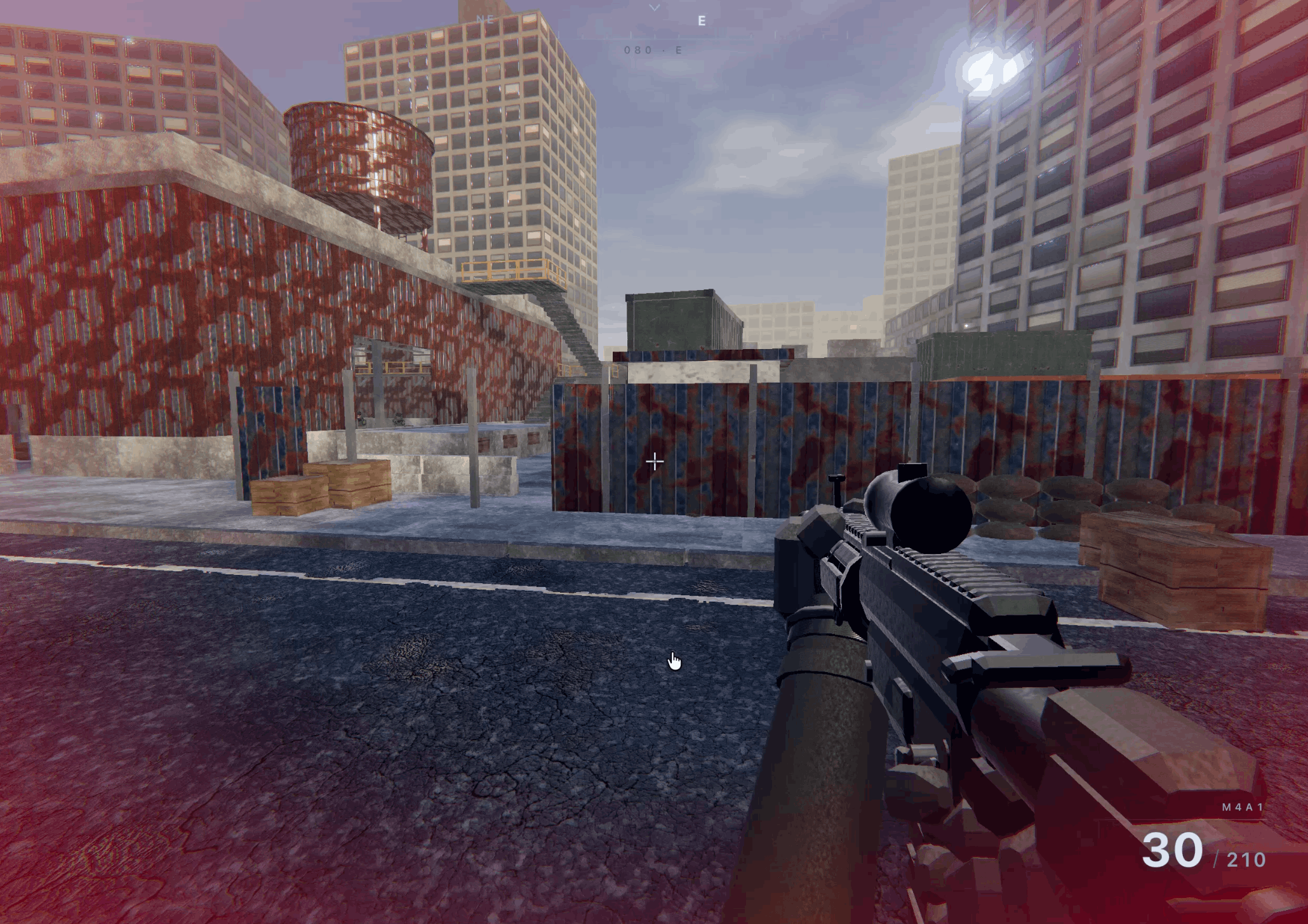
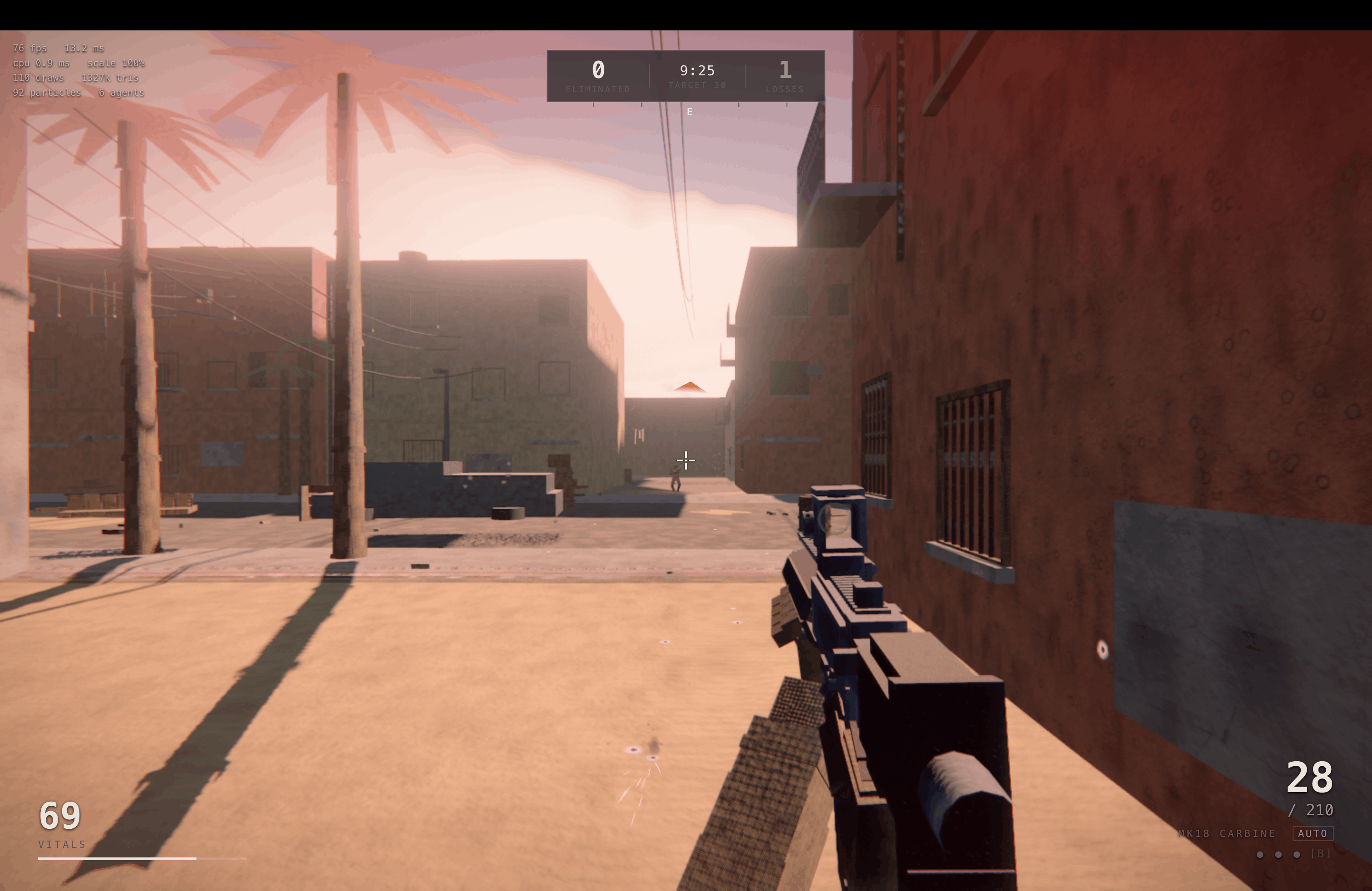
The finished game runs on Three.js and plain WebGL2, with around 55,000 lines of code spread across 11 subsystems. Every texture, mesh, animation, and sound is generated in the browser at load time. There are no downloaded models, HDRIs, image files, or audio files in the build.
Shumer’s published critic log showed the score rising from 3.59 out of 10 to a little above 5. Even so, the real game still won every round that he logged.
Skeptics assumed there must have been hours of hidden manual coding behind the scenes. In response, Shumer published the full prompt and the entire codebase. That is when copycats started to appear.
Three follow-up builds took three different routes
James Altucher, the former hedge fund manager and podcaster, ran the identical prompt and said he spent “a little over ten hours” and about 1.3 million tokens on Opus 5 to get there. His project, Operation Blackout, is free to play in the browser.
The developer behind Prompt Silo pointed the same request at OpenAI’s rival flagship and posted: “Sol 5.6 Ultra with same prompt.” The report says Sol is the top tier in OpenAI’s three-model GPT-5.6 family, which became generally available on July 9 alongside the cheaper Terra and Luna versions.
Developer Leon Lin took the opposite approach and used a detailed prompt instead of a short one. Rather than copying Shumer’s brief, he set out to “reverse engineer a prompt for this game,” producing a document roughly 20 sections deep. It spelled out components ranging from ragdoll physics to cascaded shadow maps. He then fed that prompt into Cursor using plain Opus 5 on high effort, without subagents and without ultracode. The result was Dust Corridor, a browser-playable market-street shooter that also looked impressive.
None of those follow-up builds, however, underwent the same blind test that Shumer ran on his own project. His critic log still showed real Call of Duty winning every round he recorded. That remained the bar Altucher and Atom Tan Studio were chasing with Shumer’s exact three-paragraph prompt, and the same bar Leon Lin was chasing with a far longer prompt of his own.
The bigger question is whether the system invented or recombined
The article then asks how much of this is actually new.
Agentic coding tools such as Claude Code write software in a way that resembles a supervised junior engineer. They read files, run code, inspect screenshots, and delegate pieces of work to subagents and critics that check the output against a stated goal. The report says that loop is real, and that Shumer’s Gauntlet Loop is a legitimate way to structure it.
Still, that does not prove the model designed a game from imagination rather than recombining code patterns it had already absorbed.
Three.js itself ships official pointer-lock camera control examples. That base pattern, including mouse-look, WASD movement, and raycasting for gunfire, has been forked, reposted, and turned into tutorials across GitHub, gists, and developer forums for more than a decade. A coding model trained on public repositories has almost certainly seen hundreds, if not thousands, of near-identical shooters before it ever read Shumer’s prompt.
The report does not call the project fake. It does say that claims the game was “built from scratch” are harder to credit in full under those conditions, and that the results should be viewed with caution.
Researchers already have a term for this issue: data contamination
Researchers who study code-generating models call the broader problem data contamination. That is when a model performs well on a task mainly because near-identical examples were already present in its training data, not because it reasoned out something genuinely new.
None of the published first-person shooter builds included a check for that kind of contamination. Shumer’s own repository does contain output that the report describes as Claude’s own creativity, if that is a fair term. Even so, the article argues that “one-shotted a AAA game” should be read more narrowly: as a capable agent working inside one of the most heavily documented genres in programming, not as proof that an AI designed a shooter with no prior art to rely on.