

This summer’s wave of AI breakthroughs in mathematics has now spilled into physics.
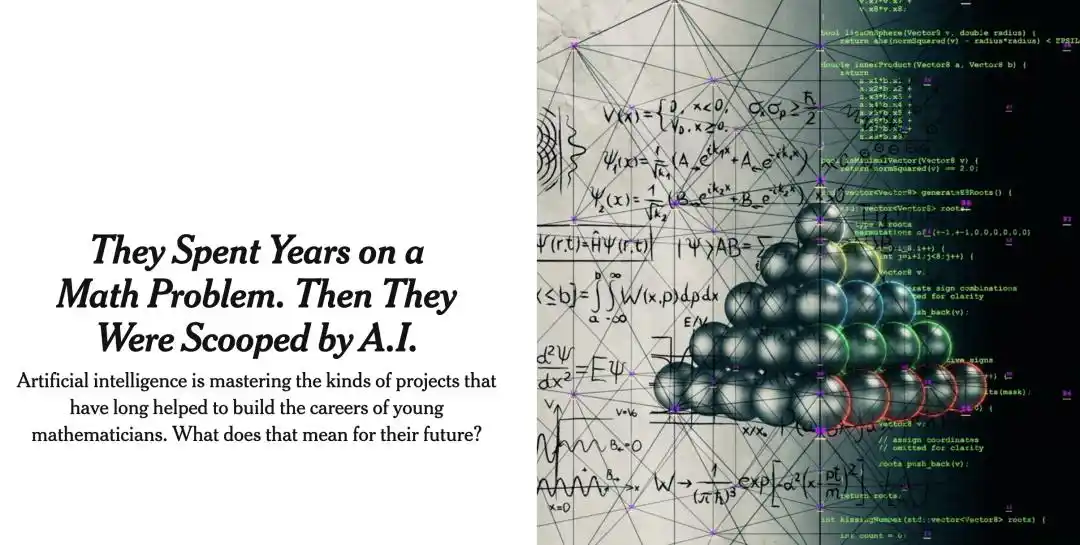
According to the source material, OpenAI’s Astra solved 10 long-standing math problems in one push, including the existence of non-sofic groups and new results in high-dimensional sphere packing. It also says Claude Fable 5 found a counterexample to the nearly century-old Jacobian conjecture and later made major progress on the Riemann hypothesis. Against that backdrop, Carnegie Mellon mathematics graduate student Sidharth Hariharan was left reeling after learning, through an email from 2022 Fields Medal winner Maryna Viazovska, that his work had already been published first by an AI agent called “Guass.”
The source says this kind of development could still be dismissed a year ago as curiosity, hype, or something with little practical use. It argues that position no longer holds, citing Fields Medalist Terence Tao as saying as much.
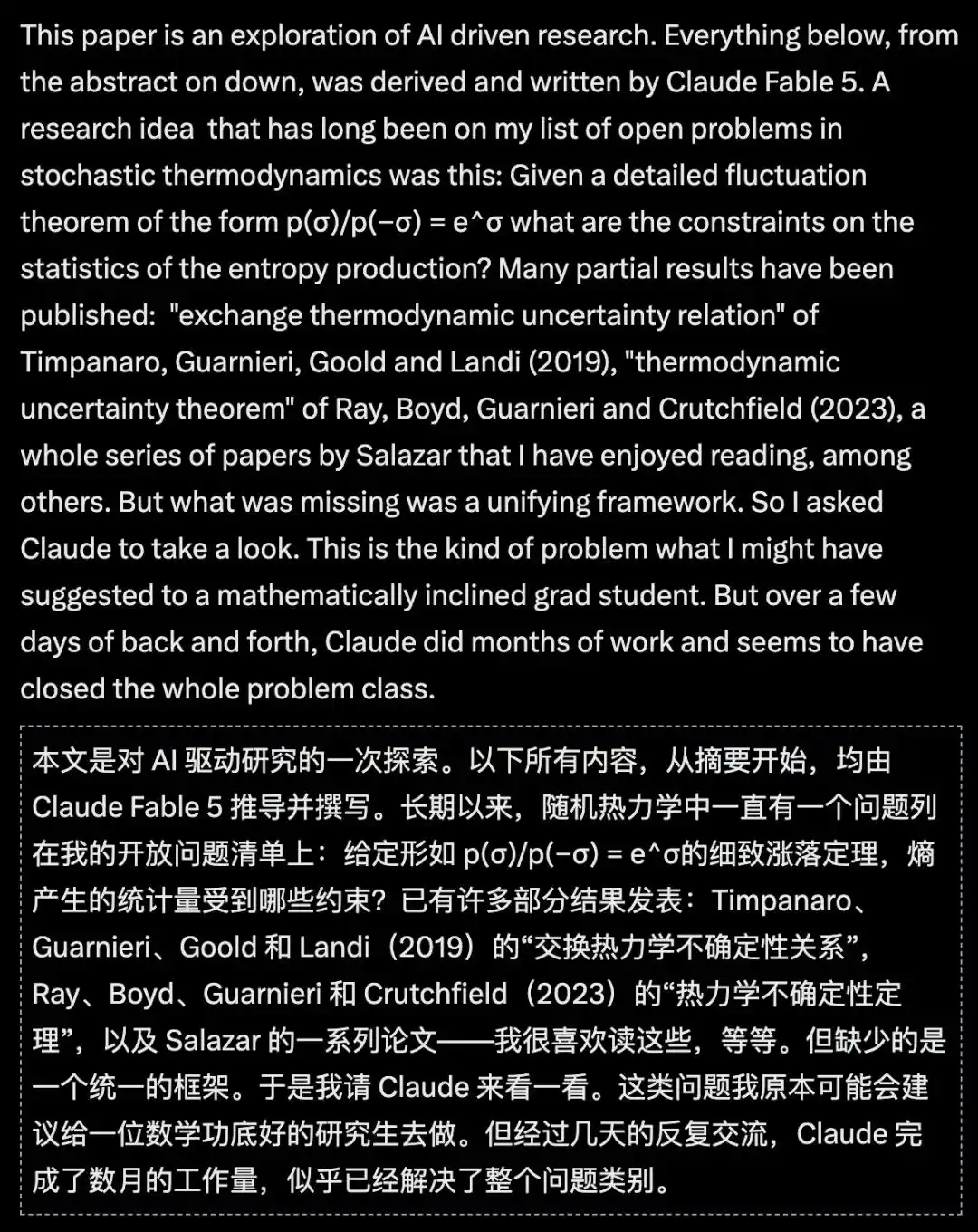
Before the discussion in mathematics had settled, a similar episode emerged in physics. Physicist Gavin E. Crooks gave Claude an open problem, and the problem was completely solved within days. The source adds that even a physics graduate student with strong mathematical training might have needed months to work through it.
Claude worked on a stochastic thermodynamics problem posed by Gavin E. Crooks
The reaction is tied in part to Crooks’ standing in the field.
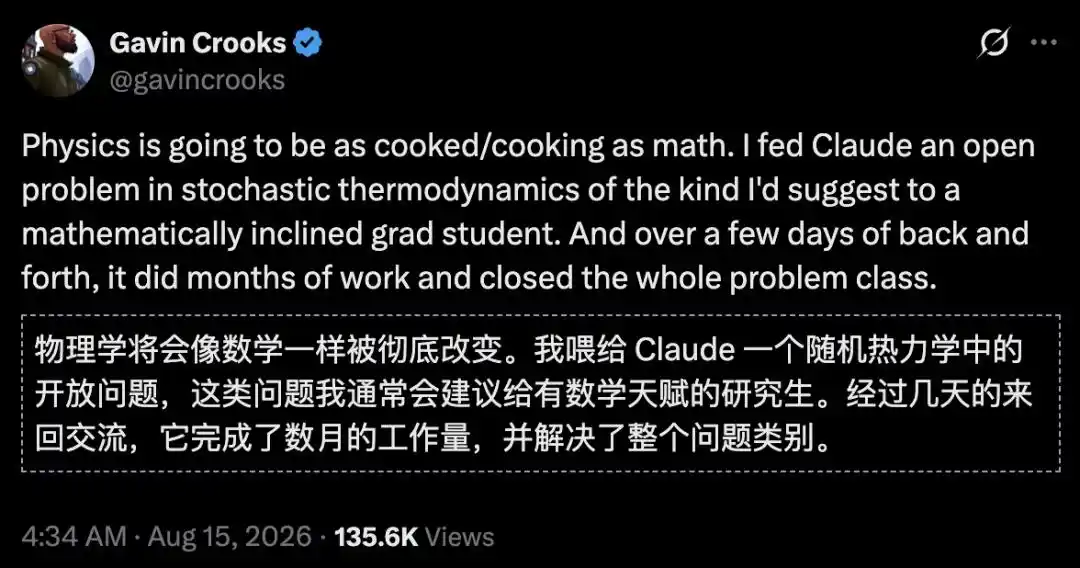
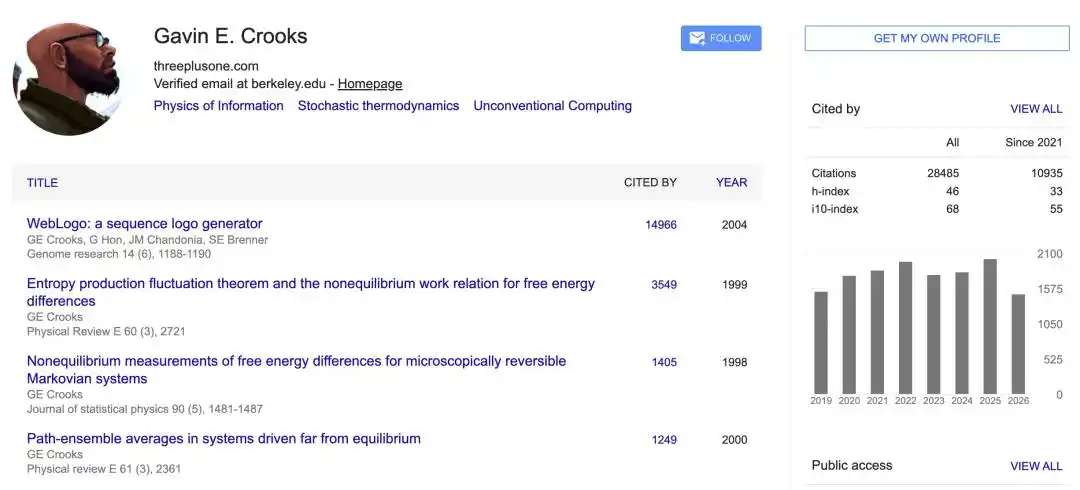
Crooks is well known in nonequilibrium thermodynamics and statistical mechanics. In 1998–1999, while still a graduate student at Berkeley, he introduced the Crooks fluctuation theorem, linking nonequilibrium work precisely to equilibrium free-energy differences. The source describes it as one of the foundations of stochastic thermodynamics. It also says a single paper he published in 1999 has already drawn thousands of citations.
His work has long sat at the intersection of thermodynamics, information theory, and computer science, with influence on nanoscale thermodynamics, free-energy estimation methods, and later computational approaches in thermodynamics. The source further notes that he received the Presidential Early Career Award for Scientists and Engineers, or PECASE, and was elected an American Physical Society Fellow in 2019.
The problem Claude solved came from Crooks and sits inside stochastic thermodynamics.
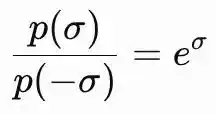
At microscopic scales, a system can occasionally appear to move, briefly, against the second law of thermodynamics. But the ratio between those reverse events and normal events is not arbitrary. The source says it is controlled exactly by entropy production and shrinks exponentially. This structure is described through the Detailed Fluctuation Theorem, or DFT.
The central question was what constraints this functional condition imposes on the statistics of entropy production.
A collection of partial results, recast as one geometric picture
That question had already generated a substantial body of work.
The source points to Timpanaro and co-authors in 2019, whose exchange TUR, or exchange thermodynamic uncertainty relation, started from the exchange fluctuation theorem and produced saturable matrix-form bounds. It also cites work by Salazar probing tight DFT bounds for skewness, tail probabilities, and information. Then, in 2023, TUT elevated TUR from an inequality to a theorem, identified the exact current that reaches the minimum scaled variance, and emphasized the role of higher entropy-production moments.
Those results kept appearing one after another, but no unified geometric picture had tied them together. The source says Claude identified all of these local results as different projections of the same convex body and supplied a complete characterization of the moment hierarchy. It also says the paper, starting from the abstract, was written entirely by Claude.
The main answer: a convex region with lower bounds but no upper bounds
Claude’s key insight, as described in the source, is unusually clean.
Every distribution satisfying DFT corresponds uniquely to a “gap distribution” ν, meaning the distribution of |σ|. For each fixed gap a, the distribution P_a has only two outcomes, ±a, with weights fixed strictly by e^σ. From there, any DFT distribution becomes a unique mixture of these basic two-outcome distributions.
That turns the jointly attainable region for the statistics into a convex body, a moment body. More than that, the source says the body can be characterized exactly at every order: once the first n−1 moments are fixed, the nth moment can lie only in a range from a sharp lower bound to positive infinity, with no upper bound. That lower bound is achieved by a unique distribution supported on finitely many symmetric outcome levels.
On that account, every previously published DFT bound can be recovered as a low-dimensional projection of this single convex region. The same framework also explains why one and the same distribution can nearly saturate many of those bounds at once.
From a structural decomposition to a classical moment problem
The source says the theory extends to the more general two-distribution Crooks fluctuation theorem.
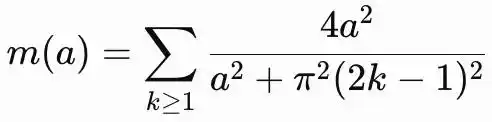
The mechanism comes from what it calls an overlooked structural fact: the DFT mean function, a·tanh(a/2), can be written as a sum of simple relaxation terms with positive weights, with poles located at odd squares. That maps the problem directly onto a classical moment problem. With exact identities involving Wronskians and Hankel determinants, the optimization collapses onto a small set of atomic distributions.
The result, in the source’s telling, is that almost all published DFT bounds become low-dimensional shadows of one unified convex body. The same two-outcome distribution often saturates several different bounds at the same time because, at fixed mean, it sits at an extreme point of that body.
For the general two-distribution Crooks fluctuation theorem, the source says the symmetric channel, defined through the sum of forward and reverse moments, inherits the same hierarchy in full, while the asymmetric channel is left almost unconstrained. It presents that as a precise explanation for why one-way free-energy estimators can be arbitrarily poor and why two-way estimation is fundamentally necessary.
Not a brand-new theorem from scratch, but a research process drawing wider attention
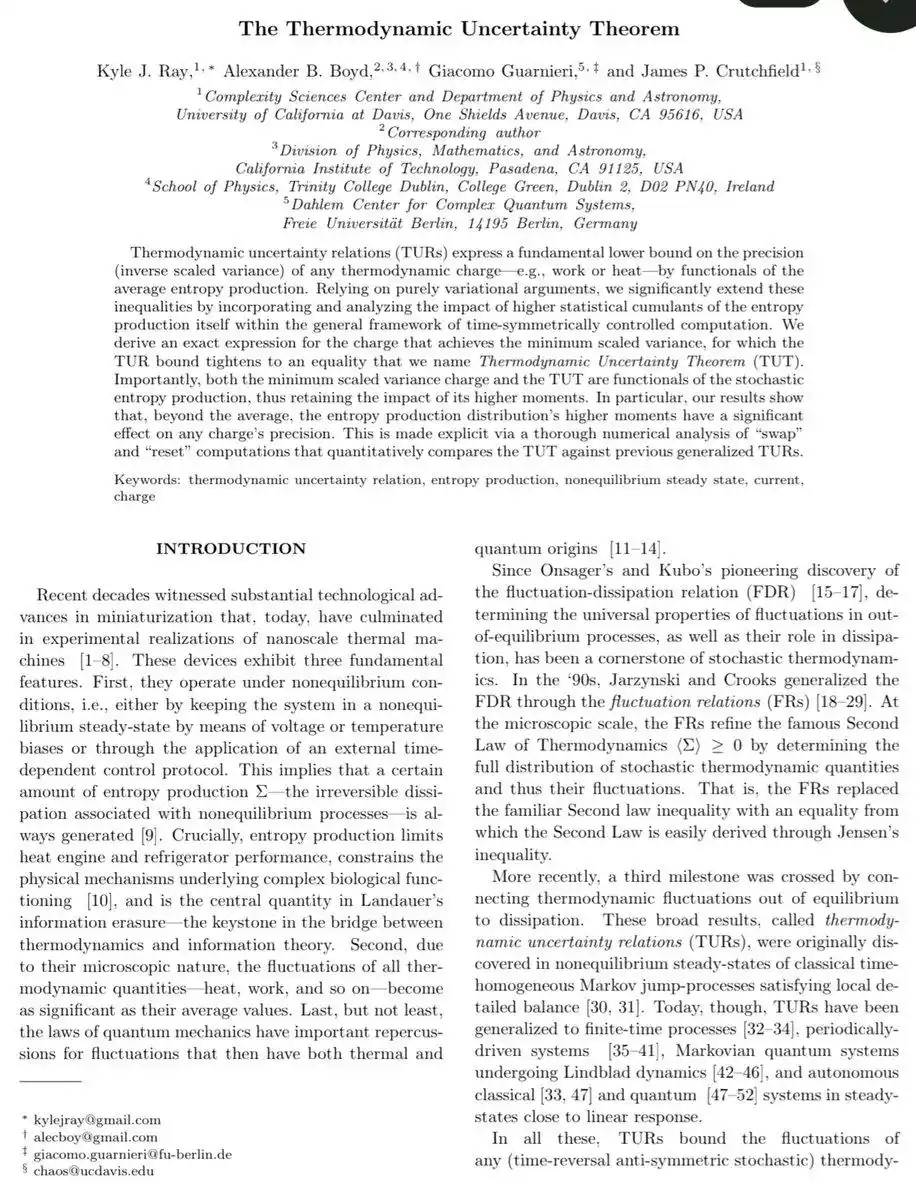
The source is careful on one point: the thermodynamic uncertainty theorem itself is not presented as a wholly new discovery by Claude. It says the basic version of that theorem was published in 2023 by Kyle J. Ray, Alexander B. Boyd, Giacomo Guarnieri, and James P. Crutchfield.
What Claude is said to have done is place those earlier “projections” back into one geometric object and prove that the object can be described completely.
The more striking element may be the AI-driven research process itself. Claude was not used merely to explain an established concept in physics. It was used, according to the source, to explore a hard theoretical problem, connect existing ideas, and search for new mathematical structure.
The source attributes a stark assessment to Crooks: physics will follow mathematics, and academia is about to go through a major change. It frames the academic world as having two roles, advancing knowledge and teaching or training the next generation. If science starts moving at a pace humans cannot keep up with, the second role comes under pressure as well. When any question a researcher asks may be answered faster by Claude, the challenge becomes how to teach and train students in that environment.
Seen from that angle, the significance may go beyond one thermodynamics result. The source presents it as evidence that AI is shifting from solving problems humans already know how to solve to helping scientists investigate problems they do not yet know how to solve.
The source’s closing claim is that physics is entering its own AI-accelerated era.
Reference links listed in the source include a New York Times page and related posts on X from SciTechera and Gavin Crooks. The original Chinese article is credited to the WeChat account “Xinzhiyuan,” written by “ASI Qishilu” and edited by “David.”