

Cloudflare announced Wallets on Aug. 4, but the launch stops short of a fully operational stablecoin wallet for agent-driven spending. What users can do now is claim a handle, effectively reserving a name for a future wallet. In the company’s announcement, the step that matters more for payments — setting up and using the wallet to buy APIs and content — is labeled “Soon.”
That gap matters. A claimed handle is not the same as an agent having a usable balance, payment permissions, and a working stablecoin spending flow.
What has shipped is an identity layer, not a complete payment rail
Cloudflare’s recent payment-related product lines look related on the surface, but they do different jobs. According to the Wallets announcement, the part delivered on Aug. 4 is the handle. Top-ups, payments, and the Virtual Wallet that agents would use through an API key are mentioned later in the product description rather than presented as live features.
Two other pieces were already on the table. Based on announcements from Cloudflare and Stripe Projects, Stripe Projects is in open beta and allows agents to act on behalf of users to open Cloudflare accounts and buy subscriptions or domain names. Under the Monetization Gateway announcement, the merchant-side entry point for taking payments through x402 is still on a waiting list.
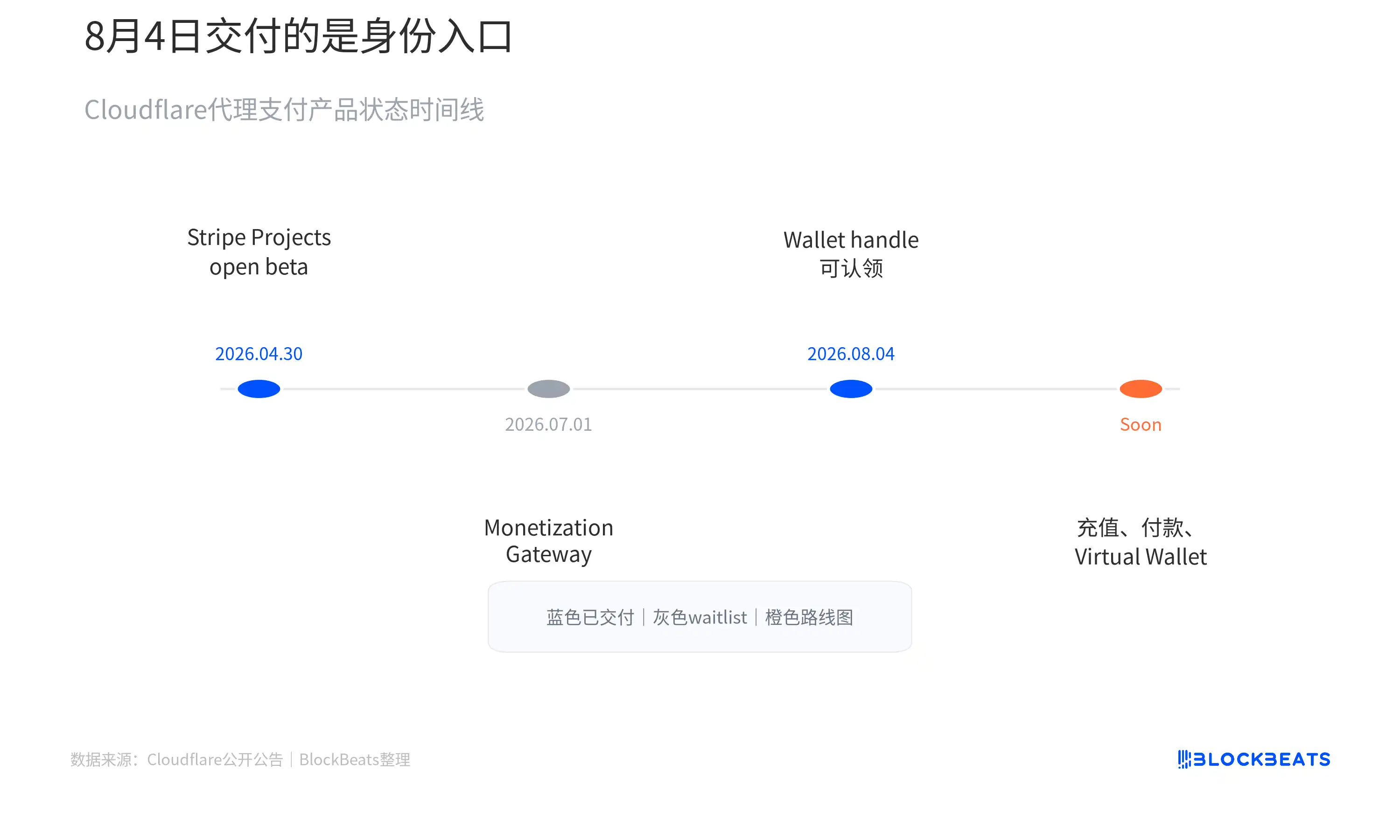
Put side by side, the split is clearer. Stripe Projects is a card-based path that can already be tried. Monetization Gateway is built for sellers that want to get paid. Wallets is intended to fill in the buyer side with identity, balances, and authorization rules. In its current form, the release looks closer to an account page for a payer than to a checkout network that is already running end to end.
x402 has network activity, but that is not Cloudflare Wallet adoption
The x402 website showed a 30-day snapshot on Aug. 5 with 75.41 million transactions and $24.24 million in transaction volume. Dividing the two gives an average transaction size of about $0.32.
That scale lines up with low-cost, frequent payments such as API calls and content access rather than large-ticket purchases. Even so, the figures have clear limits. The website does not disclose how much of that activity came from Cloudflare, how much was initiated by AI agents, or how many enabled Wallet accounts, merchants, or completed transactions the Wallet product itself has produced.
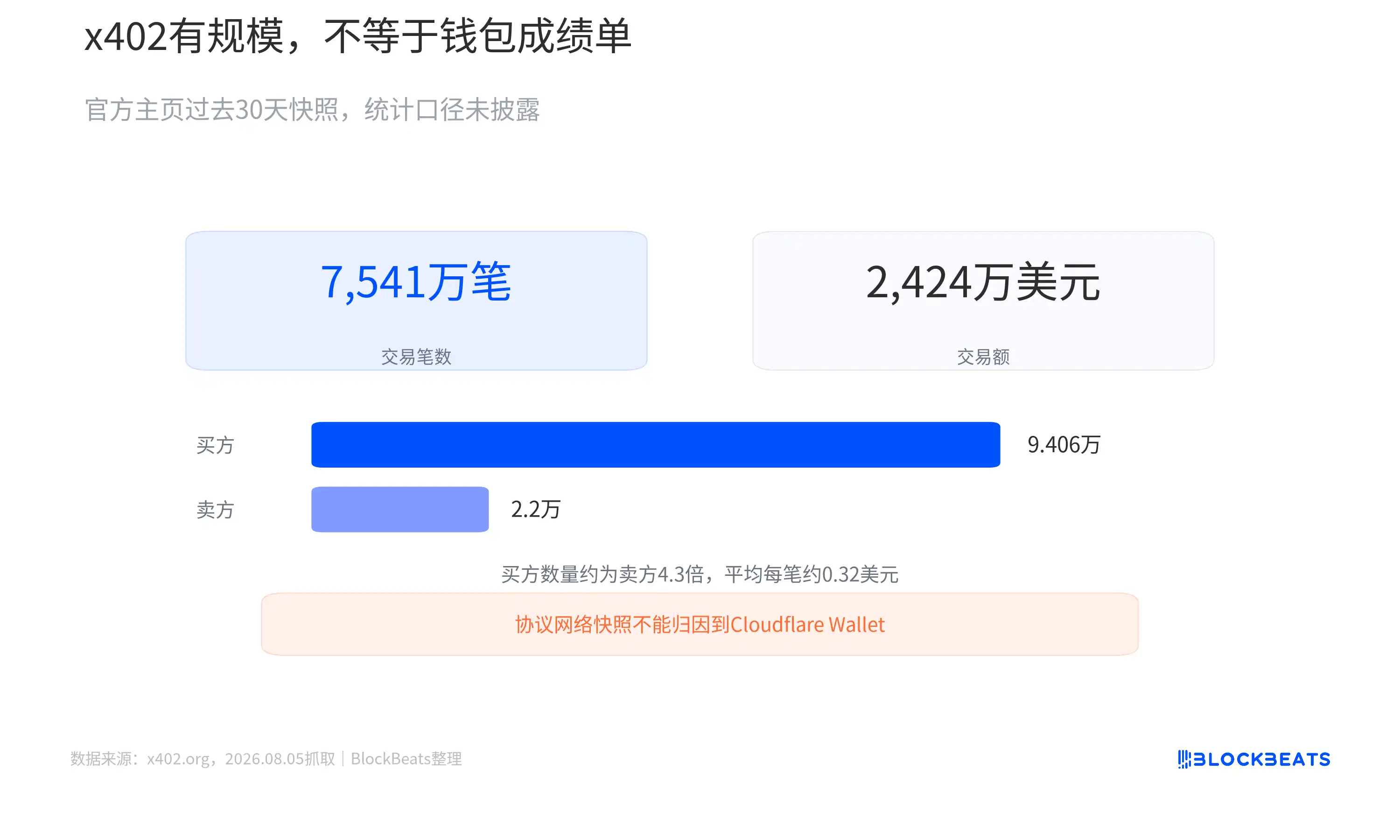
That distinction changes how the news should be read. x402 is an open payment flow that uses HTTP 402 to request payment. It is not a settlement network exclusive to Cloudflare. Public activity on x402 shows there is traffic on the protocol, but it cannot be used as a proxy for Cloudflare Wallet adoption, nor can it stand in for data on autonomous agent spending.
The $0.01 MCP example shows a payment flow, not a market price
Cloudflare’s paid MCP tool example sets one call at $0.01. The figure comes from documentation and is not presented as a market average.
What the example does make concrete is the payment sequence. The server first returns a 402 response. The agent then signs the payment. A facilitator verifies and settles it, and only after that does the server return the result.
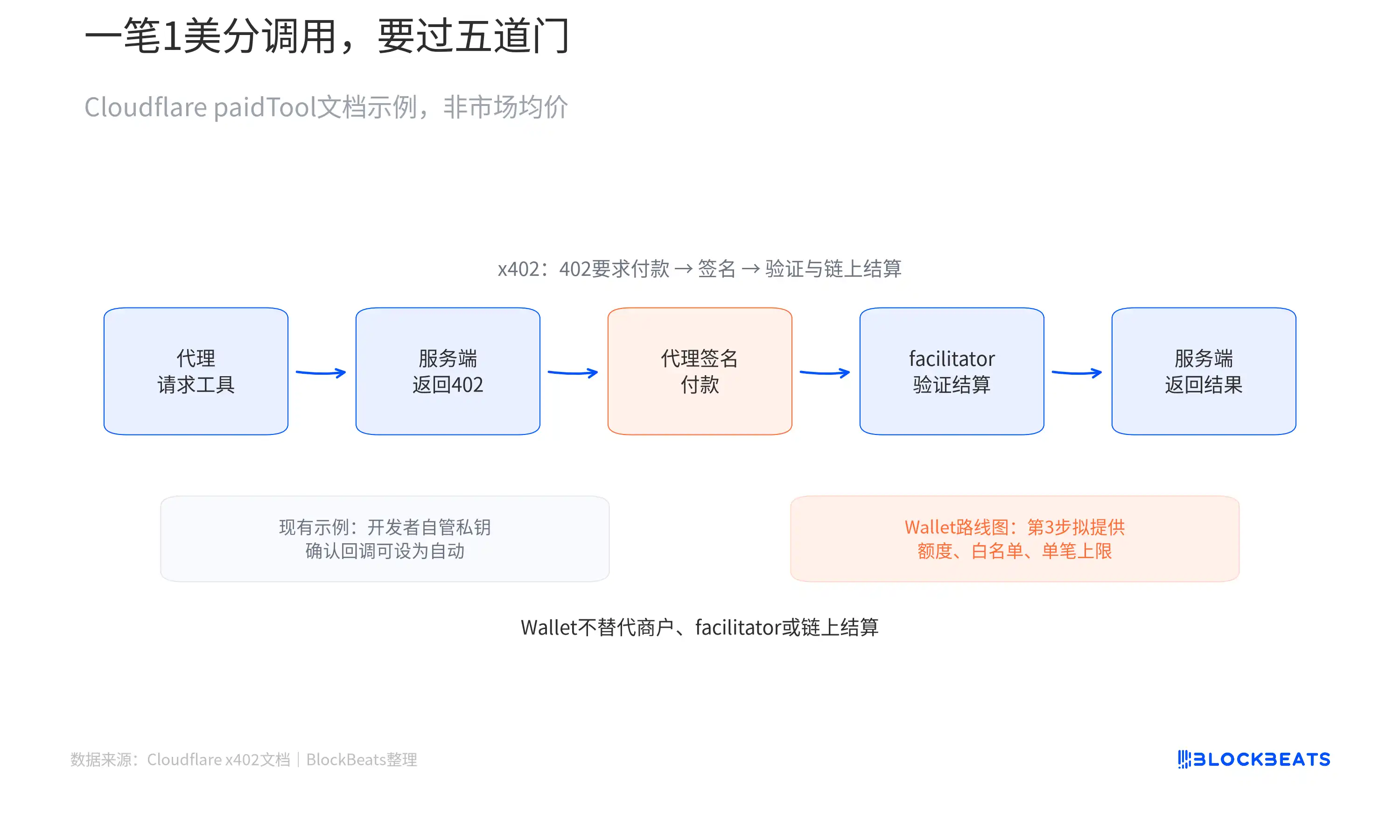
In the current developer path, key custody still sits with the developer. In the Agents SDK payment example, the confirmation callback can be automated, but the example also requires a private key and uses testnet plus test USDC. So an agent being set to pay automatically does not mean spending authority, key control, and limits have already been wrapped into a mature wallet product.
The roadmap is still stuck at the buyer-side control layer
Cloudflare plans to separate an Account Wallet, used by the account owner, from a Virtual Wallet operated by agents through an API key. It also plans to add spending limits, whitelists, and per-transaction caps. The design reads more like a corporate card with approval rules than a plug-and-play consumer wallet.
Even in that model, merchants still need to provide the goods or services, and the facilitator still needs to handle verification and settlement. More importantly, those controls have not been opened for live configuration, so they cannot be described as current features.
Three agent payment paths share a theme, not the same mechanics
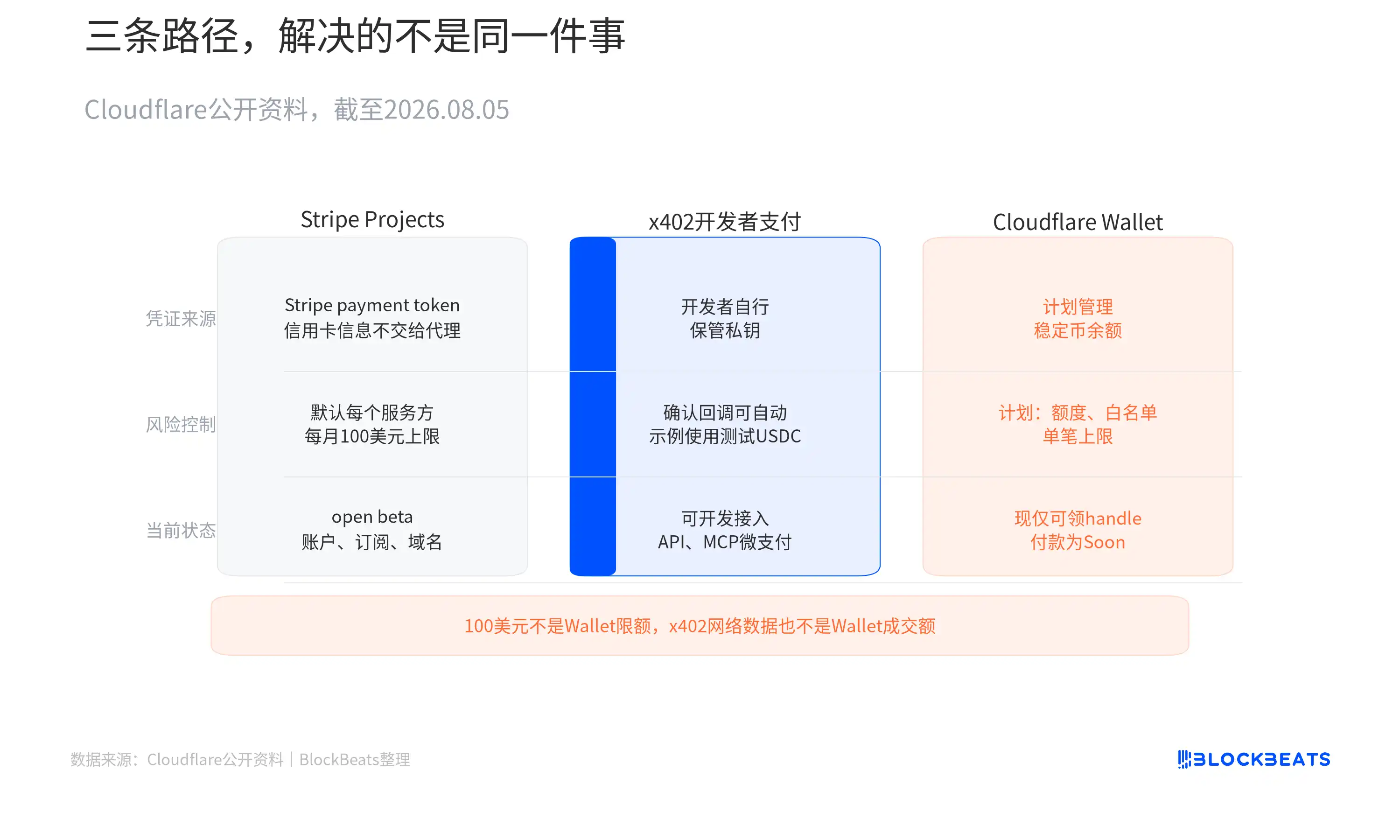
The article separates Stripe Projects, x402 developer payments, and Wallets by credentials, risk controls, and rollout status.
- Stripe Projects passes a payment token to the service provider, while the original card information is not handed to the agent. According to Cloudflare’s announcement, the default cap remains $100 per service provider each month, and the product is still in open beta.
- x402 developer payments start from a different place. Developers hold the private keys themselves and can attach usage-based pricing to APIs or MCP tools.
- Wallets currently has only handle claiming available. Stablecoin balances, limits, and whitelists have not yet been presented as usable configuration options.
The $100 monthly default cap in Stripe Projects belongs to the card-delegation path and cannot be carried over as a Wallet limit. As of now, Cloudflare also has not publicly detailed which stablecoins the Wallet will support, which chain it will run on, where it will be available geographically, or how KYC, custody, and fees will be handled.