

Coherent reported FY2026 fourth-quarter and full-year results on Aug. 12 for the period ended June 30, with quarterly revenue reaching $2.046 billion, up 33.8% from a year earlier. The company labeled the latest quarterly tables as unaudited.
Management placed demand in the context of AI data center connectivity moving from copper to optical links, expanding manufacturing capacity, and ramping new growth platforms. Even so, the company’s public reporting does not provide a quarterly breakdown for AI data centers, traditional communications, or other product lines. Coherent currently reports results under two segments, Data Center and Communications and Industrial, so reducing the filing to a simple read of “more AI optical interconnect sales” leaves out what the statements actually show.
Revenue moved higher through every quarter of FY2026
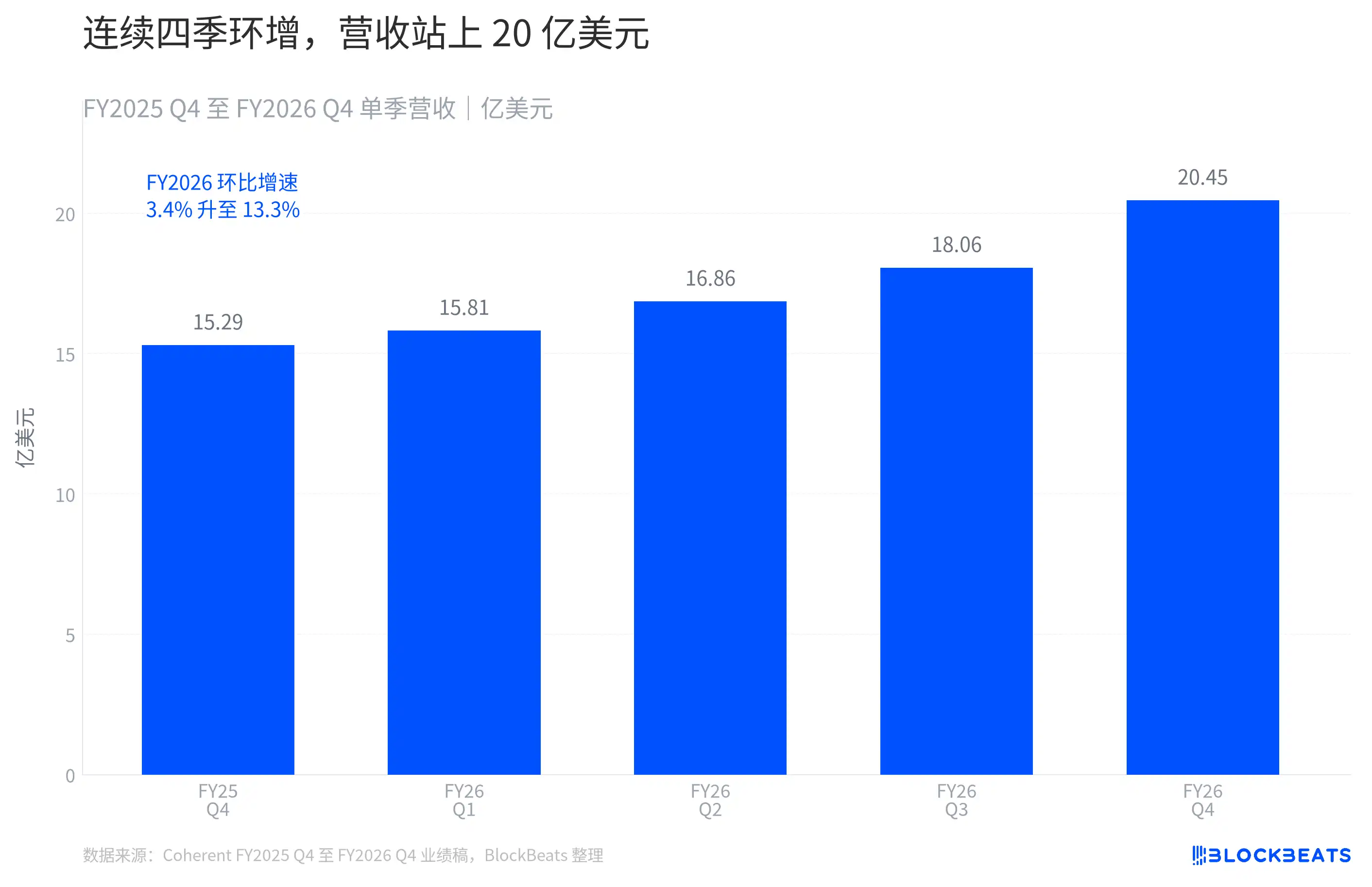
The key pattern in the revenue line is not only that Coherent crossed the $2 billion mark in the final quarter. Based on the company’s quarterly earnings releases, revenue increased sequentially in every quarter of FY2026, with Q4 reaching $2.046 billion. That was up 13.3% from the prior quarter, putting the latest period inside a broader run of continuous growth.
According to the FY2026 Q4 earnings release, the statutory year-over-year growth rate for the latest quarter was 33.8%. The company also disclosed a pro forma year-over-year growth figure that excludes divested businesses. Those are separate reporting bases and should not be treated as the same growth rate.
For the next quarter, Coherent guided FY2027 Q1 revenue to a range of $2.2 billion to $2.4 billion. The company presented that as a forward-looking view for the upcoming quarter. It should be kept separate from reported revenue that has already been recognized, and it should not be treated as orders or booked sales.
Most of the revenue increase came from Data Center and Communications
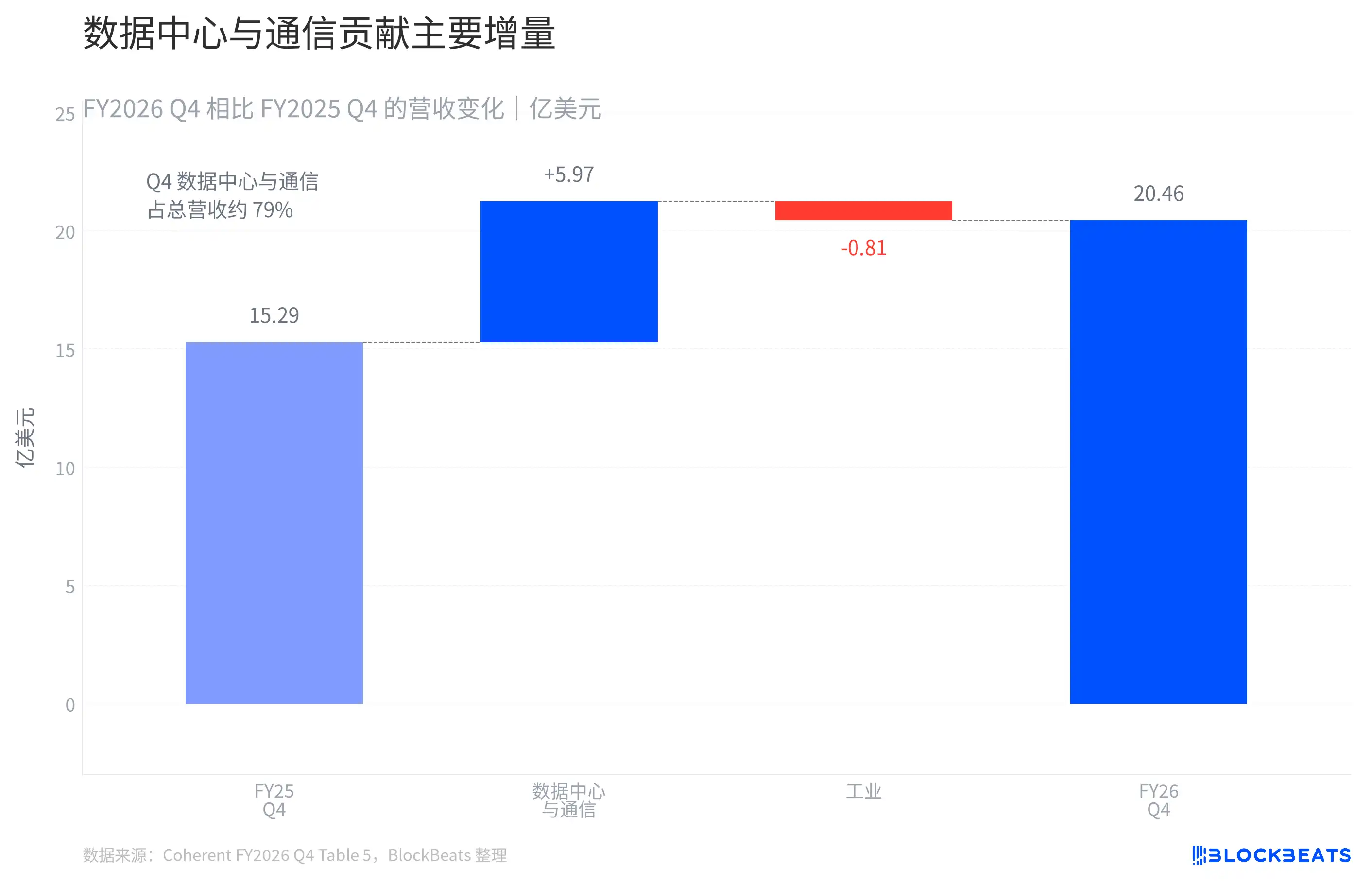
The segment revenue table splits the year-over-year change into two moves going in opposite directions. In FY2026 Q4, Data Center and Communications revenue increased by $597 million from the same period a year earlier. Industrial revenue, by contrast, declined by $81 million, leaving total company revenue up by a net $516 million.
That means the increase in Data Center and Communications was larger than the company’s total net revenue gain, with the Industrial decline offsetting part of the growth. The same table shows Data Center and Communications generated $1.615 billion in Q4, or about 79% of quarterly revenue.
That share points to where the revenue center of gravity sits. It does not mean 79% of the company’s sales came from AI optical interconnect products. The filing does not include a breakdown by product, customer, or order book, and the segment label alone cannot be used to infer the exact contribution of any one product category.
The value of the disclosure is that it identifies which segment drove growth while also marking the limit of what the filing says. It answers where the growth showed up at the segment level, but not which products or customers inside that segment made up the change.
Operating margin expanded faster than gross margin
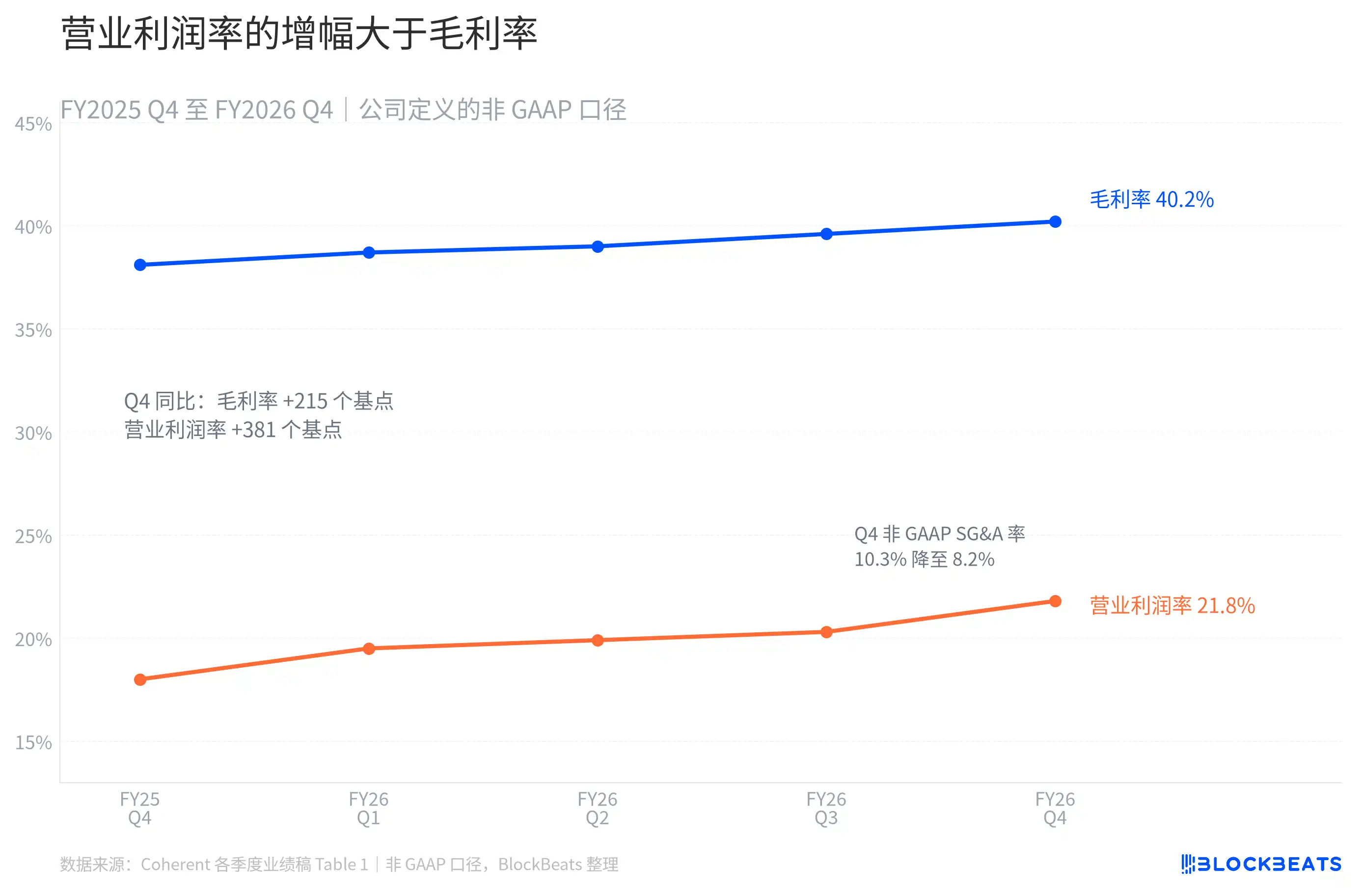
Higher revenue does not automatically mean better profit efficiency. Coherent said non-GAAP gross margin rose from 38.1% in FY2025 Q4 to 40.2% in FY2026 Q4, leaving a wider spread after direct costs on each dollar of revenue.
Over the same period, non-GAAP operating margin increased from 18.0% to 21.8%. The earnings release said the year-over-year gain in operating margin for Q4 was larger than the increase in gross margin, with the exact magnitude marked in the chart.
At the same time, the non-GAAP selling, general and administrative expense ratio declined, while the R&D expense ratio edged higher. Those changes in expense ratios appeared during the same period as the margin improvement, but the public disclosure does not support a conclusion that any single cost action explains the entire improvement.
The filing also draws a line around the metric itself. Non-GAAP figures exclude stock-based compensation, amortization of acquisition-related intangible assets, restructuring, and other items. According to the company, management uses that measure as a supplemental view of ongoing operating performance, not as a replacement for GAAP results.
Put plainly, Coherent did not only sell more products in the same period. Revenue, gross margin, and selected expense ratios moved together and showed up in operating margin, while the public statements stopped short of assigning that change to any single business line or cost item.
Capex, inventory and financing cash flow all shifted in FY2026
The final set of figures sits on the cash flow side rather than the income statement. In the FY2026 cash flow statement, additions to property, plant and equipment totaled $1.103 billion, about 2.5 times the prior fiscal year. Management said capital allocation was prioritized toward expanding manufacturing capacity, but that spending cannot be directly mapped to a single product line or a single customer’s expansion plan.
During the same fiscal year, cash flow from operating activities fell from $634 million to $80 million. On the balance sheet, ending inventory rose from $1.438 billion to $2.581 billion.
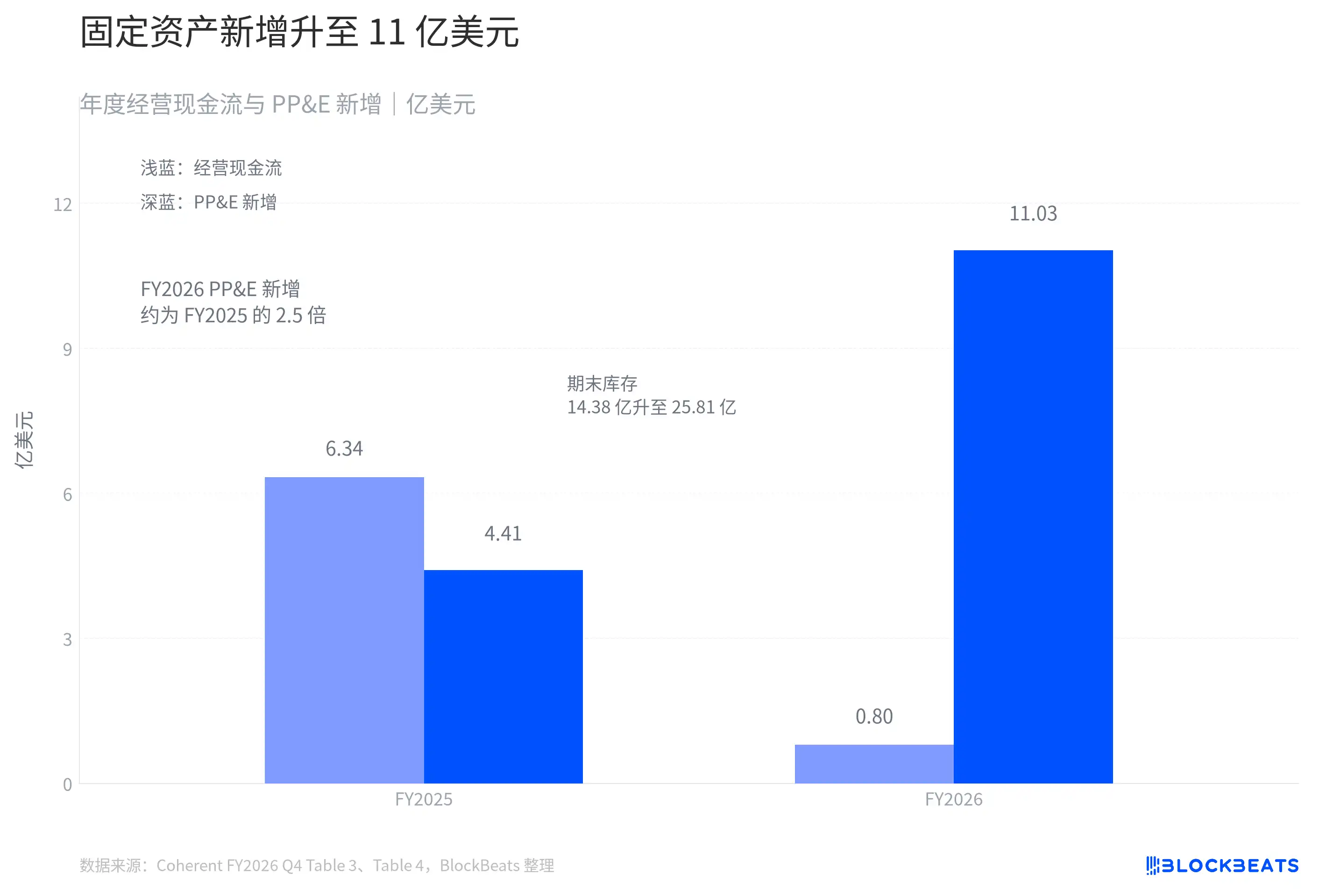
Those three changes appeared in the same fiscal year, but the public disclosure did not provide a single causal breakdown tying them together.
The cash flow statement also shows net cash from financing activities of $1.477 billion in FY2026, including multiple items such as share issuance, borrowing, and debt repayment. This is a funding schedule distinct from the income statement and cannot be explained by quarterly revenue growth alone.
The filing’s main point is not to relabel Data Center and Communications as AI revenue. What it does show is a simultaneous shift in revenue mix, margins, additions to fixed assets, and inventory during FY2026, all within the boundaries of what the company actually disclosed.