

Coinbase and Circle both rose about 3% to 4% on Wednesday even after William Blair cut its revenue and earnings forecasts for Coinbase. The Chicago-based investment bank, founded in 1935, kept its “outperform” rating on Coinbase and said, “We think investors should stay involved in Coinbase.”

William Blair cuts estimates but keeps an upbeat rating
William Blair reduced its 2026 revenue estimate for Coinbase by 12% and its 2027 estimate by 13%. It also cut adjusted EBITDA projections by 34% for both years. Analysts Andrew Jeffrey and Adib Choudhury said earnings are expected to trough in the second half of 2026 and recover in 2027. Their view is that investors should stay the course as spot crypto trading volume bottoms alongside Bitcoin.
The firm expects Coinbase’s total trading volume to decline about 44% this year to $669 billion before rebounding more than 32% in 2027.
William Blair argued that this cycle looks structurally different from 2022. It pointed to the presence of spot Bitcoin ETFs, larger institutional flows, and a regulatory setup that has matured compared with four years ago.
The firm also identified Coinbase’s Base layer-2 network as a possible major earnings driver. It said retail derivatives and prediction markets are helping build a revenue mix that goes well beyond spot trading, and noted that retail derivatives alone exceeded a $200 million annualized run rate in the first quarter.
Piper Sandler takes a more cautious near-term view
Not every analyst was as constructive in the short run. Piper Sandler analyst Patrick Moley cut his price target on Coinbase to $155 from $170 and maintained a “neutral” rating.
Moley said prediction markets and perpetual futures will be the defining story of the second quarter. He added that the World Cup drove massive growth in prediction market activity and warned of “significant investor attention on the perpetual future threat” heading into the third quarter.
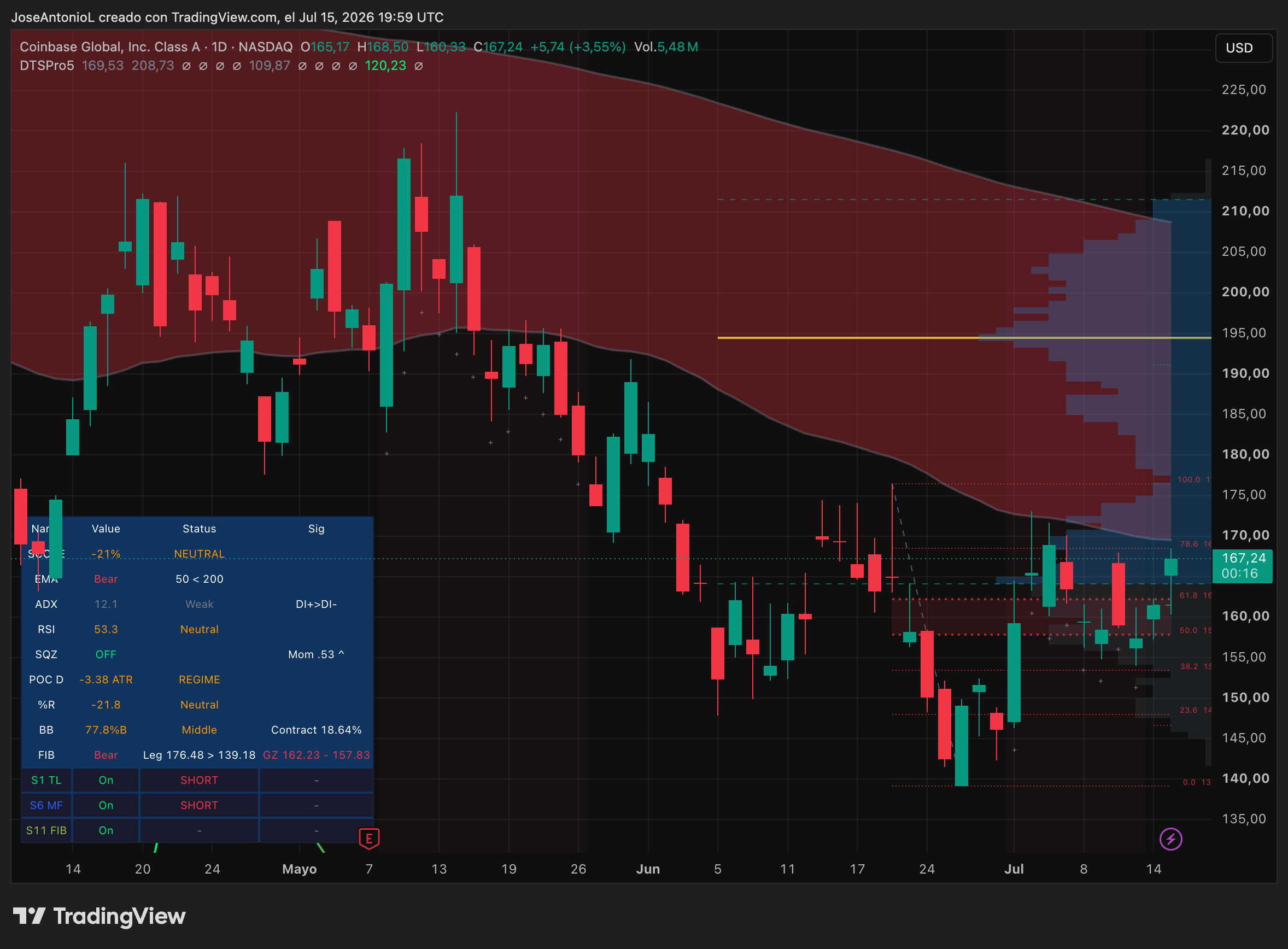
Coinbase shares are down nearly 30% this year, while Bitcoin has fallen about 26% over the same period. Circle, which went public in a June 2025 New York Stock Exchange IPO at $31 a share, has dropped about 20% since January.
John Bollinger says Bitcoin is forming a “W” on the daily chart
A similar directional view is also showing up in technical analysis. John Bollinger, the veteran analyst who created Bollinger Bands, has been pointing to a developing pattern on Bitcoin’s daily chart since early July.
On July 2, Bollinger posted on X that a “W” double-bottom was taking shape. A double-bottom is a reversal pattern marked by two swing lows with a rebound in between. It turns bullish once price breaks the resistance level at the apex between the two troughs.
He described the setup as “perfectly fractal,” saying smaller versions of the same shape sit inside the larger structure and that the pattern is also visible on the weekly chart. He also acknowledged uncertainty, noting that earlier bullish setups in this cycle had been invalidated by selling pressure.
In that July 2 post, he wrote: “Here is a chart highlighting a developing 'W' pattern in bitcoin:native. Note that it is perfectly fractal. The are small 'w's at the nadirs and a small 'm' at the apex. For extra credit look at the weekly to see a higher time frame fractal 'W'.”
In a July 6 post, Bollinger said that if the “W” completes, he would see it as “a confirmation of a change in trend.” It was his clearest public signal yet that the market may be turning rather than simply pausing.
He wrote: “We are at a critical point. In a bear market bullish setups break and in a bull market bearish setups break. So if this W pattern is successful I would see it as a confirmation of a change in trend.”
Bollinger also disclosed that he took a long Bitcoin position through his investment vehicle earlier this year, putting his market view in line with his own exposure. From a technical perspective, the report said Bitcoin price action remains bearish, but the strength of that trend is fading.
Glassnode says long-term holder capitulation may have peaked
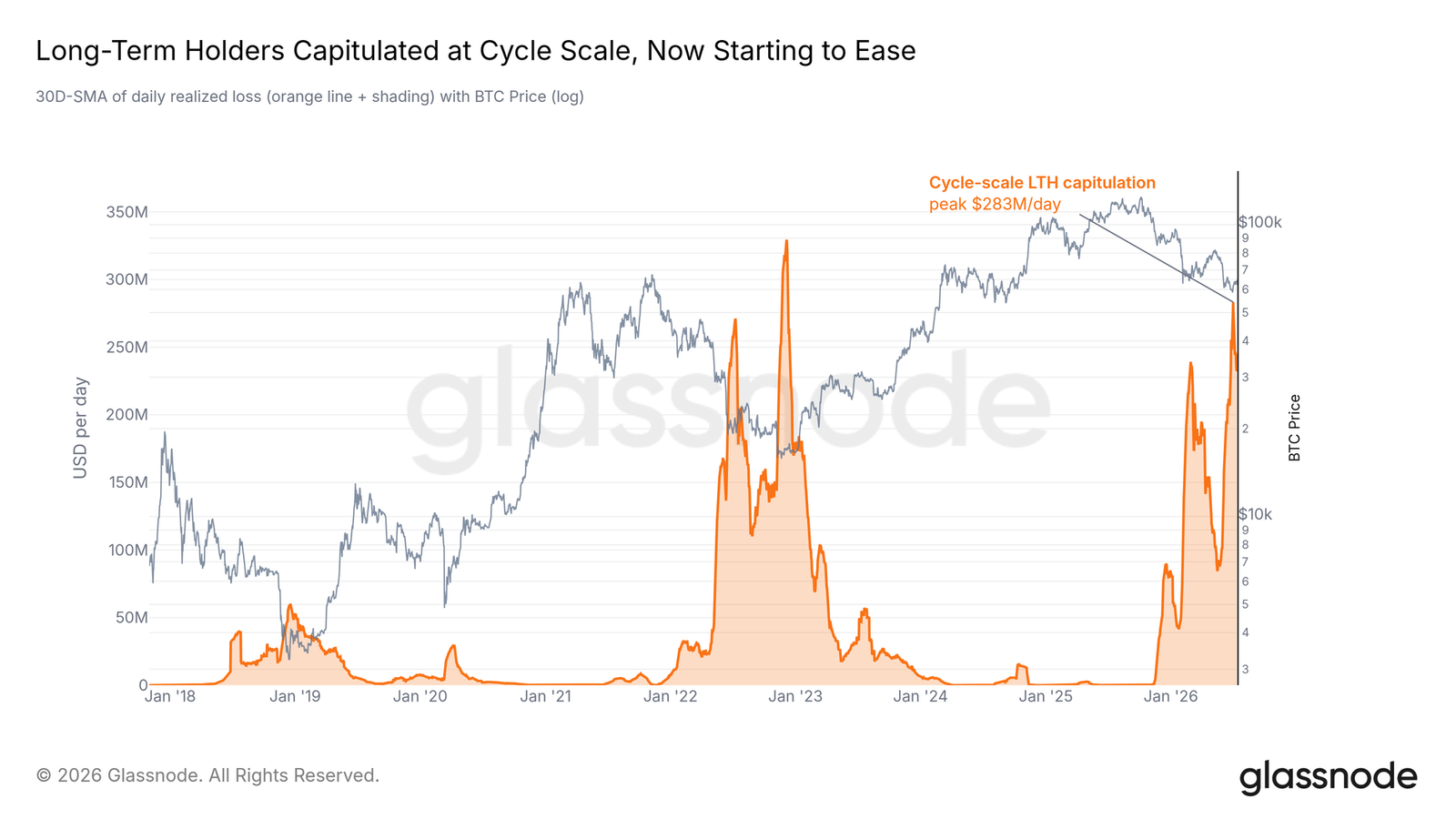
On-chain data offers a separate signal. In its latest weekly analysis, Glassnode said long-term holder capitulation, which has been the main source of selling pressure this year, reached its cycle peak two weeks ago and has started to turn lower.
According to the report, the metric tracking what long-term holders actually surrender each day, adjusted to remove internal transfers, has peaked and is now falling for the first time in this cycle.
Glassnode also said buyers appeared near the June lows. It documented broad accumulation across wallets of all sizes during that period. At the same time, Bitcoin’s inverse relationship with the dollar deepened, its correlation with U.S. equities loosened, and its sensitivity to favorable macro data returned. Tuesday’s soft inflation print moved Bitcoin more sharply than any major equity index.
Still, the main sticking point has not changed for either on-chain analysts or Wall Street: the recovery has not yet been confirmed by sustained spot-driven buying.
Derivative positions are unwinding, long-term sellers are thinning out, and the fear premium in the options market is easing. But the capital has not fully arrived. William Blair places the inflection point in 2027, when it expects Coinbase trading volume to rebound 32% after this year’s projected 44% decline.